Book Blurb vs Book Description: They’re Not the Same Thing
A strong description makes the right reader understand the promise of the book quickly, without stuffing the field with material Amazon does not allow.
The words “blurb” and “book description” are used interchangeably in most self-publishing conversations. They are not the same thing. Confusing them leads authors to use the wrong document in the wrong place; with predictable consequences for their marketing effectiveness. This article clarifies the distinction precisely. For the complete book description guide, see our .
What a Blurb Actually Is
In publishing, a is an endorsement; a short, enthusiastic statement about a book written by someone other than the author. It is the quote from a well-known author, critic, journalist, or organization that appears on the back cover of a printed book or in promotional materials: “A gripping debut.”; [Famous Author Name]. “The most important business book of the decade.”; [Publication Name].
Blurbs are earned, not written. You obtain them by sending advance reading copies (ARCs) to relevant figures and asking them to provide an endorsement quote. The quality and relevance of your blurbs signal a book’s credibility in the marketplace; a blurb from a well-known author in your genre has genuine commercial value.
A blurb is therefore: an endorsement, written by a third party, typically one or two sentences, expressing enthusiasm for the book.
What a Book Description Is
A ; or “sales description”; is the marketing copy you write yourself to sell your book on Amazon. It is the text in Amazon’s “Product Description” or “Book Description” field. It is not an endorsement from a third party. It is your own pitch for your own book.
A book description is therefore: marketing copy, written by the author or on their behalf, designed to convert browsers into buyers, appearing on the Amazon product page and in promotional materials where a sales argument is needed.
The Key Differences
| Attribute | Blurb | Book Description |
|---|---|---|
| Written by | Third party (author, critic, publication) | The author or their representative |
| Tone | Enthusiastic, endorsing | Sales-focused, narrative, structured |
| Length | One to three sentences | 150-350 words typically |
| Purpose | Social proof; “someone credible recommends this” | Conversion; “this book is for you, and here is why” |
| Primary location | Back cover, Editorial Reviews section, front pages | Amazon product page description field |
| Can you write it yourself? | No; it must come from a third party to have value | Yes; it is your marketing copy |
Where Each One Goes
- Amazon’s Book Description field (the primary sales copy on your product page)
- The back cover of your paperback or hardcover
- Your Amazon Advertising copy (adapted for shorter formats)
- Your email list promotional messages
- Your website’s book page
- Amazon’s Editorial Reviews section (a separate field from the book description)
- The back cover of your paperback or hardcover, typically above or below the description
- Your book’s front matter (typically on the page before the title page)
- Promotional copy and press releases
On Amazon, the distinction is important: the Book Description field and the Editorial Reviews section are separate. Your description goes in the description field. Endorsement blurbs go in Editorial Reviews. Many authors put their blurbs in the description field and leave Editorial Reviews empty; this is backwards and loses the full marketing benefit of both.
Endorsement Blurbs: How to Get Them
Obtaining meaningful blurbs requires advance planning and relationship investment. The process:
- Identify three to ten relevant figures who write in your genre or whose endorsement would be meaningful to your target readers
- Prepare an advance reading copy (ARC) of your finished, proofread manuscript
- Reach out politely with a personalised request; explain who you are, what the book is, and why you thought of them specifically
- Give generous lead time; at least four to six weeks before your publication date
- Accept that many will decline or not respond; this is normal and expected
The most accessible sources of early blurbs for new authors are: other authors in your genre at a similar career stage (reciprocal ARC exchanges are common), bloggers or reviewers with established audiences in your genre, and subject matter experts for nonfiction.
Where endorsement blurbs can appear on Amazon
In the United States, Author Central currently includes an Editorial Reviews feature. That is the Amazon surface to investigate for legitimate editorial endorsements. KDP’s separate Description rules prohibit reviews, quotes, and testimonials, so do not solve the placement problem by pasting endorsement copy into the Description field.
Editorial-review availability varies by Amazon feature and marketplace. Keep the original wording and attribution accurate, make sure you have the right to use the endorsement, and avoid presenting a customer review as an editorial quote.
Why You Need Both
A compelling book description and strong endorsement blurbs serve different functions in the conversion process. Your description creates want; it makes the reader feel the book is for them. Your blurbs reduce hesitation; they confirm that credible third parties have already vouched for the book’s quality.
Authors who have both optimized will consistently outperform authors who have only one. Invest in your description first (it is entirely within your control and has immediate impact), then build your blurb library over time as your network and platform grow.
For the description half of this equation, a
like KDP Rank Fuel generates a well-structured, conversion-optimized description from your book’s details; so you arrive at launch with both your description and your Editorial Reviews ready to work together.
And before any of your marketing materials matter, your book needs to be error-free. from Vappingo ensures the book itself is as compelling as the marketing around it.
Current KDP description rules to check before publishing
Amazon currently limits the Description field to 4,000 characters, including any HTML tags you add in Source view. Its own writing guidance emphasizes three qualities: keep the description simple, make the opening compelling, and publish professional copy that has been proofread carefully. Amazon also recommends keeping the main explanation easy to scan rather than overwhelming a shopper with every plot point or feature.
The restrictions matter just as much as the copywriting. KDP says descriptions cannot contain phone numbers, postal or email addresses, website URLs, customer-review requests, reviews, quotes or testimonials, promotional or time-sensitive material, pricing or alternative-ordering information, Unicode emoji, spoilers, or keyword/book-tag phrases. Treat those as publishing constraints, then make the permitted copy do the selling work through clarity, stakes, reader fit, benefits, and voice.
Use this page as part of a complete description workflow
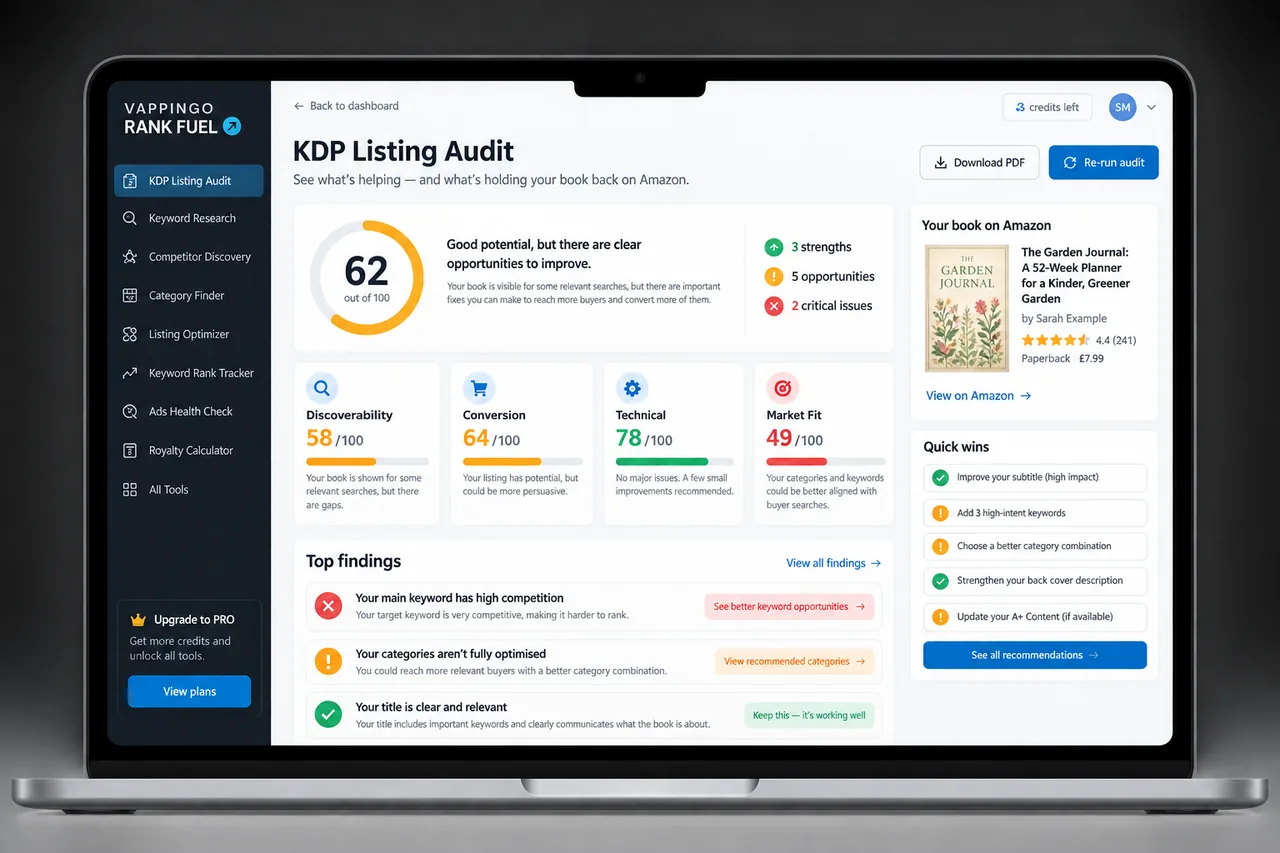
Writing the description is easier when each page has one job. Start with the complete Amazon book description guide for the overall structure, then use the specialist guides for genre, hooks, formatting, series copy, length, or diagnosis. If a live listing is underperforming, compare the description with the broader KDP Listing Audit process so you do not rewrite copy when the real bottleneck is the cover, positioning, keywords, or price.
For authors who want a more structured listing workflow, Rank Fuel’s current Listing Generator helps create a complete Amazon listing, while Listing Audit identifies the areas most likely to need attention. Treat those tools as drafting and diagnosis aids, then apply human judgment to the final promise, tone, and accuracy.