KDP Keyword Research: Find and Compare Buyer-Search Opportunities
Keyword Goldminer is now part of Rank Fuel's unified Keyword Research workspace. Generate plausible buyer language, then compare only the opportunities worth deeper analysis.
Keyword Goldminer has been consolidated into Rank Fuel’s current Keyword Research workspace. If you arrive through an old bookmark or article, the useful task has not disappeared: start with a book or idea, generate plausible buyer-search directions, and then compare the opportunities that deserve deeper attention.
The important change is that keyword discovery is now one workflow rather than a chain of separate branded tools. That reduces a common KDP problem: generating a giant list of phrases without knowing which ones matter enough to research or carry into the book.
Goldminer Is Now a Compatibility Route, Not the Current Product Name
The current code keeps the old Goldminer route so existing bookmarks, history, and journey links do not break, but it redirects into the unified Keyword Research workspace. Public guidance should therefore use Keyword Research as the current name.
This matters for customers as well as SEO. A user should not have to learn an obsolete tool name and then discover that the interface calls the same job something else.
Stage 1: Generate Buyer-Search Directions
Start with the actual book, idea, reader, format, and problem rather than a single broad seed word. The discovery step is designed to expand that context into plausible ways buyers may search, giving you a focused candidate set instead of a thesaurus dump.
At this stage the phrase is a hypothesis. It becomes useful only after the market comparison shows that the wording corresponds with real demand, relevant competing books, and a buyer intent your product can satisfy.
Stage 2: Compare the Market Behind the Phrase
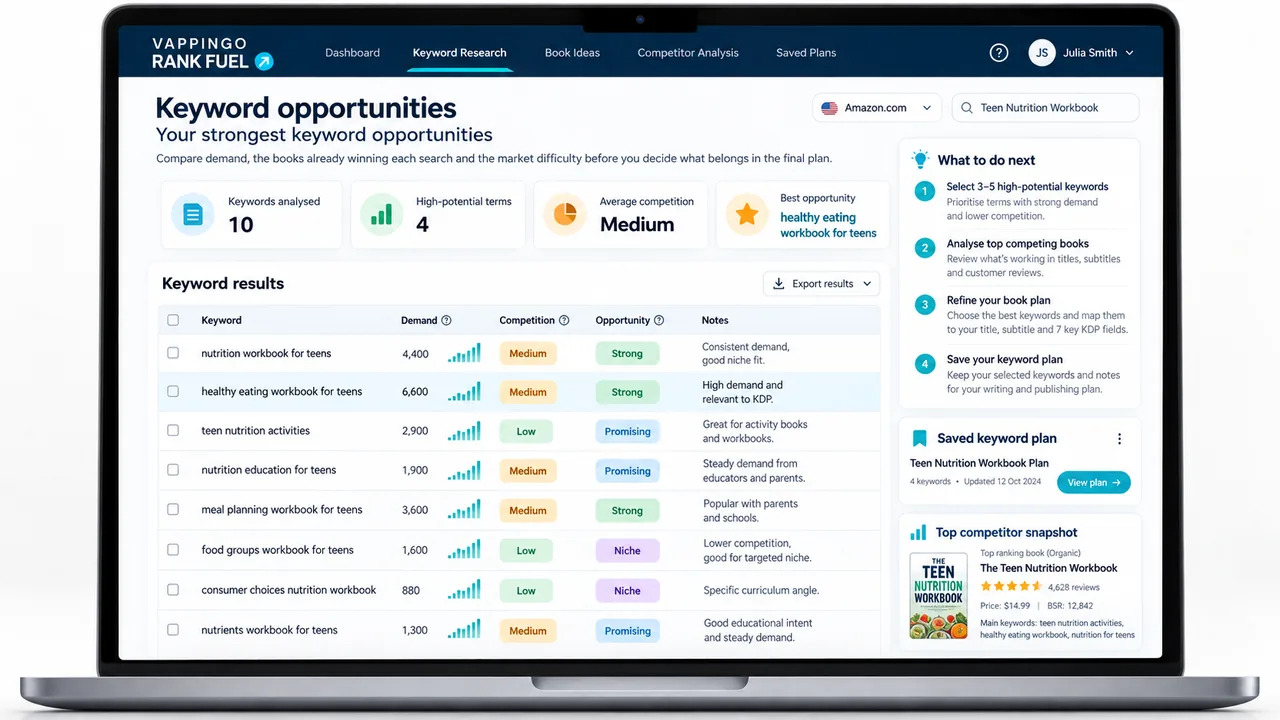
The deeper research layer looks at market evidence around selected keyword opportunities. The goal is to compare demand, competition, pricing, book characteristics, and overall opportunity in one view rather than judging phrases on search volume alone.
Opportunity assessments are research aids, not Amazon ranking factors or sales predictions. A high score does not mean Amazon will rank the book; it means the available evidence makes the phrase more interesting relative to other candidates.
Why High Search Volume Is Not the Goal by Itself
A broad phrase can attract many searches while describing several incompatible products. That creates competition and weakens buyer intent. A smaller phrase can be commercially better when the searcher clearly wants the exact format, audience, topic, or problem your book serves.
Judge volume beside relevance and competition. A keyword only matters when the book can genuinely satisfy the shopper who typed it.
Surface Phrases and More Specific Phrases Play Different Roles
Broad search language helps you understand the size and vocabulary of the market. More specific phrases reveal use cases, audiences, formats, problems, and combinations that can be easier to serve precisely.
Do not turn every specific phrase into a backend keyword. Use the research to identify distinct buyer concepts and then choose a small set that accurately describes the book across title/subtitle planning, keyword boxes, description, advertising, and content decisions.
How Access Works Now
Keyword Research discovery is credit-funded and available across plans. The current entitlement model keeps deeper live market comparison as a Pro feature, while old Goldminer routes remain only for compatibility.
That means a free or Starter user can begin the research process without learning a different tool. Upgrade becomes relevant when you need the deeper ongoing market comparison rather than merely generating candidate directions.
Carry Research Into the Listing Instead of Exporting and Forgetting It
Good keyword research should influence the next publishing decision. Before publication, the strongest phrases can shape positioning and the seven backend keyword fields. After publication, Rank Tracker and Listing Optimizer can help preserve or improve terms based on observed visibility.
This is more useful than a static spreadsheet because a phrase can change role over time. A keyword that began as an opportunity may later become one you want to protect because the live book is already ranking well.
The Three Mistakes to Avoid
First, do not choose phrases purely by volume. Second, do not target competitor brand names or misleading language. Third, do not assume every researched phrase belongs in the final metadata simply because the tool analyzed it.
The research process is a filter. Its job is to help you reject weak ideas early enough that the remaining terms deserve the limited attention available in your listing and ads.
Research Broad to Understand, Then Specific to Decide
Begin with broader language to understand the market vocabulary and the families of products shoppers encounter. Then move into more specific phrases that express audience, format, outcome, trope, setting, skill level, or use case. The specific terms often reveal where the buying decision becomes clearer.
Do not confuse specificity with obscurity. A phrase is useful when enough real shoppers use it and the books returned by the search reflect the product you plan to sell. Long wording nobody uses is not automatically a long-tail opportunity.
Turn Research Into Seven Distinct Keyword Concepts
KDP gives you seven keyword fields, so the final selection should cover distinct concepts rather than repeat the same phrase in minor variations. A good set might represent reader problem, format, audience, setting or trope, use case, subject detail, and another validated buyer concept.
Keep logical phrasing intact. Amazon’s own keyword guidance recommends logical word order and discourages vague or redundant terms. The objective is useful coverage, not filling every field with the maximum number of characters.
A phrase earns attention when…
- It accurately describes the book
- A real buyer would plausibly search it
- The current search results contain relevant books
- Demand is meaningful relative to competition
- The phrase adds a distinct concept rather than duplication
- The book can genuinely satisfy the intent
Frequently Asked Questions
Is Keyword Goldminer still a separate Rank Fuel tool?
No. The old Goldminer route is retained for compatibility and now redirects into the unified Keyword Research workspace.
Can free users use Keyword Research?
Current access allows credit-funded discovery across plans, while deeper market-comparison features are gated to Pro.
Should I choose the keyword with the highest search volume?
No. Relevance, buyer intent, competition, and the book’s ability to satisfy the search matter alongside volume.
Is the Opportunity Score an Amazon ranking factor?
No. It is a comparative research aid, not an Amazon ranking factor or sales prediction.
How should researched keywords feed into publication?
Use the strongest accurate concepts in positioning, backend keywords, listing copy, and ads where appropriate rather than trying to use every phrase.
What happens to old Goldminer links?
The current product keeps a compatibility route so older links can redirect users into Keyword Research.
A Keyword List Is Not the Outcome
The useful outcome is knowing which buyer-search concepts deserve space in the book’s positioning and which ones should be rejected before they consume metadata, ad spend, or writing time.