KDP Category Research: Compare Category Opportunity Without Treating Estimates as Facts
Category research should narrow uncertainty, not create fake precision. Compare relevant shelves, then verify the live Amazon market before choosing a category.
Category research is useful when it helps you compare several accurate shelves, not when it creates false precision around numbers Amazon does not publish. KDP gives you up to three category selections, while the exact sales needed to reach a category position changes continuously and cannot be known as a fixed official threshold.
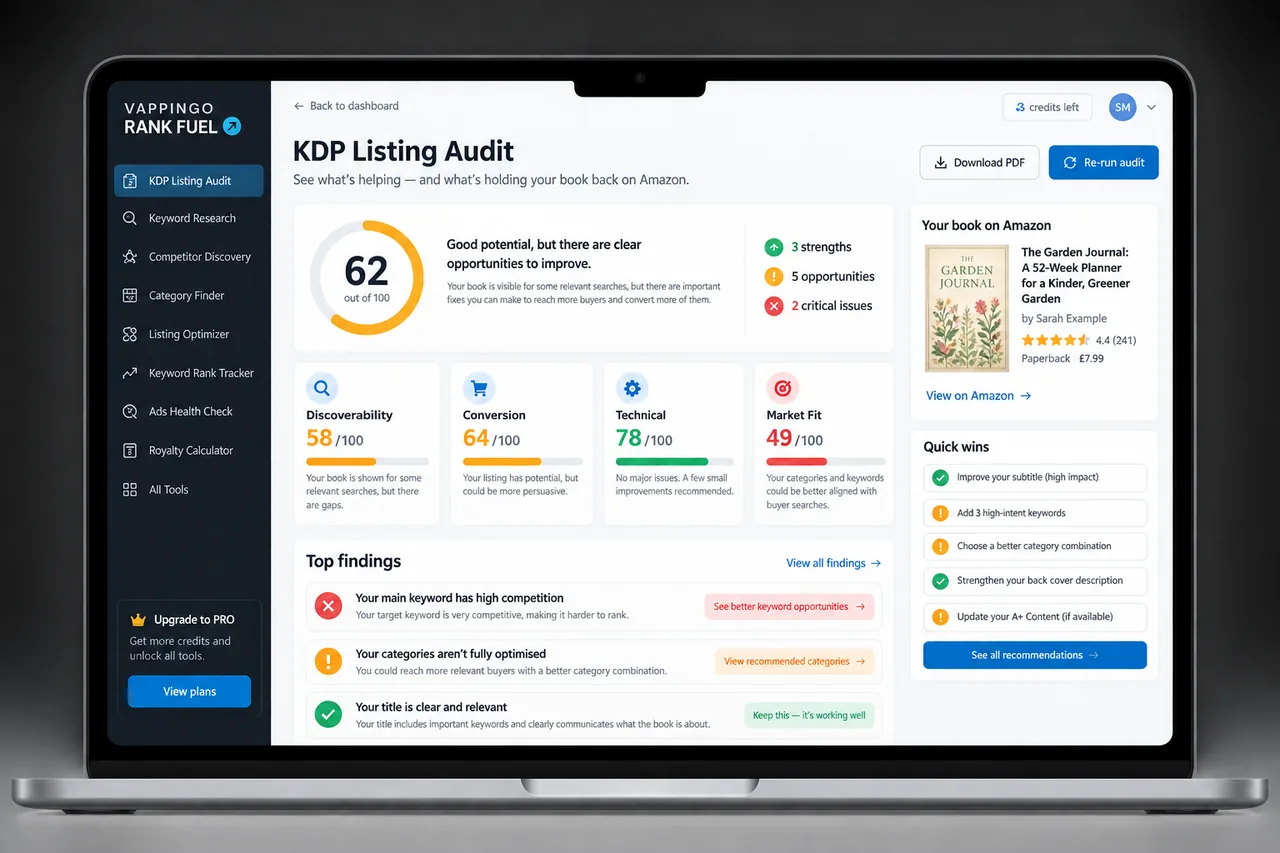
Rank Fuel’s Category Research is best treated as a directional comparison layer. It can help you think about competitive pressure, the likely sales bar, publisher mix, and category fit, but those outputs are estimates. The live Amazon category and the current books inside it remain the evidence you should verify before using one of your limited category choices.
Start With the Free Category Finder
Category Research works best after you have the exact category path. Use Category Finder first to locate accurate browse options, then move a genuinely relevant category into the deeper comparison workflow.
This matters because category opportunity means nothing if the book does not belong there. Amazon reviews category changes and warns against misleading categorization, so relevance is the first filter rather than a hurdle to work around.
What Category Research Is Trying to Estimate
The current tool provides a directional opportunity level, an estimated sales bar for strong positions, a broad view of publisher mix, market description, warnings, and example competitor context. These are research aids rather than Amazon-issued metrics.
Use them comparatively. If two accurate categories appear to offer very different competitive environments, the estimate can tell you where to inspect the live market more carefully. It should not be quoted as a fact such as ‘this category requires exactly 11 sales per day.’
Why the Indie vs. Established-Publisher Mix Can Matter
A category dominated by long-established franchises and major publishers can be harder for a new independent title to enter, especially when the visible books have years of reviews and strong brand recognition. A category where newer or independently published books appear regularly can show a more permeable competitive set.
Publisher type is only one clue. Strong indie titles can be extremely difficult to displace, and a traditionally published category can still contain openings for a distinctive specialist book.
Treat the Sales Bar as Directional
Category ranks move because sales velocity, competing-book performance, seasonality, promotions, and catalog changes move. No public tool can freeze that dynamic environment into a permanent threshold.
The practical use is comparison: category A appears to require substantially stronger sales than category B, while both genuinely fit the book. That can influence which shelf deserves one of your selections, especially for a newer title.
Always Inspect the Live Category
Open the category on Amazon and study the current top books. Check publication dates, prices, formats, review counts, series presence, cover expectations, and whether the category actually contains books like yours. Look for recent entrants as well as entrenched leaders.
If the directional analysis and live shelf tell different stories, trust the live evidence. A model can simplify a market; the current bookstore shows what the shopper actually sees.
Use Keywords for Specificity Categories Cannot Express
Categories are browse structures, so they are often broader than the exact buyer intent around a book. Backend keywords can add setting, trope, audience, problem, format, use case, or subject language that does not have its own category path.
KDP explicitly notes that keywords can help determine shelving when a more specific category is unavailable. That makes category and keyword research complementary rather than competing tasks.
Use the Three Choices Deliberately
KDP currently lets you select up to three categories. They do not have to be three variations of the same branch. Choose the combination that accurately represents the book and gives readers sensible browse paths from different angles.
Avoid spending a slot on an irrelevant low-competition category. A temporary rank in the wrong shelf is weaker than sustained discovery in a place where the shopper actually wants the book.
Revisit Categories When the Market or Book Changes
Category availability can change over time and differs by marketplace and format. Revisit selections after a meaningful edition change, a shift in positioning, or when KDP adds a more accurate category that did not exist at launch.
Record the old category set before changing it. KDP says updates can take up to 72 hours to display, with sales-rank placement sometimes taking longer, so avoid judging a change immediately.
Compare Categories With the Same Questions
A category comparison is only useful when the criteria stay consistent. For each candidate, note reader fit, visible demand, strength of established books, presence of newer entrants, format mix, price range, review depth, and whether your book’s cover and promise look natural on that shelf.
This prevents one attractive number from dominating the decision. A category with a lower estimated sales bar can still be a worse choice if the reader fit is weak or the products occupying the shelf are fundamentally different.
Watch for Seasonality and Temporary Category Distortion
Holiday books, exam guides, planners, gift products, travel titles, and event-driven nonfiction can produce category snapshots that look unusually strong or weak at one point in the year. A single observation can therefore overstate durable demand.
Look at publication history and repeated market behavior where possible. If the opportunity depends on a short seasonal window, build production and promotion around that reality rather than treating the category as evergreen.
Verify the estimate against the shelf
- The book genuinely belongs in the category
- Comparable current books serve the same reader
- Newer entrants can gain visible positions
- Price and format expectations fit your product
- Any seasonal distortion is understood
- The category adds a useful browse path beyond your other two selections
Frequently Asked Questions
Is Rank Fuel Category Research live Amazon sales data?
Treat its opportunity and sales-bar outputs as directional estimates, not official Amazon sales thresholds.
Is Category Research a Pro tool?
Yes. Category Research currently requires Pro.
How many categories can I choose in KDP?
Up to three categories in current KDP book setup.
Should I choose the easiest category?
Only among accurate choices. Relevance should be the first filter because misleading categorization creates a poor shopper experience.
Why use Category Finder first?
It helps you identify the exact valid category path before you spend time comparing the market around it.
How often should I review categories?
When the market, book positioning, format, or available category tree changes enough to affect the reader’s browse path.
Use Estimates to Decide What to Verify
A good research tool points you toward the live evidence that matters. Let Category Research narrow the field, then make the final category decision from what Amazon is actually showing shoppers.