KDP Category Strategy for a Book Series
Plan KDP categories across a series without copying the same three choices mechanically or relying on unsupported recommendation-graph claims.
Series authors face a category question that standalone authors do not: how much should stay consistent across volumes, and where should later books be allowed to diverge? The answer is not to spread every book across as many shelves as possible, and it is not to copy the same three categories forever without review.
KDP categories are chosen at the individual-book level, while KDP Series Pages provide the explicit structural connection between volumes. That means category strategy should help each book reach the right readers without pretending category overlap itself is the mechanism that links the series.
Book One Is the Main Acquisition Page
For most series, book one carries the largest share of new-reader acquisition because it is the natural starting point. Its categories should therefore make the core genre, audience, and reader promise as obvious as possible.
Use the strongest accurate category as the anchor, then choose secondary shelves that genuinely reflect the book and add meaningful discovery routes. Do not sacrifice clarity simply to distribute the series across more category names.
A cozy mystery series set in a village may lead book one with the clearest cozy-mystery shelf, then use another accurate detective or amateur-sleuth category if the story supports it. The aim is to make the first book easy to recognize, not to maximize category count.
Later Volumes Can Reflect Their Own Emphasis
Later books may introduce a new setting, protagonist focus, trope, professional context, or subgenre emphasis that justifies a different secondary category. If that distinction is substantial, using a different accurate shelf can broaden discovery without making the series feel inconsistent.
Do not invent differences solely to gain coverage. A book that is still fundamentally the same kind of cozy mystery should not suddenly be categorized as psychological thriller because one plot is darker.
- Keep the core genre or subject position coherent.
- Allow secondary categories to reflect genuine volume-specific content.
- Use keywords and descriptions for themes too narrow to justify a category.
- Document why each volume differs so later audits remain understandable.
Use Series Metadata for the Explicit Connection
KDP’s Series feature is designed to connect books that belong together and can create a Series Page showing the titles in sequence. That is the explicit structural signal authors should rely on for reading order and series identity.
Do not claim that sharing a category node guarantees recommendation links or “Also Bought” connections. Amazon does not publish such a rule, and recommendations are influenced by customer behavior and other signals beyond author-selected categories.
Coordinate Categories Without Creating Internal Confusion
If every volume uses completely different shelves, the series can lose genre clarity. If every volume uses identical categories despite meaningful differences, you may miss useful discovery routes. The practical middle ground is one or two stable core positions plus carefully chosen secondary differences where the books justify them.
This is especially useful for hybrid series. A historical mystery series, for example, may keep one mystery category across all volumes while different books use an accurate historical-period or location category when that element is central.
Treat Formats as Separate Retail Contexts
KDP says category options can differ by format, so eBook and print editions should be reviewed separately. Do not multiply category counts in your planning and assume every format offers an identical set of shelves.
A three-book series published in two formats gives you multiple book-format setups to manage, but the objective remains coherent positioning. Use each format’s actual live options rather than calculating an abstract total number of “placements” and trying to fill them all differently.
Completed Series and Box Sets Need Their Own Positioning
When a series is complete, the marketing proposition changes because some readers actively prefer finished series. That is usually better expressed through the description, series metadata, advertising, and keywords than through a speculative “completed series” category unless KDP actually offers a relevant current shelf.
Box sets and omnibus editions should be treated as separate products with their own category decisions. Their reader promise may differ from an individual installment because the value proposition is collection, convenience, or binge reading.
Measure Series Categories With Downstream Value
A category that brings the right new reader into book one can be more valuable than a category that produces a better numerical rank on book three. Evaluate categories in the context of series economics: entry-book sales, KU reading, follow-on sales, and overall reader progression.
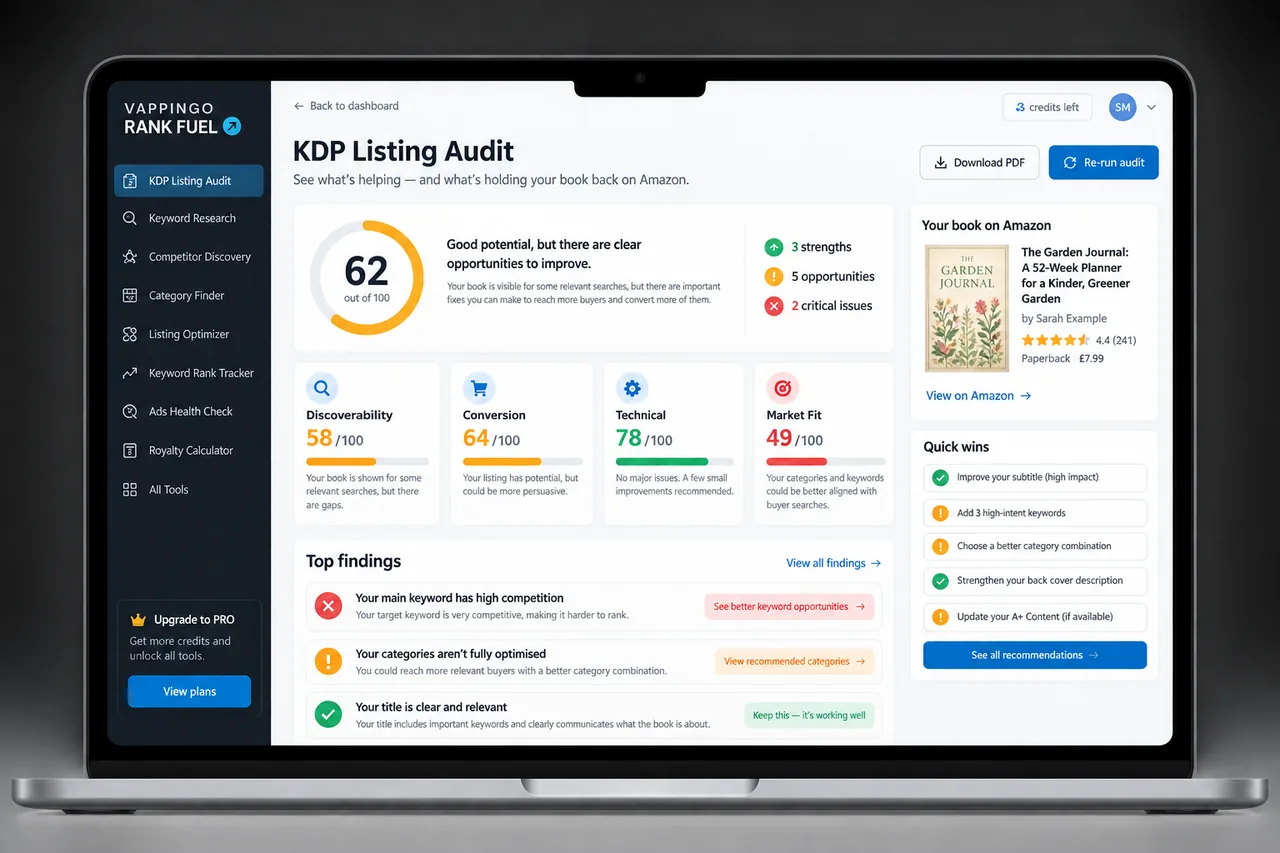
Rank Fuel’s Earnings Outlook and other book-level tools can help organize performance signals, but they do not provide reader-level attribution proving that one category caused a later-volume purchase. Use the data directionally and keep the causal claims modest.
Avoid Cannibalization Between Your Own Category Pages
The same principle applies to your content strategy. If you publish multiple guides about series categories, give each a clear job: one can cover category selection across volumes, another series sell-through, and another KDP Series Pages. Repeating the same target query across several articles weakens the cluster.
For this Vappingo content estate, the newer series-category strategy guide substantially overlaps this legacy page. The long-term SEO decision should be to consolidate around one canonical series-category article rather than keep two pages competing for the same core intent.
Frequently Asked Questions
Should every book in a series use the same categories?
Not necessarily. Keep the core reader positioning coherent, but allow secondary categories to differ when a volume has a genuinely different emphasis.
Does category overlap make Amazon recommend the next book?
Amazon does not publish a rule saying shared categories guarantee recommendation links. Use KDP series metadata for the explicit series connection.
Does book one need different categories from later books?
Book one often deserves the clearest acquisition-focused positioning because it is the natural entry point, but every book should still be categorized accurately.
Can paperback and eBook categories differ?
Yes. KDP says category options can differ by format, so review each edition separately.
Should a completed series use a special completed-series category?
Only if KDP actually offers a relevant category and it accurately fits. Completion is usually better communicated through series metadata and marketing copy.
How should I measure category performance in a series?
Combine book-level sales and rank data with KENP where relevant and downstream series performance. Avoid assuming category rank alone proves business value.
Make the Series Coherent Without Making Every Volume Identical
A good series category plan preserves the central promise readers associate with the series while allowing individual books to reflect meaningful differences. That is a metadata strategy, not a mathematical exercise in spreading slots across the maximum number of shelves.
Keep book one easy to understand, use KDP Series Pages for the explicit connection, and evaluate category decisions by the quality of readers they help attract. If two Vappingo pages continue targeting the same series-category query, consolidate them rather than expanding both indefinitely.