Automatic vs Manual Targeting in Amazon Ads for Books
Understand automatic and manual targeting for book ads, the four automatic targeting groups, keyword and product targeting, and how to use both as one learning system.
When authors first encounter automatic and manual targeting, the instinct is to treat them as alternatives, to pick one and run with it. This is the wrong frame. Automatic and manual targeting are not competitors; they are a system with distinct roles that only produces its best results when both are running simultaneously and connected through a weekly optimization cycle. Understanding this changes how campaigns are structured, what you look for in the data, and how quickly your advertising becomes efficient.
The Question Most Authors Ask Wrong
“Should I use automatic or manual targeting?” is the wrong question. The right questions are: what is automatic targeting for, what is manual targeting for, how do they feed each other, and what does the optimization cycle look like when both are running well?
Automatic targeting is a data source and discovery mechanism. It finds converting search terms you did not know existed and surfaces them in the Search Term Report. Manual targeting is an efficiency machine, it runs proven terms at optimized bids without the noise of Amazon’s broader automatic matches. One discovers; the other converts. You need both.
How Automatic Targeting Works
In an automatic targeting campaign, you set a bid (and optionally separate bids per sub-type) and Amazon takes full control of matching your ad to searches and product pages. Amazon reads your book’s metadata, title, subtitle, description, backend keywords, and categories, and uses that to decide which searches your ad is eligible for and which product pages are relevant to show it on.
You have no keyword list to build or maintain. You have no say in which specific searches trigger your ad, except through your negative keyword list (terms you explicitly exclude). The quality and specificity of your metadata directly determines the quality of Amazon’s automatic matches, more on this below.
Automatic campaigns are the only ad type that proactively reveals what your readers actually search for. The Search Term Report for an automatic campaign shows you the real, unfiltered vocabulary of your book’s audience, not what you guessed they search, but what they demonstrably searched before clicking your ad. This data is priceless and unavailable by any other means without buying it through ad spend.
The Four Automatic Sub-Types
Within automatic targeting, Amazon operates four distinct matching behaviors. You can set individual bids per sub-type, which allows meaningful budget control without giving up the discovery function entirely.
Close Match matches your ad to searches that are closely and specifically related to your book’s metadata, the tightest relevance filter. A cozy mystery set in a British village with “village mystery” and “amateur sleuth” in the keywords would match searches like “cozy village mystery books UK” and “amateur sleuth British detective fiction.” Close Match is typically the highest-converting automatic sub-type and should receive your default (or slightly above default) bid.
Loose Match broadens the relevance net to searches less directly related, tangentially connected genre terms, related subject areas, and broader category searches. The same book might match “British fiction cozy” or “light-hearted mystery books” under Loose Match, terms that might be slightly off the mark but can still find the right readers. Lower conversion than Close Match, useful for discovering peripheral audience vocabulary. Set Loose Match bids 25-30% below your default.
Substitutes places your ad on the product pages of books Amazon considers substitutes for yours, directly comparable titles where a reader is actively evaluating a purchase. This sub-type functions like a product targeting campaign, it reaches readers in active consideration mode for a book like yours, at the point they are already on a directly relevant product page. Conversion rates from Substitutes placements can match or exceed Close Match in many genres. Bid at your default or slightly below.
Complements targets product pages of books readers might buy alongside yours, adjacent rather than competitive. A reader on the page of a “how to write cozy mysteries” craft book might be shown your actual cozy mystery via a Complements placement. The relevance logic is indirect and conversion rates are typically lower, set Complements bids 30-40% below your default and review performance at 30 days to decide whether to maintain or pause.
Why Your Metadata Determines Automatic Targeting Quality
The quality of your automatic targeting results is a direct function of how well your metadata communicates your book’s genre, audience, and content. Amazon can only match what it can read. Vague, generic, or inaccurate metadata produces vague, generic automatic matches, and wasted spend.
Specific consequences: if your backend keywords are broad genre terms like “mystery” and “fiction” rather than specific terms like “cozy mystery British village amateur sleuth,” Amazon’s Close Match sub-type will produce much broader, lower-converting matches. If your book description does not include the trope vocabulary your genre readers use, “forced proximity,” “enemies to lovers,” “dark academia”, Amazon will not surface your ad for those trope-specific searches in automatic targeting. If your categories are incorrect or overly broad, Amazon’s Substitutes placements will target non-comparable books.
Before launching any automatic campaign, audit your metadata rigorously. See our KDP keyword research guide for the full metadata optimization process. A well-optimized metadata layer makes automatic campaigns dramatically more efficient from day one and dramatically reduces the time to finding your first converting search terms.
How Manual Targeting Works
In a manual campaign, you specify exactly what to bid on, either specific keywords (with match types) or specific products (ASINs or categories). Amazon only enters the auction for searches or pages that match what you have specified. You have complete control over the targeting and full visibility into performance per target.
Manual campaigns are more efficient than automatic for proven targets because they contain no discovery overhead, there are no exploratory searches burning spend while you wait for signal. Every keyword or ASIN in a mature manual campaign has either been verified as converting or should be paused. The weakness is the reverse of automatic’s strength: manual campaigns cannot discover new terms. They can only perform as well as the list you give them. A manual campaign seeded with generic, unresearched keywords will underperform a well-maintained automatic campaign every time.
Manual Keyword Targeting
Manual keyword campaigns let you bid on specific search terms with defined match types (exact, phrase, broad). Building your initial keyword list requires combining several sources: your primary genre and trope vocabulary, comparable author search terms, Amazon autocomplete suggestions, and any converting terms you have gathered from research before launch.
The KDP Rank Fuel by Vappingo Book Keyword Spy tool lets you enter any comparable book’s ASIN and see every keyword it ranks for, effectively reverse-engineering the keyword strategy of proven bestsellers in your category. If three comparable books all rank consistently for “small town cozy mystery female sleuth UK,” that term has proven audience demand and belongs in your manual campaign from day one. This kind of pre-launch keyword research means your manual campaign is seeded with informed targets rather than guesses, and shortens the time to finding profitable terms considerably.
Alexa for Shopping, formerly Alexa for Shopping, has expanded conversational shopping on Amazon, but Amazon does not publish a special automatic-targeting formula for authors tied to it. Use natural, specific book positioning and let campaign reports show which queries and contexts are actually producing clicks.
Manual Product Targeting
Manual product targeting lets you choose specific products or broader product categories rather than shopper keywords. Use individual ASINs when you can explain why a reader considering that book could plausibly want yours next. Use categories when the product group itself represents a useful audience and you want broader discovery.
Build the initial ASIN list from genuinely comparable books: same reader problem or genre, similar tone or promise, relevant format and price expectations, and a believable substitution or complementary-reading relationship. Rank Fuel’s current Competitor Discovery can help identify books competing for the same shoppers, while Book Keyword Spy and Keyword Research provide additional search evidence. Treat those tools as research support and validate the targets inside the ad account.
Keep product-target performance readable. You can separate product and keyword targeting when their bids, objectives, or reporting needs differ, but Amazon Ads does not require a universal one-campaign-per-targeting-type structure. The right structure is the simplest one that still lets you make target-level decisions.
Connecting Them: The Harvest-and-Scale Workflow
Automatic and manual targeting work best as a feedback loop. Let automatic campaigns reveal searches and product contexts you did not explicitly choose, then use the Search term and matched-product evidence to decide which opportunities deserve direct manual control. The loop can run weekly, fortnightly, or at another cadence that matches the account’s spend and traffic.
Promote a useful search term when it is relevant and has enough repeated evidence to justify a separate bid and clearer reporting. Add it as an exact target if you want to control it directly. Negating the same term in automatic targeting is optional: use a negative when you want cleaner routing or the discovery campaign is consuming budget you would rather reserve for new searches. Do not claim that overlap automatically makes your own campaigns bid up CPC against each other.
Negative decisions also need context. Amazon recommends allowing enough evidence before excluding a target and gives guidance around 20 clicks, but obvious mismatches can be blocked sooner. For plausible terms, compare spend with royalty or reader value, attribution maturity, and conversion evidence. There is no universal “1.5 times royalty” cutoff or 60-to-90-day point at which the account becomes optimized.
When Each Type Should Dominate Your Spend
Do not force automatic and manual targeting into a calendar-based budget split. Early in a campaign, automatic targeting can deserve more discovery budget if you have little search-term evidence. A well-researched manual campaign can also deserve meaningful spend from day one when the book has obvious genre, trope, problem, author-comparison, or product targets.
As evidence accumulates, move budget toward the campaigns that are doing valuable work. If manual exact targets repeatedly convert and are budget constrained, fund them. If automatic targeting is still discovering profitable searches or product contexts, keep it active. If a targeting group produces persistent mismatch, reduce its bid or exclude the relevant terms instead of protecting its budget because a template says “30% automatic.”
The mature account can therefore look very different from book to book. Some titles keep substantial automatic spend for continuous discovery; others become mostly manual; many use both. The useful question is not which targeting type should dominate at month four. It is which campaign has evidence that another dollar can still produce useful traffic, conversions, or learning.
What Happens If You Run Only Automatic
An automatic-only strategy produces campaigns that plateau. After the first 30-60 days, the Search Term Report repeats itself, the same terms converting, the same terms wasting spend, without any mechanism for improvement. Without harvest cycles feeding proven terms to a manual campaign, you keep paying broad-match prices for terms that could be handled at exact-match efficiency. Without negative keyword management, the wasted spend fraction never shrinks. The campaign generates consistent mediocre results indefinitely instead of improving over time.
Many authors who report that “Amazon Ads don’t work” have been running automatic-only campaigns for months. The campaigns are working, they are generating data, but that data is not being used to improve anything.
What Happens If You Run Only Manual
A manual-only strategy can be profitable if your initial keyword research is excellent, but it has a ceiling and a discovery problem. Without an automatic campaign running alongside it, your manual campaign’s keyword list never grows beyond what you knew at launch. You miss the converting terms that readers actually use but that you did not know to target. Over time, without fresh discovery data, manual-only campaigns stagnate on their initial keyword list, which gradually loses relevance as the market shifts. The keyword list also ages: terms that were competitive at launch may become more crowded, and new trope and genre vocabulary that emerges in reader search behavior never enters your targeting.
Practical Setup for Both Simultaneously
A practical launch can begin with two or three clear jobs rather than a fixed set of budgets. One automatic campaign can explore close match, loose match, substitutes, and complements. A manual keyword campaign can test the strongest researched queries using exact, phrase, or broad match according to how much discovery you want. A separate product-target campaign is useful when comparable ASINs or categories are important enough to warrant their own bids and reporting.
Set budgets from the total amount you can afford to learn with, then make sure each active campaign has enough room to gather meaningful traffic. If the available budget is small, simplify the campaign structure instead of dividing it across so many campaigns that none can teach you anything. If the budget is larger, separation can make analysis cleaner, but extra campaign count is not a goal in itself.
Use the first reporting periods to validate your assumptions. Is automatic traffic relevant? Are manual keywords producing the searches you expected? Are product targets attracting shoppers with a credible fit? Shift budget only after you can answer those questions with evidence.
Bidding in Automatic Campaigns
Choose automatic-targeting bids from the book’s economics and the amount of discovery you are willing to fund. Amazon exposes close match, loose match, substitutes, and complements, so you can use different bids when the groups show different relevance or conversion patterns. Suggested bids are a useful market reference, not a command.
Dynamic bids – down only is a conservative option because Amazon can reduce the bid when a conversion appears less likely. Fixed bids can make a test easier to interpret, while up-and-down gives Amazon more freedom to raise bids in stronger predicted opportunities. Calculate the possible bid exposure before combining up-and-down with placement adjustments.
Do not wait for an arbitrary day 30 before acting. Fix obvious mismatches early; give plausible groups enough traffic for attribution and conversion evidence to mature; then change the group that actually needs a different bid.
Bidding in Manual Campaigns
Manual bids should reflect the value and evidence of the individual target. A proven exact search can justify a different bid from a new broad term because the uncertainty is different. Product targets can also warrant their own range when their CPC and conversion pattern differs from keywords.
Avoid automatic percentage rules such as “reduce every keyword by 20% after 20 clicks.” Compare CPC, spend, attributed outcomes, relevance, and the expected value of a reader. If a target is clearly uneconomic, a meaningful bid reduction or pause can be appropriate; if it is close to the line, make a smaller change so you can still observe it.
Record the old bid, new bid, date, and reason. The value of incremental changes is not that 15% or 20% is magically correct; it is that a controlled change leaves you a clearer baseline for the next decision.
The Targeting Mistakes That Cost the Most
Running automatic only and treating it as a complete strategy. Automatic discovers terms. Manual converts them efficiently. Without manual, you leave all the efficiency gains of proven exact match targeting untapped.
Never connecting the two campaigns via the harvest cycle. Running both campaigns without the weekly harvest-and-scale cycle means they operate in parallel but never improve each other. The harvest is the compounding mechanism, without it, there is no compound.
Failing to negate in auto when adding to manual. Not adding the exact match negative to the automatic campaign when promoting a term to manual means both campaigns compete for the same search, inflating CPC with no benefit. This is the single most common and most expensive omission in the harvest cycle.
Assuming all four automatic sub-types perform equally. Close Match and Substitutes typically outperform Loose Match and Complements by a significant margin for most book types. If you set identical bids across all four from day one and never check, you are paying top-of-search prices for bottom-of-funnel placements.
Abandoning automatic campaigns once manual is established. Automatic remains a perpetual discovery engine even when your manual campaign is mature. Reader search behavior evolves, new tropes emerge, new comparable authors become breakout hits, seasonal search patterns shift. Automatic campaigns running continuously surface these evolutions. Stopping auto targeting to “save budget” cuts off the discovery pipeline and your manual campaign slowly ages.
For the Search Term Report mechanics that power the harvest cycle, see our dedicated Search Term Report guide. For the full campaign structure these targeting types sit within, see our complete Amazon Ads guide for authors. The ads connect readers with your book, professional manuscript proofreading from Vappingo ensures the book they find meets the professional standard that earns the reviews your next campaign depends on.
How to Use Automatic and Manual Targeting as One System
A useful workflow begins with a hypothesis rather than a campaign type. Suppose a thriller appears to fit “locked-room mystery,” several comparable authors, and a group of specific competitor ASINs. Manual targeting lets you test those hypotheses directly. Automatic targeting runs beside it to reveal searches and product contexts you did not predict. After enough traffic arrives, the Search term report tells you which ideas deserve promotion, which need lower bids, and which should be excluded.
The loop then repeats. Manual campaigns become more precise because automatic discovery keeps feeding them new evidence; automatic campaigns become less wasteful because negative targeting removes obvious mismatch. You do not need to force every successful search out of automatic targeting, and you do not need to treat manual targeting as “better.” The objective is a clean account in which discovery and control both have a visible role.
Turn the article into a repeatable Amazon Ads workflow
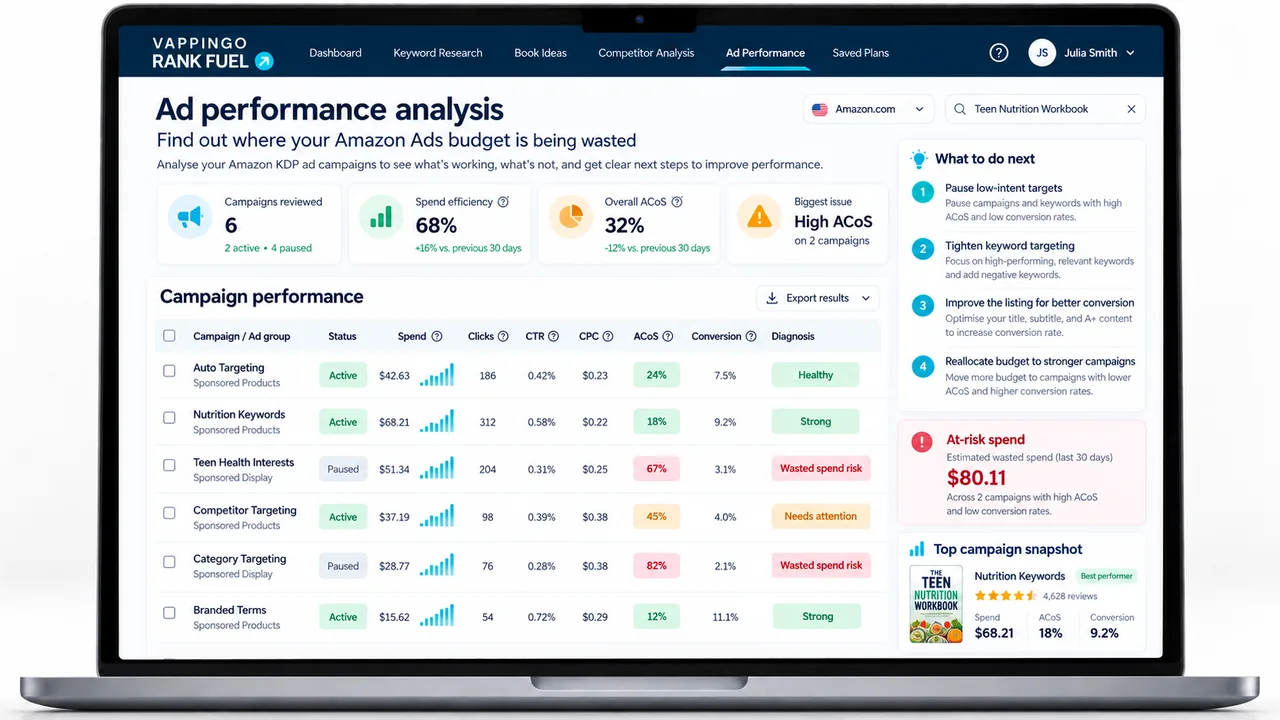
KDP Rank Fuel’s current Amazon Ads Generator builds a guided five-campaign Sponsored Products plan, while Amazon Ads Weekly Coach helps turn exported reports into clearer recurring decisions. Use the tools as decision support and keep the live Amazon Ads console as the authority on eligibility, settings, and final changes.
Frequently Asked Questions
Is automatic targeting better than manual targeting?
They do different jobs. Automatic targeting is useful for discovery; manual targeting gives deliberate control over keywords and products. Many accounts use both.
What are automatic targeting groups?
Amazon currently uses close match, loose match, substitutes, and complements for Sponsored Products automatic targeting.
Does KDP backend metadata directly control automatic ads?
Amazon uses product information and shopping signals, but it does not publish a simple one-to-one formula linking each backend keyword to automatic ad delivery.
Can I move a search term from automatic to manual targeting?
Yes. A common workflow is to use search-term evidence from automatic campaigns to create more controlled manual keyword or product targets.
Should I negative the term in automatic as soon as I promote it?
Sometimes, if you want clean separation, but it is not mandatory. Consider whether the automatic campaign still has a useful discovery role for that term or related variants.
Discovery and Control Work Better Together
Automatic targeting helps show you what Amazon finds relevant; manual targeting lets you choose what deserves deliberate investment. The advantage comes from connecting the two through reports and negatives rather than declaring one type the winner.