Keyword Research for Amazon Book Ads: Build Targets from Buyer Language
Build Amazon book-ad keyword lists from buyer language, comparable books, autocomplete, campaign evidence, and Rank Fuel research without relying on generic high-volume terms.
Most authors launching their first manual Amazon Ads campaign have the same problem: they know they need a keyword list, but they do not know where to get one. Amazon’s console suggests a few keywords automatically, genre terms feel obvious but vague, and the thought of building a list from scratch is daunting. The result is usually a small list of generic terms that generates poor performance and confirms the author’s suspicion that manual targeting does not work. The issue is not the campaign structure, it is the research that preceded it.
Good pre-launch keyword research produces a manual campaign that generates meaningful data from day one, rather than sitting nearly dormant waiting for automatic campaign results to arrive. This guide covers every research source available.
Why Keyword Research Before Launch Matters
There is no single correct keyword count for a book campaign. The list should be large enough to test several meaningful routes into the book but small enough that the available budget can actually produce evidence. Expand when the first set has taught you something, not because you are trying to hit a generic target count.
Amazon says Sponsored Products delivery depends on the bid and the relevance of the ad to the shopper’s query or context. It does not publish an author-facing “quality score” formula that lets you calculate a hidden multiplier. Treat listing quality as a conversion and relevance issue: a professional, clearly positioned detail page can make paid traffic more valuable, but do not claim that a review count or conversion rate feeds a documented numeric quality score.
The Six Keyword Research Sources
For book advertising specifically, the most productive research sources are: competitor ASIN keyword analysis, Amazon autocomplete, browse category terminology, reader trope vocabulary, author comparison terms, and, once you have campaigns running, your own Search Term Report. The first five are pre-launch sources. The sixth is a continuous, real-time improvement layer.
Competitor ASIN Keyword Research
Comparable books are useful because they reveal the language and shopping contexts around the same reader. Start with a focused set of titles that genuinely compete for your audience rather than a fixed quota of ten or fifteen. Mix established titles with newer books when that helps you see both durable genre language and emerging vocabulary.
KDP Rank Fuel’s Book Keyword Spy can surface Amazon searches associated with competing books, while Competitor Discovery helps identify books competing for the same shoppers. Treat the outputs as market evidence, not as a direct view into another author’s private backend keywords and not as proof that every term should become an ad target.
Filter every candidate through your book’s actual promise. A keyword can drive traffic to a successful competitor and still be wrong for your tone, trope, format, audience, or price. The best competitor research produces hypotheses that your own Search term report can later confirm or reject.
Amazon Autocomplete Mining
Amazon’s search bar autocomplete is driven by real user search volume data. Every suggestion Amazon shows is a term that large numbers of real Amazon readers have searched recently. This makes it one of the most accurate available windows into actual reader search behavior, not hypothesised behavior, but observed patterns from Amazon’s own data.
Process: go to Amazon.co.uk (or your target marketplace) and type your primary genre term into the search bar without pressing Enter. Record all autocomplete suggestions. Then type each of those suggestions, and record their autocomplete suggestions. Systematically work through your primary subgenre terms, trope terms, and series-type phrases in the same way.
For “cozy mystery,” Amazon’s autocomplete typically surfaces “cozy mystery books,” “cozy mystery series,” “cozy mystery books UK,” “cozy mystery British,” “cozy mystery with recipes,” “cozy mystery with cats,” “cozy mystery short stories”, each a distinct audience segment with its own demand signal. “Cozy mystery with cats” tells you there is a meaningful subset of cozy mystery readers who specifically want cat characters, if your book has a cat, that term belongs on your keyword list immediately.
Autocomplete mining for 10-15 seed terms typically produces 80-150 candidate keywords in an hour. Many will overlap; many will reveal audience segments you had not specifically considered.
Category and Browse Node Terms
The names of Amazon’s browse categories in your book’s genre area are reader-facing search terms that Amazon explicitly associates with your type of book. If your book belongs in “Crime, Thrillers & Mystery > Crime Fiction > Cozy Mystery,” every level of that hierarchy is a keyword your readers may search: “crime fiction,” “crime thrillers mystery,” “cozy mystery”, and importantly, all the adjacent categories: “amateur sleuth,” “women sleuths,” “culinary mysteries,” “village mysteries.” These terms are not guesses, Amazon built its browse structure around how readers actually search and categorize books.
Find comparable categories by browsing Amazon’s Books > Categories > Mystery, Thriller & Suspense hierarchy (or your equivalent). Note the full names of every category that could apply to your book. These category-level terms have high search volume and moderate competition, good volume to start generating data quickly. Add them as phrase match keywords.
Trope and Reader Vocabulary
Readers, particularly romance and fantasy readers, have developed rich, specific trope vocabulary that they actively search by. This vocabulary is often dramatically different from what an author would naturally think to target. Authors think in genre terms (“contemporary romance”); readers think in trope terms (“forced proximity office romance slow burn”). Trope vocabulary examples by genre:
Romance: enemies to lovers, forced proximity, fake dating, second chance romance, grumpy sunshine, slow burn, sports romance, small town romance, billionaire romance, friends to lovers
Fantasy: dark academia, cozy fantasy, romantasy, fae romance, chosen one, found family fantasy, portal fantasy, progression fantasy, litrpg Mystery: cozy mystery, amateur sleuth, armchair detective, locked room mystery, village mystery, culinary mystery, tea shop mystery
Science fiction: solarpunk, hopepunk, first contact, generation ship, hard sci-fi, space opera, cli-fi, near-future thriller These trope terms are underused by most book advertisers, CPCs are typically lower than broad genre terms, and conversion rates are often higher because the reader searching a specific trope is expressing highly specific intent. A romance reader searching “grumpy sunshine slow burn” who finds your book and clicks has already self-identified as exactly your target reader, they have done the relevance filtering themselves before the click.
Where to find your genre’s current trope vocabulary: reader communities on Goodreads (particularly the reading challenge threads), BookTok and Bookstagram hashtag collections, Reddit’s r/suggestmeabook and genre-specific subreddits, and reader review language on Amazon itself (what words appear repeatedly in five-star reviews of comparable books?).
Author Comparison Keywords
Readers regularly search Amazon for “books like [author name]” or “[author name] books” when they want more of a reading experience similar to a favorite author. For KDP authors, targeting comparable traditionally published authors, particularly breakout or critically acclaimed names in your specific subgenre, captures readers who are explicitly in the market for what you offer.
“Books like Richard Osman” is a real search term generating real Amazon traffic from cozy mystery readers. “Books similar to M.C. Beaton” targets Hamish Macbeth fans. “Books like Jodi Picoult” targets emotional contemporary fiction readers. “If you like Stephen King” targets horror readers. These searches have high purchase intent, the reader is explicitly asking for a recommendation in a genre they already love.
Research method: identify 10-20 comparable published authors who write in the same specific subgenre as your book. For each, check Amazon autocomplete for “[author name] books,” “books like [author name],” “similar to [author name],” “authors like [author name].” Add the patterns that emerge as phrase match keywords.
Important restriction: do not use trademarked book or series names (e.g., “Twilight,” “Harry Potter”) as keywords, this can violate Amazon’s advertising policies and risk campaign rejection. Author names are generally acceptable; branded series titles are not.
Search Term Report as a Research Source
Once your automatic campaign has run for 14+ days, the Search Term Report is your most valuable and most accurate research source, because it is not research at all, it is evidence. Real searches, real clicks, real conversion data for your specific book in your specific marketplace.
The entire harvest-and-scale workflow described in our Search Term Report guide is essentially keyword research conducted through live advertising spend. The terms you harvest are not candidates, they are proven converters. Treat the Search Term Report as your ongoing research engine and your pre-launch research as the starting investment that produces data quickly enough to begin the real research cycle.
How Alexa for Shopping Affects Keyword Strategy in 2026
Amazon renamed Alexa for Shopping to Alexa for Shopping in May 2026. Conversational shopping increases the importance of clear, natural product positioning, but it does not replace keyword targeting and Amazon has not published a special “Alexa keyword” formula for book ads. Research buyer language that accurately describes genre, problem, audience, trope, outcome, or comparable reading experience, then verify it with campaign evidence.
Amazon renamed Alexa for Shopping to Alexa for Shopping in May 2026. Conversational shopping increases the importance of clear, natural product positioning, but it does not replace keyword targeting and Amazon has not published a special “Alexa keyword” formula for book ads. Research buyer language that accurately describes genre, problem, audience, trope, outcome, or comparable reading experience, then verify it with campaign evidence.
The practical adaptation: write your description with reader vocabulary in mind, the words your readers use to describe the reading experience they want, not just the words that describe your book’s plot. Monitor your Search Term Report for emerging conversational patterns in search terms and add them to your phrase match ad group as they appear.
Organising Your Keyword List by Type
Structure your keyword list into thematic groups before entering it into campaigns. This makes campaign organization much cleaner and reveals whether you have coverage across all the keyword types your genre requires.
Recommended groupings: Genre/subgenre terms (broad category language), Trope terms (specific reader vocabulary), Setting/period terms (particularly useful for historical fiction and location-specific novels), Author comparison terms, Series-type terms (“complete series,” “long series to binge”), Mood/atmosphere terms (“cozy read,” “light-hearted mystery,” “feel-good fiction”), and Format-specific terms (if relevant: “standalone mystery,” “series starter,” “novella”).
In your manual campaign, create separate ad groups for each major thematic cluster. This keeps performance data clean per theme, if your trope terms are outperforming your genre terms, you can see that clearly and adjust bids independently rather than managing everything from one mixed pot.
How Many Keywords You Actually Need
There is no ideal launch count. The useful list is large enough to test several meaningful buyer routes and small enough that the available budget can produce evidence. A tightly positioned niche book can launch with a compact set of highly relevant terms; a broad commercial genre can justify more exploration.
Organize the list by intent rather than counting rows: genre or problem, trope or method, audience, setting, outcome, comparable author or title, and product targets. Then choose match types according to how much freedom you want Amazon to have around each idea.
Expand when the first set teaches you something. Search-term evidence, autocomplete, competitor research, and new releases can all reveal additional routes. More keywords are useful only if you can still identify which ones deserve spend.
Keyword Research Mistakes at Launch
Confusing ad keywords with KDP backend metadata. The language can overlap, but paid targets are bids you evaluate through campaign evidence. Backend keywords serve metadata and discoverability purposes and should not be copied into ads without a reader-intent reason.
Copying competitor terms without checking fit. A successful competing book can rank for language that describes a different trope, audience, format, or promise. Use competitor data to discover possibilities, then filter aggressively for truth and relevance.
Launching hundreds of targets on a small budget. A huge list can spread spend so thinly that nothing gathers useful evidence. Start with a structure your budget can actually test and expand deliberately.
Treating autocomplete as search volume. Suggestions are useful evidence of shopping language, but Amazon does not publish the exact volume represented by each autocomplete phrase. Validate demand with multiple signals and campaign results.
Build a Keyword Map, Not a Flat List
Organize candidate ad keywords by why the reader is searching. Fiction examples include genre, trope, mood, setting, relationship dynamic, comparable author, and comparable title. Nonfiction examples include problem, desired outcome, audience, method, life stage, profession, and competing solution. This prevents a list of 300 disconnected phrases from looking more sophisticated than a list of 50 well-understood buyer routes.
Then assign a testing role. Some terms belong in exact because they are already proven. Some belong in phrase or broad because you want Amazon to reveal modifiers and related searches. Some are better handled as product targets because the shopper is signaling interest through a specific competing book. Research becomes useful when it tells you what to test and why, not when it merely maximizes the number of rows in a spreadsheet.
Turn the article into a repeatable Amazon Ads workflow
KDP Rank Fuel’s current Amazon Ads Generator builds a guided five-campaign Sponsored Products plan, while Amazon Ads Weekly Coach helps turn exported reports into clearer recurring decisions. Use the tools as decision support and keep the live Amazon Ads console as the authority on eligibility, settings, and final changes.
Frequently Asked Questions
Where should book-ad keywords come from?
Start with reader problems, genre and trope language, audiences, outcomes, comparable authors or books, autocomplete, and your own Search term report.
Is ad keyword research the same as KDP backend keyword research?
No. They overlap in reader language, but paid keywords are targets you bid on and evaluate by campaign performance. Backend keywords serve a different metadata role.
How many keywords should I launch with?
Enough to test several meaningful routes to the book without spreading the budget so thinly that nothing gathers evidence. There is no universal count.
Does Alexa for Shopping change keyword research?
It increases the value of clear natural-language positioning, but Amazon has not published a special “Alexa keyword” formula for author ads.
How can Rank Fuel help?
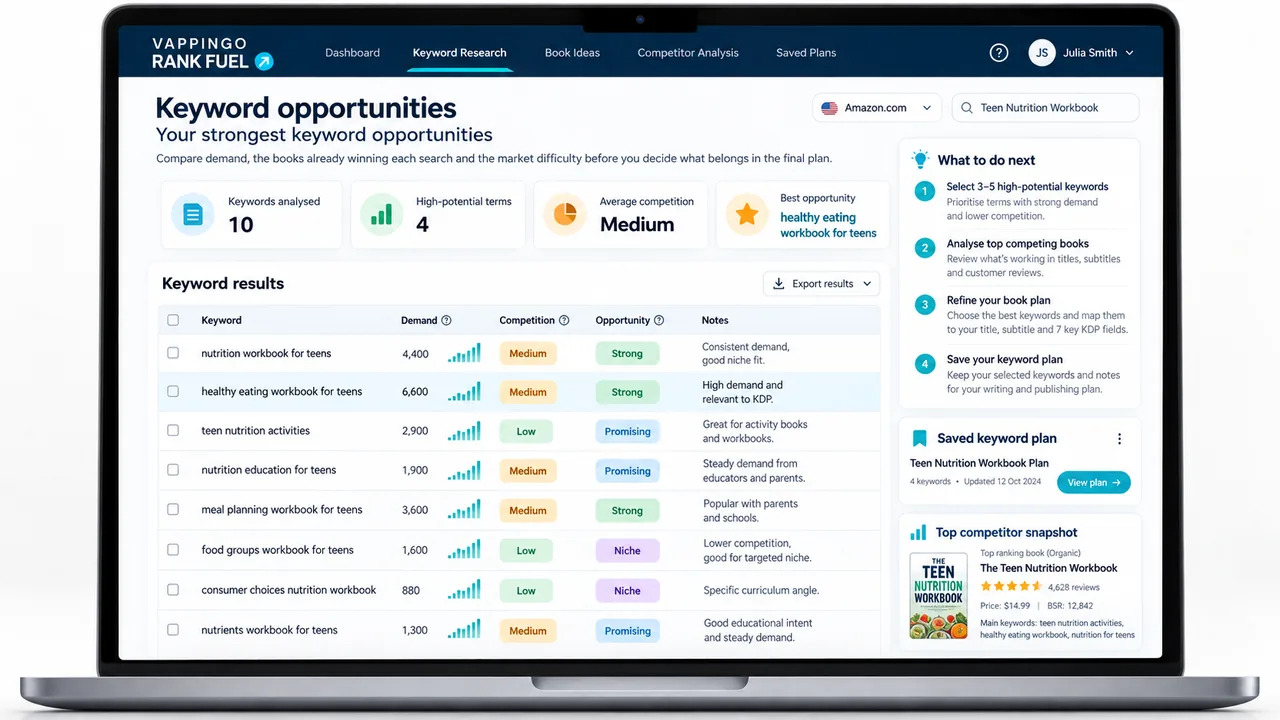
Rank Fuel Keyword Research is designed around buyer searches and can help generate and compare candidate terms before you validate them with live advertising evidence.
Research Buyer Routes, Then Let Ads Verify Them
Pre-launch research should give you plausible paths to the reader, not a giant list. Organize the paths, choose the right match type or product target, and let actual search-term evidence decide which ideas deserve to survive.