Amazon Ads ROAS for KDP Authors: What ACoS Does and Doesn’t Tell You
ACoS and ROAS measure attributed ad performance, not complete publishing profit or reader lifetime value. Add the business metrics they cannot capture.
What does a 30% ACoS actually tell you about whether your KDP ads are making money? At first glance, the calculation seems reassuring. If Amazon attributes $100 in sales to $30 of ad spend, it is easy to assume the campaign has left plenty of room for profit. The problem is that the $100 shown in Amazon Ads is sales revenue, not the royalty that reaches you.
For a KDP author, that distinction changes the way ACoS needs to be interpreted. A paperback sale still has printing costs deducted before the royalty is calculated, while an eBook royalty depends on the price, royalty option, and delivery costs. A campaign can, therefore, look efficient in the Ads console while producing far less immediate income than the headline ACoS suggests.
The calculation becomes more complicated again when the advertised title is part of a series or enrolled in Kindle Unlimited. A reader acquired through an ad for book one may later buy book two or book three, while KU reading can generate KENP royalties that sit outside the ACoS calculation. Those later returns matter, but simply assigning all of them to the original ad would make the opposite mistake by giving the campaign credit for value we cannot cleanly attribute.
The useful question is, therefore, not simply whether an ACoS is “good.” It is whether the amount being spent to acquire readers makes sense once immediate royalties, series read-through, KU activity, and the limits of Amazon’s attribution are considered together. This guide shows how to make that calculation without turning ACoS into a profitability metric it was never designed to be.
What Does Amazon Ads ACoS Mean for KDP Authors?
Amazon Ads ACoS for KDP authors measures one specific relationship: advertising spend divided by the sales revenue Amazon attributes to the ads.
If you spend $30 and Amazon attributes $100 in book sales to the campaign, the ACoS is 30%. That does not mean you made $70 profit. The $100 is attributed sales revenue, while the amount the author actually keeps is the KDP royalty, which is much smaller and varies by format, price, printing costs, delivery costs, and royalty option.
That is why ACoS should sit beside the book’s royalty economics rather than being treated as a standalone profitability score.
How Is Amazon Ads ACoS Calculated?
Amazon defines advertising cost of sales as:
ACoS = ad spend ÷ ad-attributed sales revenue × 100
$50 spend ÷ $100 attributed sales revenue = 50% ACoS.
The formula is simple. The interpretation is where KDP authors need more care, because Amazon Ads is measuring retail sales value rather than the royalty that lands in the publishing account.
What Does ROAS Mean for a KDP Advertising Campaign?
ROAS is the inverse expression of the same relationship:
ROAS = ad-attributed sales revenue ÷ ad spend
$100 attributed sales revenue ÷ $50 spend = 2.0 ROAS.
A 50% ACoS and 2.0 ROAS describe the same campaign outcome from opposite directions. Neither automatically tells you whether the campaign is profitable for the author.
Is Amazon Ads ACoS Based on Book Sales or Author Royalties?
It is based on ad-attributed sales revenue, not KDP royalties.
This distinction is easy to miss because the Amazon Ads console and KDP Reports are reporting different economic layers. Amazon Ads tells you the retail value attributed to advertising. KDP Reports tells you estimated or finalized royalties, orders, and KENP read.
| Metric | Where it comes from | What it tells you |
|---|---|---|
| ACoS / ROAS | Amazon Ads | Relationship between ad spend and attributed sales revenue |
| Estimated royalties | KDP Reports | Approximate author earnings from book sales and KENP |
| Final royalties | KDP Prior Months’ Royalties | Recorded royalty earnings for the reporting month |
| KENP read | KDP Reports | Eligible first-time pages read in Kindle Unlimited |
Do not compare ad spend with attributed retail revenue and call the difference profit. The royalty layer has to be introduced first.
What Is a Good ACoS for KDP Books?
There is no universal good ACoS. Amazon itself says there is no definitive benchmark because the right target depends on the business, campaign, and objective.
For KDP, the first useful threshold is the book’s own immediate break-even ACoS: the point at which the estimated royalty generated by an attributed sale is roughly equal to the advertising cost used to produce it.
A campaign may intentionally run above that line during a launch or reader-acquisition phase, but that should be a deliberate decision rather than the result of copying another author’s target.
How Do You Calculate Break-Even ACoS for a KDP Book?
The cleanest calculation uses the royalty you actually expect to retain from the advertised sale.
Suppose the ad report attributes $100 in retail sales. Based on the formats sold, you estimate those units generated $35 in KDP royalties.
Your immediate royalty break-even spend is approximately $35.
Break-even ACoS ≈ $35 royalty ÷ $100 attributed sales revenue = 35%
This is why a 30% ACoS can be excellent for one book and too expensive for another. Different formats, list prices, print costs, eBook delivery costs, and royalty options change the amount available to spend.
How Does Amazon Ads Attribution Work for Authors?
For Sponsored Products, Amazon currently uses a 14-day click attribution window for authors. That means an eligible sale can be attributed when it follows a qualifying ad click within that lookback period.
Amazon’s current attribution guidance also says book products do not receive brand-halo attribution. That is important for series authors because the ad report should not be treated as a lifetime-value ledger for every later book a reader may buy.
Why Can ACoS Understate the Value of a Book Series Campaign?
A book-one campaign can introduce a reader who later buys book two, book three, or the rest of the series. Those later transactions can create real business value without appearing inside the original book-one ACoS calculation.
That does not mean every later sale should be credited to the ad. Some readers would have discovered the series organically, returned because of a promotion, or bought later for reasons you cannot observe.
The defensible approach is to keep two layers separate:
Observed ad performance
Spend, attributed sales, orders, ACoS, ROAS, clicks, impressions, and search terms from Amazon Ads.
Estimated downstream value
Read-through, later-book royalties, and catalog value estimated from KDP performance rather than assigned to individual ad clicks.
How Do You Estimate Series Reader Value Without Inventing Attribution?
Start with the actual series behavior rather than an industry percentage.
If 100 readers buy or read book one and 55 go on to book two, book-two read-through is 55%. If 35 continue to book three, that gives you another observed stage in the reader path. Combine those proportions with the royalties those later books typically generate to estimate the expected downstream value of a book-one reader.
That is still an estimate. It becomes more useful when it is based on several months of your own data and less useful when it is built from one launch week.
Can Amazon Ads ACoS Measure Kindle Unlimited Page Reads?
Not as a complete KDP profitability measure.
KDP separately reports Kindle Edition Normalized Pages read and estimates/finalizes KU royalties from the KDP Select Global Fund. Amazon Ads ACoS is based on ad-attributed sales revenue, while KENP is a different reporting stream.
A campaign can coincide with an increase in KU reading, particularly when the advertised book is enrolled in KDP Select, but standard author reporting does not give you a perfect click-to-every-later-page-read ledger.
Use KENP trends as separate business evidence and describe the relationship carefully.
How Should You Measure Kindle Unlimited Alongside Amazon Ads?
Track the two systems side by side rather than forcing KENP into ACoS.
- Amazon Ads spend
- ad-attributed sales and orders
- ACoS and ROAS
- book-level KENP read
- estimated or finalized KU royalties
- series read-through
- major promotions, launches, price changes, and listing changes
If KENP rises during a paid campaign, the honest wording is that the increase was associated with or consistent with the campaign period unless you have stronger evidence.
Which Business Metrics Should KDP Authors Track Beside ACoS?
ACoS is useful, but it needs company-level context around it.
| Metric | Calculation or source | Why it matters |
|---|---|---|
| Immediate ACoS | Ad spend ÷ ad-attributed sales revenue | Shows campaign efficiency against attributed retail sales |
| Royalty after ad spend | Estimated/final royalties minus ad spend | Shows what remains after paid acquisition before other business costs |
| Ad spend as % of total royalties | Ad spend ÷ total KDP royalties | Shows how heavily the publishing business depends on paid acquisition |
| Series read-through | Later-book readers ÷ earlier-book readers | Supports a cautious estimate of downstream reader value |
| KENP and KU royalties | KDP Reports | Captures subscription reading outside the ACoS calculation |
Do not call ad spend ÷ total royalties TACoS. In wider ecommerce, TACoS normally uses total sales revenue as the denominator. For KDP, “ad spend as a percentage of total royalties” is less elegant but much harder to misunderstand.
Does Total Royalties Minus Ad Spend Equal KDP Profit?
No. It is a useful contribution measure after advertising, but it is not full business profit.
Editing, proofreading, cover design, formatting, software, research tools, advertising creative, taxes, and other publishing costs may still sit outside that number.
Use clear labels in the spreadsheet. Royalties after ad spend tells you exactly what was calculated without suggesting all other costs have disappeared.
What Should You Do When a KDP Campaign Has High ACoS?
Do not begin by lowering every bid.
A high ACoS can come from several different problems: irrelevant targeting, bids that are too aggressive, a weak search-result package, poor conversion on the product page, or simply too little data to judge yet.
- check whether the target genuinely matches the book
- look at clicks and spend before deciding a no-sale term has failed
- inspect the search terms that actually triggered the ads
- compare current ACoS with the book’s immediate break-even line
- check whether the listing can convert the traffic you are paying for
- change bids, negatives, or budgets only after the problem is clear enough to justify the action
Should You Always Scale a KDP Campaign With Low ACoS?
No. A low ACoS is encouraging, but it can still sit on very little volume.
A campaign spending $2 and producing one sale may have an excellent ACoS without having enough scale to change the book’s economics. Before increasing budget, check whether the useful targets have room to deliver more impressions and clicks, whether the campaign is actually budget-constrained, and whether more spend would still fit the book’s economics.
What Should a Monthly KDP Advertising Review Include?
Use one page or spreadsheet tab that keeps campaign performance and publishing performance visible together without pretending they are the same dataset.
Ads
Spend, impressions, clicks, orders, attributed sales, ACoS, ROAS, and major search terms.
KDP
Total royalties, orders, KENP, KU royalty estimate or finalized value, and title-level movement.
Series
Read-through and later-book performance where the catalog makes this relevant.
Context
Launches, promotions, price changes, listing edits, seasonality, and other events that could explain the movement.
Compare several periods before building a causal story around one spike. The purpose of the review is to narrow the next decision, not to make every number prove the ads worked.
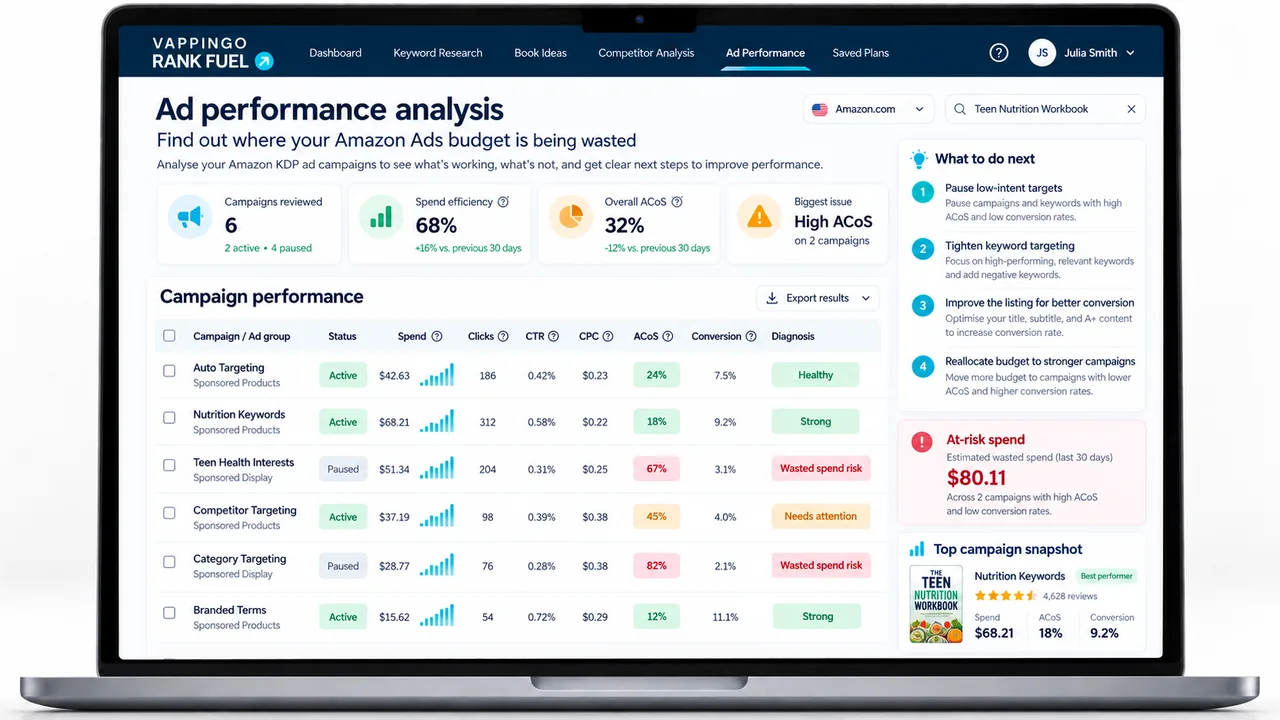
Which Rank Fuel Solutions Help With Amazon Ads ACoS and ROAS?
Use the ad tools for campaign decisions and the listing/ranking tools when the problem appears to sit outside the campaign itself.
| Solution | Use it when… |
|---|---|
| Amazon Ads Weekly Coach | You have campaign reports and need ranked recommendations on waste, bids, negatives, winners, budgets, and watch items. |
| Amazon Ads Generator | You are building campaigns and want the initial structure tied to the book price, royalty, advertising goal, and break-even point. |
| Listing Audit | The ads are receiving impressions or clicks but the product page may be the reason traffic is not becoming sales. |
| Keyword Rank Tracker | You want to keep organic Amazon.com search positions separate from paid campaign attribution. |
Frequently Asked Questions About Amazon Ads ACoS for KDP Authors
What does ACoS mean in Amazon Ads?
ACoS is ad spend divided by ad-attributed sales revenue, multiplied by 100. It is a campaign-efficiency metric, not an author-profit percentage.
What does ROAS mean?
ROAS is ad-attributed sales revenue divided by ad spend. It is the inverse expression of the same relationship measured by ACoS.
What is a good ACoS for KDP?
There is no universal good ACoS. Start with the royalty economics of the advertised book and decide what objective the campaign is supposed to achieve.
How long is Amazon Ads attribution for authors?
Amazon currently lists a 14-day Sponsored Products lookback window for authors, based on eligible clicks.
Does ACoS include later books in my series?
Do not assume it does. Amazon’s current attribution guidance says book products do not receive brand-halo attribution, so model later-book value separately through series read-through and catalog economics.
Does Amazon Ads ACoS include Kindle Unlimited page reads?
ACoS is based on ad-attributed sales revenue. KENP and KU royalties are reported separately through KDP and should be analyzed alongside, rather than folded automatically into, ACoS.
Is total royalties minus ad spend my profit?
No. It is royalties remaining after advertising before other publishing and business costs. Label it accordingly.
What Is the Best Way to Use ACoS as a KDP Author?
Use ACoS for the question it actually answers.
It tells you how much advertising spend Amazon recorded relative to the retail sales revenue it attributed to the campaign. Then bring in the royalty economics, KU data, series behavior, and wider publishing costs separately.
The goal is not to make ACoS explain the whole business. It is to know enough about the rest of the business to interpret ACoS correctly.