Amazon Ads for Series Books: Measure Reader Value Beyond Book One
Advertise a book series using book-one acquisition economics, read-through scenarios, Sponsored Products, Sponsored Brands, series pages, and careful downstream-value measurement.
For authors writing standalone books, every sale Amazon Ads generates is the end of the transaction. For series authors, every sale is potentially the beginning of one. A reader who buys book one and loves it will buy book two, three, and four without any further advertising spend. This fundamentally changes what a profitable ACoS looks like, and it fundamentally changes how you should structure campaigns across your catalog. Series advertising is the most powerful lever in independent publishing economics. The authors generating consistent six-figure incomes from KDP are almost exclusively series authors running intentional read-through advertising strategies. This guide covers the mechanics of that strategy.
How a Series Changes the Economics of Advertising
A series can support a higher acquisition cost than a standalone because one new reader may buy or borrow later books. Treat that as an expected-reader-value scenario, not “true ACoS,” because Amazon Ads cannot attribute every downstream series purchase to the first click. Estimate downstream value from observed read-through cohorts, then compare the scenario with total series revenue over time.
Calculating Read-Through Rate
Read-through rate is the percentage of readers who buy book one and go on to purchase the next book in the series. It is calculated per book-to-book transition: book one to book two has one read-through rate; book two to book three has another (typically higher, because readers who make it to book two are more committed). To calculate your series read-through rate from KDP sales data: pull your monthly sales by book over a 90-day period. Divide book two sales by book one sales. Divide book three sales by book two sales. And so on. These ratios give you the per-step read-through rates, from which you can calculate the full-series read-through (book one to final book) by multiplying the per-step rates together. A series with a 45% book 1→2 rate, 60% book 2→3 rate, and 70% book 3→4 rate has a full-series read-through of 18.9% (0.45 × 0.60 × 0.70). This calculation is imprecise because it does not account for time lag (readers who bought book one this month may buy book two next month) and it conflates ad-driven and organic sales. But as a directional benchmark for advertising economics, it is sufficient and significantly more useful than ignoring read-through entirely.
Modeling Series-Adjusted Reader Value
A series can support a higher acquisition cost than a standalone because one new reader may buy or borrow later books. Treat that as an expected-reader-value scenario, not “true ACoS,” because Amazon Ads cannot attribute every downstream series purchase to the first click. Estimate downstream value from observed read-through cohorts, then compare the scenario with total series revenue over time.
Which Book to Advertise Most Heavily
The general rule is: advertise book one most heavily if your series has strong read-through. Book one is the series entry point, every reader you acquire there becomes a candidate for books two through N. Advertising book three directly means paying for a reader who may never have read books one and two and therefore cannot appreciate what they are buying. The exception: if your series has poor read-through between books one and two specifically, advertising book one heavily is pouring readers into a leaky funnel. Before spending significantly on book one ads, understand why read-through is low (is book one weak? Does it not end satisfyingly? Is the genre hook unclear?) and fix the underlying issue. Advertising a poor series entry point is an expensive way to learn that the entry point needs work. For series with more than four books, many authors also run light campaigns on the most recent release to capture readers actively looking for new series entry points in the genre, some of these readers will be introduced to the full back catalog. But the primary advertising investment remains on book one.
Advertising Book One: Entry-Point Strategy
The campaign structure for series book one is the standard launch structure described in our, with one key addition: your target ACoS should be set using your read-through calculation, not your single-book royalty margin. Set campaigns that would conventionally look slightly aggressive, because the economics justify it when read-through is factored in. Keyword strategy for book one should include: direct genre keywords (“cozy mystery series books”), series comparison terms (“books like [comparable series]”), trope keywords specific to your series (“found family fantasy series,” “dragon rider academy series”), and competitor series ASINs in product targeting. The series-specific vocabulary, series name, key character names if searchable, world-building terms, is often underutilised by new series authors and can provide low-competition, high-relevance traffic for books with an established readership base.
Advertising Books Two and Beyond
Books two and beyond in a series typically need lighter ad support than book one because organic series sell-through carries a meaningful portion of their revenue. Readers who purchased book one and enjoyed it will naturally look for book two, Amazon’s also-bought algorithm, Kindle Unlimited new releases feed, and purchase history notifications all help. Your advertising for books two and three is therefore supplementary to organic read-through, rather than primary. The most effective ad strategy for mid-series books is product targeting: targeting book one’s own ASIN with ads for book two in Sponsored Products. Readers currently visiting your book-one page who have already bought it are natural book-two prospects. Similarly, targeting the pages of the most directly comparable series books in your genre drives readers who are between series and looking for a new one, intercepting them at the moment of high intent with your book two or three as an entry point.
Series-Wide Campaign Structure
Do not force a fixed portfolio percentage across the series. Book one often deserves more acquisition budget because it is the entry point, while a new release may deserve temporary support of its own. Allocate from the commercial role of each title, its conversion evidence, and the measured value of moving a reader deeper into the series.
Series-Specific Keywords
As a series accumulates readers and reviews, its name, character names, and world-specific vocabulary begin to be searchable on Amazon. Readers who heard about “The [Series Name] Series” from a recommendation will search for it directly. Adding your series name and key proper nouns from the world as exact match keywords in your book-one manual campaign captures this high-intent branded traffic at very low CPC, there is almost no competition for searches for your specific series name, making these among the most efficient keywords in your account. As series visibility grows, add author-specific branded terms too: “[Your Name] books,” “[Your Name] fantasy series,” “[Your Name] new release.” These branded terms are your most efficient ad spend because the searcher already knows and wants your work, you are simply making sure they find the right listing rather than a competitor’s look-alike.
Sponsored Brands for Series Promotion
Sponsored Brands is the natural home for series advertising once you have three titles. A banner showcasing books one, two, and three side by side, with a headline like “Start the complete [Series Name] series today,” tells the full series story at a glance and gives readers confidence that they are investing in a complete story arc rather than a book with an uncertain sequel. The landing page should be a Brand Store series page showing all titles in order, with synopses and read-order guidance. Target Sponsored Brands on your top-performing genre keywords, the same terms driving your book-one Sponsored Products campaigns. Having both a Sponsored Brands banner at the top of the search results page and Sponsored Products listings below it for the same genre search creates the maximum possible visibility footprint. Readers who are uncertain about book one individually may be more confident seeing three books in the series already published and available.
Series Retargeting Without Assuming Sponsored Display Access
A standard KDP author account should not rely on self-service Sponsored Display for series retargeting. Use Sponsored Products to acquire readers around relevant searches and comparable books, and Sponsored Brands to present several titles when eligible. The Amazon Series Page, book endings, Author Central, email, and release messaging do the explicit work of helping an existing reader find the next installment.
Advertising a Complete Series Differently
A standard KDP author account should not rely on self-service Sponsored Display for series retargeting. Use Sponsored Products to acquire readers around relevant searches and comparable books, and Sponsored Brands to present several titles when eligible. The Amazon Series Page, book endings, Author Central, email, and release messaging do the explicit work of helping an existing reader find the next installment.
Using Book Endings and Amazon Series Pages
Advertising drives readers to your book one. What happens at the end of book one determines whether they buy book two. Strong series sell-through is supported by: a compelling end-of-book reader magnet or series pitch (not just “read book two”, give a reason, a hook, a tease); a correctly configured Amazon Series Page (set up in KDP) that groups all books under one clickable series landing page; and a back-matter link to the next book on Amazon using the ASIN URL. These elements convert the readers advertising acquires into series completers, turning your ad spend into its maximum possible return.
KDP Select and Series Advertising
For series enrolled in KDP Select, advertising economics look somewhat different because page reads (KENP) generate additional revenue beyond the purchase price. A reader who borrows book one on Kindle Unlimited and reads it contributes KENP revenue. If they borrow books two through four and read those too, the total KU revenue across the series may equal or exceed what direct sales would have generated. When calculating your series advertising economics for a KU series, add estimated KENP revenue to your read-through calculation. The
Royalty Calculator includes KENP rate modeling to help you build this calculation accurately. With KU series, your tolerable break-even ACoS on book one may be even higher than the direct-sales model suggests, which often justifies more aggressive launch advertising for series starting their KU enrollment. A reader who is not buying but borrowing and reading deeply through your series is still generating the real-world revenue that makes the advertising worthwhile. Whatever your series structure, the foundation is a professionally executed manuscript in every book. Readers who find a typo-riddled book two will not buy book three. ensures every book in your series upholds the quality standard your readers expect, protecting your read-through rate and maximizing the return on every advertising pound spent on book one.
Measure Series Reader Value Without Pretending You Have Perfect Attribution
Build a simple cohort model. Estimate how many new book-one readers entered during a period, then observe how later-book sales or KU reading moved over the following weeks or months. Adjust for promotions, release timing, and existing audience where you can. The result will still be an estimate, but it is better than assigning every later sale to the original ad click.
Use a low, base, and high read-through scenario when setting acquisition limits. If the campaign is only viable under the high scenario, it is fragile. If it works under the base scenario and actual downstream performance keeps matching that assumption, you have stronger evidence that book one can tolerate a higher acquisition cost than a standalone title.
Turn the article into a repeatable Amazon Ads workflow
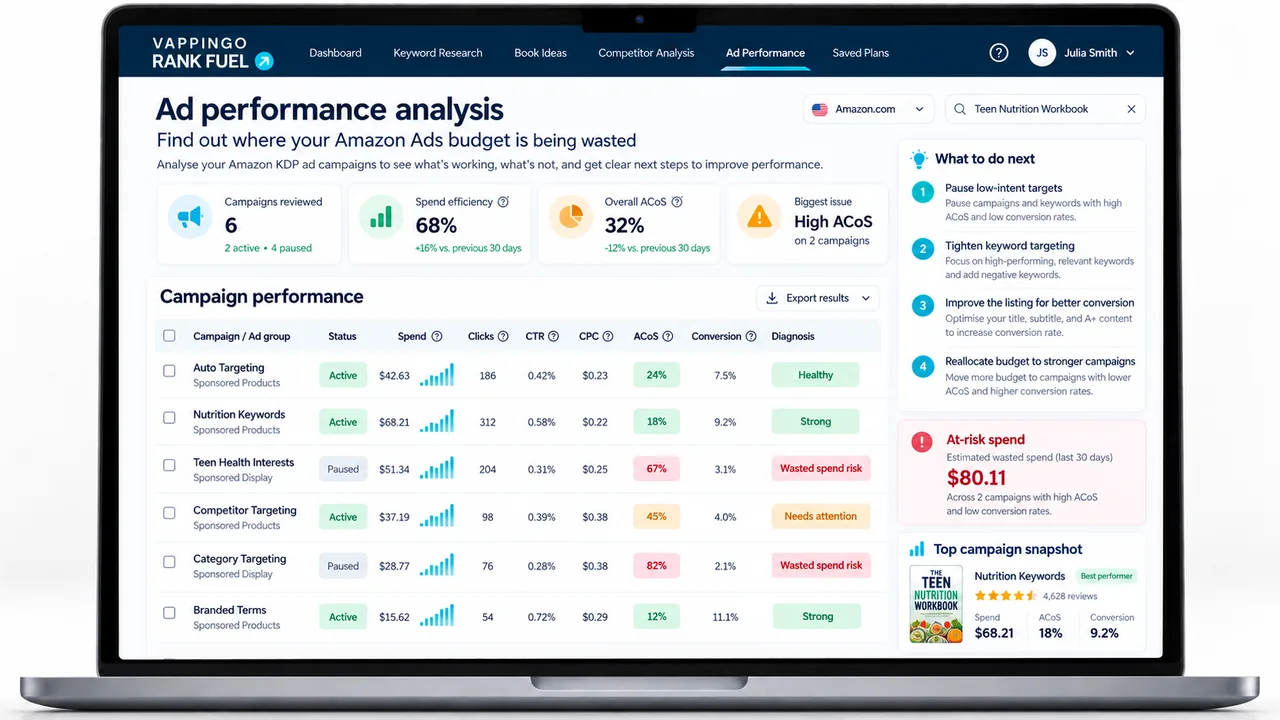
KDP Rank Fuel’s current Amazon Ads Generator builds a guided five-campaign Sponsored Products plan, while Amazon Ads Weekly Coach helps turn exported reports into clearer recurring decisions. Use the tools as decision support and keep the live Amazon Ads console as the authority on eligibility, settings, and final changes.
Frequently Asked Questions
Why can a series afford a different acquisition cost?
A new reader may produce royalties from later books, so book-one acquisition can be judged against expected downstream reader value as well as the first sale.
What is read-through?
Read-through is the share of readers who continue from one book to the next. Estimate it from cohort or period data rather than assuming every later sale came from an ad click.
Should I call downstream-adjusted ACoS “true ACoS”?
It is clearer to keep standard ACoS unchanged and calculate a separate expected reader-value or series-adjusted acquisition scenario.
Can I use Sponsored Display to retarget series readers?
Do not assume it is available in a standard KDP author account. Use Sponsored Products, eligible Sponsored Brands, Series Pages, back matter, and your owned audience to support continuation.
Which book should get the most ad budget?
Often book one has the strongest acquisition role, but allocate from actual conversion, read-through, release timing, and the commercial job of each title rather than a fixed percentage.
Buy Readers, Then Measure What They Become
Series advertising works when book-one acquisition and downstream reader value are measured as separate layers. Keep standard ad metrics intact, build a cautious read-through model beside them, and scale only when the wider series economics repeatedly support the assumption.