Amazon Ads Backlist Strategy: How to Advertise a Growing KDP Catalog
Build an Amazon Ads strategy across a growing KDP catalog without spreading budget too thin.
Most Amazon Ads advice assumes you are promoting one book. Once you have a backlist, the decision changes from “Which campaign should I run?” to “Which titles are worth using to acquire readers, which should be supported selectively, and which should rely mostly on organic or series traffic?”
Amazon’s current author guidance explicitly treats backlist growth and series promotion as valid uses for Sponsored Products and Sponsored Brands. That gives multi-title authors a useful toolkit, but it does not remove the need for disciplined budgeting and clean reporting.
Give Every Book an Advertising Job
Start by separating reader-entry books from continuation books and specialist titles. A first-in-series novel, a broad nonfiction handbook, or a proven standalone can justify acquisition spend because a new reader may continue into other books. A late-series title or narrow reference book may still deserve ads, but its role is usually different and its acceptable acquisition cost should reflect that.
Do not turn these labels into permanent tiers. Review them as the catalog changes. A new release can become the best entry point, an older title can lose conversion strength after its market changes, and a book that once needed ads may gain enough organic or series traffic to need less support.
Use Sponsored Products for Book-Level Discovery
Sponsored Products are available to authors and can appear in shopping results and on book detail pages. They are useful when you want to learn which searches, books, or categories can bring qualified shoppers to a specific title. Automatic targeting can help with discovery, while manual keyword and product targeting gives you more control once you have evidence.
For a large catalog, keep campaign naming and portfolios consistent enough that you can tell which book, objective, and targeting type produced the result. Duplicate targeting across many campaigns is not automatically a disaster, but it can make budgeting and diagnosis much harder because several campaigns may chase the same audience with different bids and rules.
Use Sponsored Brands When the Catalog Itself Is Part of the Pitch
Amazon says Sponsored Brands are available to authors with at least three eligible titles claimed under the same author name. That makes them especially useful for series authors and nonfiction publishers whose authority is strengthened by showing several related books together. The ad can present a collection rather than forcing the reader to encounter one isolated title.
Choose books that make sense together. Three unrelated books may satisfy the eligibility rule but create a weak reader proposition. A trilogy, a cluster of books for the same professional audience, or a clear progression from beginner to advanced content gives the format a stronger reason to exist.
Measure Reader Value Beyond One Attributed Sale
A first-book campaign can look expensive if you judge it only against the royalty on book one. For connected books, model downstream value separately: estimate how many acquired readers continue, what those later books earn, and how much uncertainty belongs in the estimate. This is a planning model, not Amazon attribution, so keep the assumptions visible.
If 100 new readers buy book one and 45 later buy book two, the expected value of those book-two royalties belongs in your catalog economics. It should not be reported as attributed ad revenue unless Amazon attributes it, but it can help you decide how much you are willing to spend to acquire a new series reader.
Allocate Budget by Evidence, Not Equality
Equal budget per title feels tidy and is usually inefficient. Give more room to books that convert reliably, open a valuable series, or support a strategic launch. Cap or pause titles that repeatedly spend without producing useful sales evidence, and avoid protecting an old campaign simply because it has been running for a long time.
A monthly catalog review is usually more useful than daily tinkering. Compare spend, attributed orders, search terms, and wider sales direction. If a title is structurally weak, fix the listing, price, sample, reviews, or positioning before solving the problem with more traffic.
Keep Branded and Discovery Traffic Legible
Author-name, series-name, and exact-title searches are different from cold genre discovery. Separate them enough that you can see whether ads are acquiring new readers or simply intercepting people who already intended to find you. That distinction matters when you decide whether a campaign is incremental or defensive.
You do not need to assume that duplicate branded targeting literally makes you bid against yourself in every auction. The practical problem is measurement: if the same term appears across many campaigns, it becomes harder to understand which budget and bid changes are producing the result.
Use Rank Fuel as a Workflow Aid, Not as Amazon’s Source of Truth
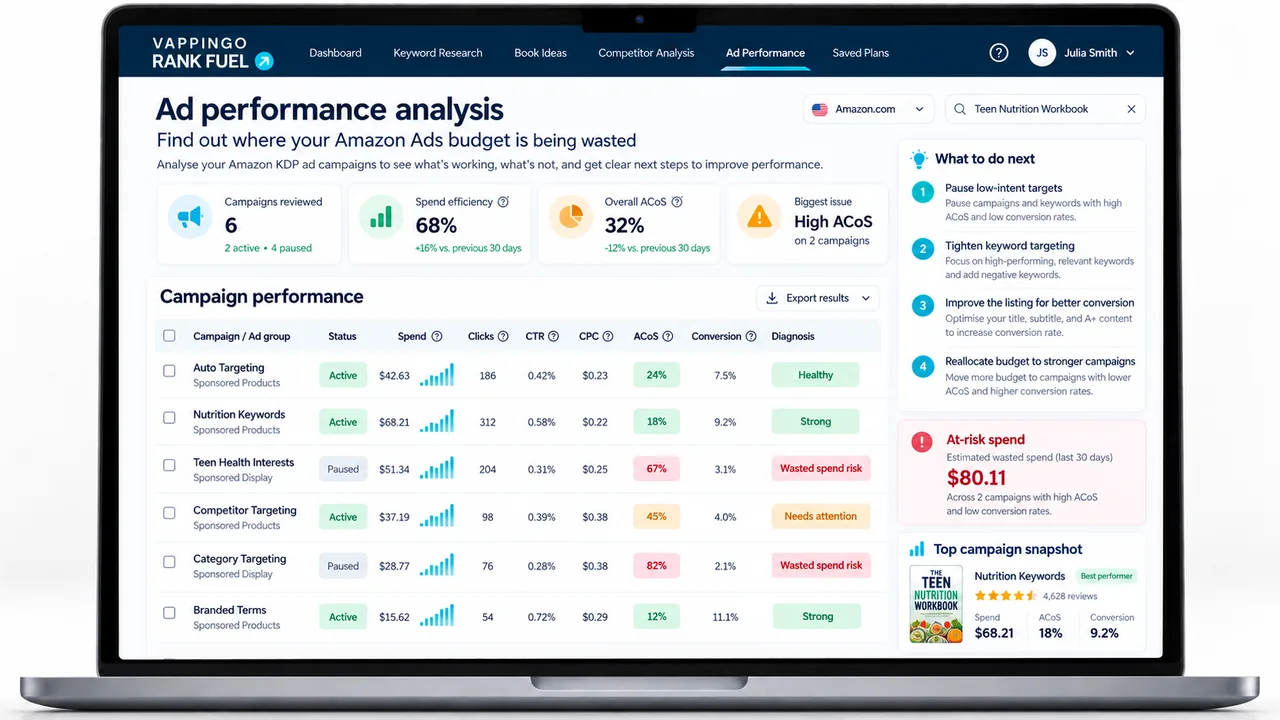
Rank Fuel’s current advertising workflow includes the Amazon Ads Generator for campaign planning and the Amazon Ads Weekly Coach for turning uploaded Search Term, Keyword, and Campaign reports into clearer weekly decisions. The tools are designed to organize evidence and next actions; they do not replace Amazon Ads reporting or guarantee profitability.
Turn ad reports into weekly decisions
Use Rank Fuel to organize campaign research and review what to scale, watch, or cut without exposing private implementation details.
Example: Allocate a Five-Book Catalog by Role
Imagine a five-book catalog containing a trilogy, one standalone novel, and a narrow nonfiction guide. The first trilogy book may deserve the largest discovery budget because a successful acquisition can create later-series value. The standalone can be judged mostly on its own attributed economics. Book two and book three may need defensive or branded support rather than broad cold acquisition, while the specialist guide can receive tightly controlled keyword or product targeting only where the search intent is precise.
This does not require a complicated spreadsheet. Give each title a role, a monthly spend ceiling, the metric that would justify continued spend, and a review date. When a title changes role, document why. The result is a catalog plan that can absorb new releases without automatically increasing total spend every time another book is published.
Frequently Asked Questions
Can authors use Sponsored Brands?
Yes, when they meet Amazon’s current author eligibility requirements. Amazon currently requires at least three unique eligible book titles under one pen name claimed in Author Central.
Should every book in my catalog have ads?
No. A catalog strategy is stronger when budget follows the job and economics of each title. Some books are reader-acquisition assets, some need tactical launch support, and some may not justify ongoing spend.
What should I review each week?
At minimum, review spend, clicks, attributed orders or sales, search terms, and obvious waste. For a larger catalog, also review results by book role or series rather than only campaign by campaign.
Does a profitable book-one campaign guarantee profitable series advertising?
No. Downstream value depends on real read-through, royalties, pricing, and reader behavior. Model it conservatively and update the assumptions with your own data.
Can Rank Fuel run my Amazon Ads account automatically?
Rank Fuel supports campaign planning and report analysis. Public copy should not imply that it directly controls Amazon Ads or guarantees bid, sales, or ranking outcomes.
Build the Catalog System Before You Scale the Spend
The advantage of a backlist is optionality: several books can attract readers, prove demand, and create downstream value. The risk is complexity. Give each title a job, keep discovery and branded activity legible, and increase spend only when the evidence says the wider catalog can earn it back.
If clicks are arriving but sales are not, diagnose the book before adding budget. A stronger listing and cleaner reader promise often create more leverage than another layer of campaigns.