

The Claim–Evidence–Reasoning model is a simple academic writing method that helps you build clear, logical, and convincing arguments. It asks you to make a clear point (the claim), support it with facts or examples (the evidence), and explain how that evidence proves your point (the reasoning). Using this structure can help you turn vague ideas into strong academic arguments that meet university marking criteria.
If you want to write essays that earn high marks, you need a reliable way to organize your ideas. This guide will show you exactly how to use the CER model in your own assignments.
What Is the Claim-Evidence-Reasoning Model?
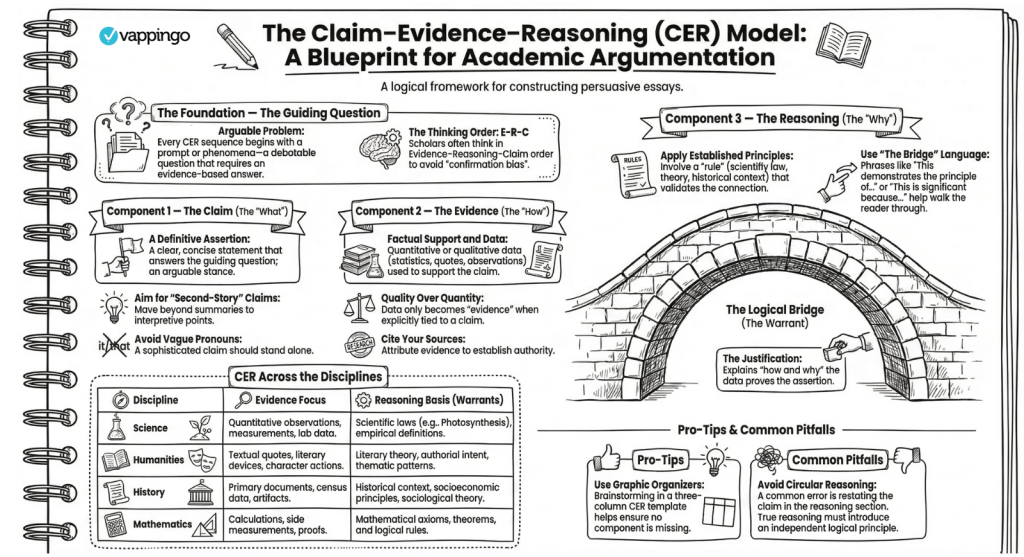
The Claim–Evidence–Reasoning (CER) model is a writing tool that helps students move from basic writing to stronger academic argument. It was developed as a simpler version of Stephen Toulmin’s ideas about logic and argument. The CER model focuses on the three most important parts of an argument.
At university, the CER model works like a support structure for your thinking. It helps you do more than just describe a topic. Instead, it pushes you to explain how and why you reached your view. Once you get used to this model, you can spend less time worrying about structure and more time thinking deeply about your subject.
How Do You Write a Strong Claim for a University Essay?
A claim is a clear statement that answers a question or addresses a problem. It is the main point of your essay and the idea that the rest of your writing tries to prove.
It is important to understand the difference between a fact and a claim. A fact simply gives information, such as saying that August is the hottest month of the year. A claim is an opinion or interpretation that can be debated. For example, saying that August is the best month to begin marathon training is a claim because other people may disagree.
Strong university writing often includes what teachers sometimes call “three-story claims.”
- First-story claims state basic facts or summaries.
- Second-story claims offer an interpretation that needs proof.
- Third-story claims explain why the argument matters in a wider social, historical, or cultural context.
If you need more help getting started, learning how to formulate a strong thesis statement is a great way to practise building stronger claims.
What Counts as Academic Evidence?
Evidence is the support for your argument. It includes the facts, data, observations, or quotations you use to prove your claim. In university writing, the strength of your claim depends heavily on the quality of your evidence.
Academic evidence should go beyond personal opinion or personal stories. Your opinion alone is not enough. Instead, your evidence should come from trusted research, statistics, or close analysis of texts.
You will usually work with two main types of evidence:
- Primary sources: These provide original, first-hand material, such as interview transcripts, historical objects, lab results, or works of art.
- Secondary sources: These are written by other researchers who analyse or discuss primary sources, such as journal articles or academic textbooks.
Understanding the difference between primary and secondary sources will help you choose the best support for your claims.
How Do You Write Effective Reasoning?
Reasoning is the part where you explain exactly how your evidence supports your claim. This is often the hardest part of academic writing. It is not enough to include a quote or statistic and then move on. You must explain why that evidence matters and how it proves your point.
You can think of reasoning as a bridge between your evidence and your claim. It helps your reader understand how you moved from the facts to your conclusion. In advanced writing, this often means using accepted theories, key concepts, or logical steps to explain your thinking.
In Toulmin’s model of argument, this link is called the “warrant.” A warrant is the belief or assumption that connects the evidence to the claim. If your reader does not accept that assumption, your argument may not be convincing, even if your evidence is strong.
For a deeper explanation of how this works in academic writing, you can explore the resources from the Purdue Online Writing Lab (OWL).
How Does the CER Model Compare to Other Essay Structures?
The CER model is especially useful for building clear body paragraphs, but it is not the only writing structure you will come across at university. Different assignments call for different approaches depending on your purpose, your audience, and the kind of argument you want to make.
Below is a comparison of several common argument models:
| Argument Model | Primary Purpose | Structural Components |
|---|---|---|
| CER Model | Clear explanation, analysis, and inquiry | Claim, Evidence, Reasoning |
| Classical | Direct persuasion and a firm position | Introduction, Narration, Confirmation, Refutation, Conclusion |
| Rogerian | Finding common ground on sensitive issues | Introduction, Opposing Views, Your Position, Common Ground |
| Toulmin | Breaking down complex or technical arguments | Claim, Grounds, Warrant, Backing, Qualifier, Rebuttal |
| PEEL | Creating clear and connected paragraphs | Point, Evidence, Explanation, Link |
Why Do Students Struggle with the CER Framework?
Even with a clear structure, academic writing is not easy. One common problem is circular reasoning. This happens when your reasoning simply repeats your claim in different words instead of actually explaining it. For example, saying “cats are the best pets because they have always been the best pets” adds no real explanation.
Another common issue is using absolute statements. If you write something like “every single person agrees with this policy,” your argument can be weakened very easily by one example that proves otherwise. It is usually better to use careful words such as “many,” “some,” or “likely” to make your argument more accurate and defensible.
Learning to spot and avoid logical fallacies is an important step in becoming a stronger writer.
These skills take time to develop. Many students find it hard to keep their evidence and reasoning separate, or to maintain a clear line of argument in longer essays. Professional editing can help. Vappingo can review your work to make sure your argument stays clear, your reasoning links back to your claims, and your academic voice remains natural. If you want extra support, consider using our professional academic proofreading service.
How to Apply CER Across Different Disciplines
One of the biggest strengths of the CER model is that it works across many university subjects. The structure stays the same, but the type of evidence and reasoning you use will change depending on the subject area.
- In the sciences: Your claim may be a hypothesis. Your evidence may include data, measurements, or lab results. Your reasoning explains the results using scientific laws or principles.
- In the humanities: Your claim may focus on themes, character motives, or an author’s purpose. Your evidence will often be quotations or paraphrased passages from texts. Your reasoning explains how the text supports your interpretation.
- In the social sciences: Your claim may suggest a cause for a social change or historical event. Your evidence may come from official records, surveys, census data, or historical documents. Your reasoning explains how the evidence connects to the event or trend.
Whatever subject you study, using strong academic transitions will help you connect your claim, evidence, and reasoning smoothly.
What Is an Example of the CER Model in Action?
To see how the CER model works in practice, look at the example below.
Question: Does switching to a four-day workweek improve company output?
Claim: A four-day workweek can significantly increase employee productivity.
Evidence: A recent study by the Global Business Institute found a 20 percent increase in weekly output among employees on a four-day schedule compared with those on a traditional five-day schedule.
Reasoning: This suggests that shorter working weeks can improve output because employees feel less tired and less burned out. With more time to rest, they may return to work with better focus and energy, which helps them complete tasks more efficiently.
Notice that the reasoning does not simply repeat the evidence. It explains why the increase may have happened and connects that explanation back to the claim. For more examples of how to build and test arguments, the Excelsior OWL is another useful resource.
Frequently Asked Questions (FAQ)
Is a claim the same as a thesis statement?
In a full essay, your main claim usually works as your thesis statement. However, you will also make smaller claims in your body paragraphs, often in the form of topic sentences, to support your main argument.
How long should my reasoning section be?
Your reasoning is often the longest part of the paragraph. Evidence gives the facts, but reasoning explains them. This is the part that does most of the work in your argument.
Do I need to include a counter-argument in the CER model?
The basic CER model does not require a counter-argument, but strong university writing often includes one. Recognising another point of view and responding to it can make your essay more balanced and persuasive.
