Book Description Mistakes That Drive Readers Away
Amazon limits a book description to 4,000 characters including supported HTML, and its current metadata rules prohibit reviews, quotes, testimonials, keyword/tag phrase lists and several…
Most book description problems fall into two categories: structural problems (covered in our article on why your description is killing your sales) and execution problems, the specific wording, phrase, and formatting choices that undermine an otherwise sound structure. This article focuses on the execution layer: the exact mistakes authors make at the sentence and word level, and precise fixes for each one. For the full description writing guide, see our complete book description guide.
1. Clichéd Opening Phrases
Certain opening constructions have been used so many times across Amazon’s catalog that they have lost all ability to create interest. Readers have been trained to skim past them. The most common offenders:
- “In a world where…”, the most overused opening in speculative fiction
- “What if everything you knew was a lie?”, so generic it could describe thousands of books
- “Follow [character] on a journey…”, the word “journey” is description poison
- “Meet [character name], a [profession]…”, bureaucratic, not compelling
- “When [character] discovers [thing], she must [action] before [deadline]…”, the formula is so exposed that readers see the template rather than the story
- “A page-turning thriller…”, every author thinks their thriller is page-turning; this says nothing
The fix: Lead with the specific, the concrete, the unexpected. “She came back for the funeral. She stayed for the murder.” is infinitely more powerful than “Meet Sarah, a former detective who returns to her hometown and discovers a dark secret.” Same information, completely different pull.
2. Passive Voice Throughout
Passive voice drains energy from descriptions. Every passive construction places the character in the position of being acted upon rather than acting, which is the opposite of the agency and drive that makes stories compelling.
Passive: “A secret is uncovered by the detective that could destroy the city.”
Active: “The detective uncovers a secret that could destroy the city.”
Passive: “The letter was found hidden beneath the floorboards.”
Active: “She found the letter hidden beneath the floorboards, and immediately wished she hadn’t.”
The fix: Read your description and circle every passive verb construction. Rewrite each one with the character as the grammatical subject performing the action. Your description will gain immediate energy.
3. Vague, Unspecific Language
Vague language is description poison. It creates the impression of meaning without delivering any. These phrases appear in thousands of descriptions and convey precisely nothing to a potential reader:
- “dark secrets”, every mystery has secrets; what specifically is yours?
- “nothing will ever be the same”, why? what changes? what specifically is at stake?
- “a gripping tale of love and loss”, this describes approximately 60% of all fiction
- “explores themes of identity and belonging”, academic language that kills commercial interest
- “everything she thought she knew”, about what? be specific
- “life-changing journey”, the word “journey” is doing no work here
The fix: For every vague phrase, ask “what specifically?” Replace the abstraction with the concrete detail. “A dark secret” becomes “a letter proving her grandmother was not who she claimed to be.” “Nothing will ever be the same” becomes “she will have to choose between the life she built and the truth she can’t unknow.” Specificity creates interest. Vagueness creates indifference.
4. Unintentional Spoilers
The purpose of a description is to create the desire to read the book, not to summarize it. Authors who are too close to their own story frequently include reveals, twists, or resolution details that should be discovered by the reader inside the book, not announced in the description.
Common spoiler categories in descriptions: revealing the identity of a villain or mystery figure; revealing a major character’s death or fate; summarising the book’s thematic conclusion (“she ultimately learns that family is more important than ambition”); and describing the ending emotional state (“they both realize their love was worth the sacrifice”).
The fix: Your description should end at the point of maximum tension, the moment where the stakes are clearest and the outcome is most uncertain. The reader should be thinking “I need to find out what happens,” not “I already know what happens.” If your description tells the reader how the story resolves, cut everything after the point where the conflict is established.
5. Tone Mismatch With the Book
Your description’s tone is a promise about the reading experience. A cozy mystery description written in a dark, urgent thriller voice will attract thriller readers who will be disappointed and leave negative reviews. A romance description written in dry, clinical language will drive away romance readers who expect warmth and emotional energy.
This mistake is particularly common when authors use a description template from a different genre, or when they write the description before fully understanding the emotional register of their own book.
The fix: Read the first chapter of your book. Pay attention to the vocabulary, sentence rhythm, emotional temperature, and pace. Your description should feel like it came from the same world as that first chapter. Then read the top-selling descriptions in your specific subcategory and identify the tonal patterns. Your description should sit comfortably within those patterns while maintaining your book’s specific voice.
6. Stuffing Review Quotes Into the Description Field
This is no longer simply a conversion judgment. KDP’s current description rules explicitly prohibit reviews, quotes and testimonials in the book description. That means a string of praise from reviewers, bloggers or other authors can create a metadata-compliance problem as well as crowding out the copy that should sell the book itself.
The fix: keep the description focused on the reader, premise, promise, stakes and fit. Use Amazon features that are designed for editorial or promotional material where available, but do not paste review quotes into the KDP description field.
7. Forced Keyword Insertion
KDP’s description rules also prohibit keyword or book-tag phrase lists. More importantly, even natural-looking keyword stuffing usually makes the copy worse. Readers need persuasive, fluent language, while discoverability work belongs primarily in the seven dedicated keyword fields, title/subtitle where genuinely descriptive, and accurate category selection.
The fix: write the description for a human buyer. If an important search phrase fits naturally, it can appear because it accurately describes the book, but never distort a sentence to force a phrase into the copy. Use KDP Rank Fuel to research keywords separately from the reader-facing description.
8. Missing Series Information for Series Books
If your book is part of a series, your description needs to communicate three things clearly: the series name, the book’s position in the series, and whether the book can be read as a standalone. Readers who encounter a series book and cannot quickly determine whether to start from book one will frequently abandon the page rather than investigate further.
The most common version of this mistake: writing a description that reads as if the book is a standalone, with no mention of the series. This confuses readers who have already read book one and are looking for book two; it also misses the opportunity to direct new readers to book one of what might be a long and profitable series.
The fix: Include the series name and book number clearly in your description, either in an opening line (“Book 3 in the [Series Name] series, can be read as a standalone”) or in the call to action (“Start the complete [Series Name] series today”). For the full guide, see our article on how to write book descriptions for a series.
9. Never Updating the Description
A book description written at launch is not necessarily the best description your book could have. As you accumulate reviews, reader feedback, and sales data, you learn what resonates with your actual audience, information you did not have when you launched. Authors who never revisit their descriptions miss the opportunity to compound their initial conversion rate improvement over time.
Reasons to revisit and update your description: your book has gained significant reviews whose language reveals how readers actually describe it (often more compellingly than the author’s own framing); you have identified a comp title that did not exist at launch; your book’s rankings suggest a different category is performing better; or your description has never been tested against an alternative version.
The fix: Schedule a description review every six months. Read your most enthusiastic reviews. Extract the specific language readers use to recommend the book to other readers, that language often makes better description copy than what the author wrote. For how to test systematically, see our article on how to A/B test your Amazon book description.
Mistake Elimination Checklist
- No clichéd opening phrase (“In a world where…”, “Meet [name]…”, “Join [name] on a journey…”)
- No passive voice constructions, every sentence has an active subject
- Every vague phrase replaced with a specific concrete detail
- No unintentional spoilers, description ends at maximum tension, not resolution
- Tone precisely matches the book’s emotional register and genre conventions
- Endorsement quotes moved to Editorial Reviews, not in description field
- Keywords present naturally, not forced or keyword-stuffed
- Series information clearly stated (if applicable)
- Description reviewed and updated since launch based on reader feedback
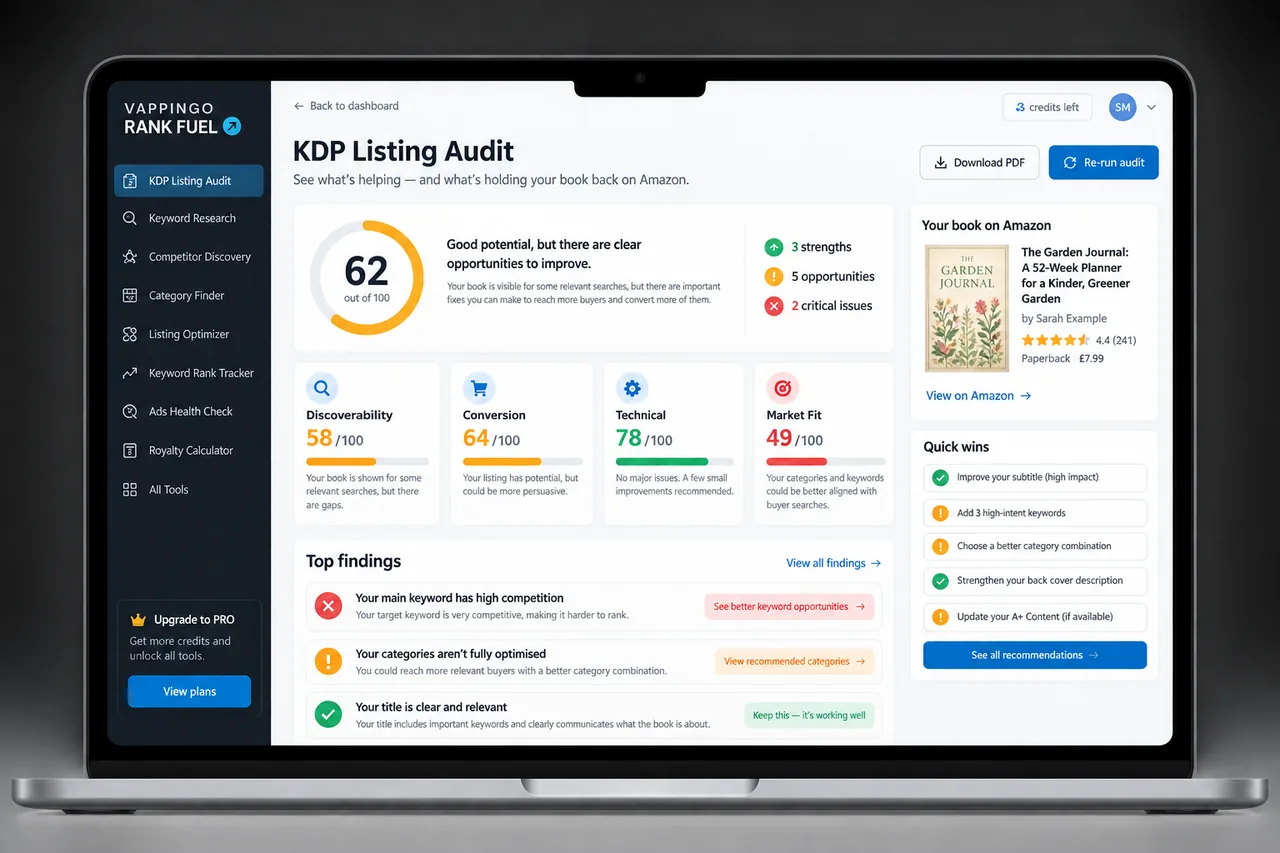
Working through this list on an existing description is time well invested. If you are writing a new version, KDP Rank Fuel can create and then audit listing copy around the book’s actual positioning and research, giving you a stronger baseline to edit rather than starting from a generic template.
Before the description brings readers to the product page, the manuscript also needs to deliver on the promise the listing makes. Vappingo’s book proofreading service catches errors before they become part of the reader experience.
Continue Reading · Book Descriptions
Current KDP Rules to Recheck
Amazon changes KDP pricing, metadata and distribution rules, so this guide has been checked against current KDP Help rather than relying on older self-publishing conventions. The most useful official references for the topics covered here are:
- eBook royalty options and list-price requirements
- print royalty and printing-cost calculations
- book details, keywords and categories
- book description and formatting rules
Where a decision affects a live book, check the help page again before publishing. Marketplace thresholds and eligibility details are more important than memorizing an old rule from a blog post.
Frequently Asked Questions
Do KDP rules change often enough to recheck before publishing?
Yes. Royalty thresholds, file rules, metadata guidance and feature eligibility do change. Use current KDP Help for the final decision, especially when pricing or changing metadata on a live book.
Should I optimize for Amazon or for readers first?
Both matter, but they do different jobs. Metadata helps the right shoppers discover and understand the book, while reader-facing copy has to make a credible case for the click and purchase. Do not damage clarity by forcing keywords into persuasive copy.
How should I decide what to change first on an underperforming book?
Start with evidence. Check whether the book is being found for relevant searches, whether the cover and title earn the click, whether the description communicates value, and whether price and reviews create a competitive offer. KDP Rank Fuel is designed to connect those research and listing decisions rather than treating them as unrelated tools.
Can I change metadata after publication?
Many fields can be updated, but some book details are restricted after publication and changes can take time to appear. Make deliberate changes, keep a record of what changed and avoid judging the result before the update has propagated.
When should I get professional editorial help?
If the manuscript, description or publishing copy is difficult to assess objectively, a qualified editor can identify clarity, structure and language problems before marketing spend amplifies them. Vappingo offers book editing and professional proofreading for authors who want a human editorial review.