Why Your Book Description Is Killing Your Sales
A strong description makes the right reader understand the promise of the book quickly, without stuffing the field with material Amazon does not allow.
Mistake 1: Writing a Synopsis Instead of a Pitch
This is by far the most common mistake. A synopsis tells what happens: characters, plot points, twists, resolution. A pitch makes the reader want to experience the story for themselves. The distinction sounds simple but is genuinely difficult to internalise for authors who have spent months or years inside their own book.
The symptom: your description reads like a book report. “When Sarah discovers a mysterious letter in her grandmother’s attic, she is led on a journey across three continents to uncover a family secret that will change her life forever.” This tells us what the book is about. It does not make us want to read it.
The fix: ask yourself, for every sentence in your description, “does this make the reader want to read on, or does it just inform them?” Information belongs in a synopsis. Emotional pull belongs in a description. Cut the information. Amplify the pull.
Mistake 2: A Weak or Absent Hook
Amazon shows only the first 100-150 characters of your description above the “Read more” fold on mobile and in some search views. If those characters are not immediately compelling, a large proportion of potential buyers will never read the rest of your description.
Weak openings that lose readers:
- Starting with your character’s name and backstory: “Emma Hartley has always been the responsible one in her family…”
- Starting with setting description: “In the rolling hills of the Cotswolds, where the stone cottages…”
- Starting with praise: “A gripping debut from an exciting new voice…”
- Starting with a question that answers itself: “Have you ever wondered what would happen if…?”
For genre-specific opening ideas, use our book description hook formulas.
Mistake 3: Missing Stakes
Stakes are what make readers care. Stakes are the answer to the question: what happens if your protagonist fails, or what does the reader miss if they don’t buy this book? Without stakes, there is no urgency, no reason to read on, no emotional investment.
The most common version of this mistake in fiction: describing the situation without establishing what’s at risk. “Detective Marsh investigates a series of connected murders in a small coastal town.” There is no stake here. Compare: “Detective Marsh has 48 hours before the killer moves on; and this time, the next victim has her daughter’s name.” Now there is something to lose.
In nonfiction, the stake is the cost of not solving the problem. “Most small business owners discover the flaw in their pricing model too late; after three years of working for below minimum wage.” That is a stake. It creates urgency to read the book that contains the fix.
Mistake 4: The Unformatted Wall of Text
For the full nonfiction treatment, see our guide to writing nonfiction book descriptions.
Mistake 5: Too Much About the Author
Author biographical information belongs in the “About the Author” section of your book’s back matter and on your Author Central page. It does not belong in your product description; except as a single sentence of credibility establishment in nonfiction, when it is directly relevant to the book’s subject matter.
A description that spends two sentences on the author’s background before getting to the book has used its most precious real estate to answer a question the reader has not yet asked. They are still deciding whether to buy the book. They do not yet care about your writing credentials. Tell them why the book is worth their time first. If that lands, they will seek out your biography afterwards.
Mistake 6: Wrong Genre Signals
Every genre has a set of tonal, structural, and linguistic conventions that readers recognize unconsciously. A romance description that reads like a thriller description; urgent, dark, threat-forward; will confuse romance readers even if the book itself is a romance. A cozy mystery that uses literary fiction language will lose the cozy reader in the first paragraph.
Study the descriptions of the top ten bestsellers in your specific subcategory before writing your own. Not to copy them, but to understand the tonal vocabulary your target readers expect. For genre-specific guidance, see our articles on and .
Mistake 7: No Call to Action
Readers who have read your description and are on the verge of purchasing need a gentle final push. Descriptions that simply stop; ending on a plot question or a thematic statement; leave potential buyers hovering. A direct, brief call to action (“Scroll up to start reading today”) removes the hesitation and creates a clear next step.
The call to action does not need to be elaborate. One sentence is enough. Its job is to be the final signal that the experience the description has promised is available right now, with a single click.
Diagnosing Your Own Description
If you suspect your description is hurting your sales, work through this checklist: Use the points that follow as a practical checklist rather than a rigid formula. Read it again in the context of the whole product page and make sure the next sentence gives the shopper something concrete to understand, feel, or evaluate.
- Does your first sentence create immediate curiosity or tension?
- Does your description avoid telling the reader what they’ll experience (show, don’t tell)?
- Have you established clear stakes; what’s at risk if the protagonist fails?
- Is your description formatted with paragraphs and visual breathing room?
- Does the tone match your genre conventions precisely?
- Have you ended with a clear call to action?
- Is there no more than one sentence about the author?
If any of these answers is no, that is where to start your revision. A like KDP Rank Fuel can give you a well-structured baseline to work from; particularly useful if you are struggling to apply the techniques in this article to your own book.
Once your description is bringing readers to your book’s purchase page, what they find inside needs to reward their decision. A from Vappingo ensures your content is as compelling as the description that promised it.
Current KDP description rules to check before publishing
Amazon currently limits the Description field to 4,000 characters, including any HTML tags you add in Source view. Its own writing guidance emphasizes three qualities: keep the description simple, make the opening compelling, and publish professional copy that has been proofread carefully. Amazon also recommends keeping the main explanation easy to scan rather than overwhelming a shopper with every plot point or feature.
The restrictions matter just as much as the copywriting. KDP says descriptions cannot contain phone numbers, postal or email addresses, website URLs, customer-review requests, reviews, quotes or testimonials, promotional or time-sensitive material, pricing or alternative-ordering information, Unicode emoji, spoilers, or keyword/book-tag phrases. Treat those as publishing constraints, then make the permitted copy do the selling work through clarity, stakes, reader fit, benefits, and voice.
Use this page as part of a complete description workflow
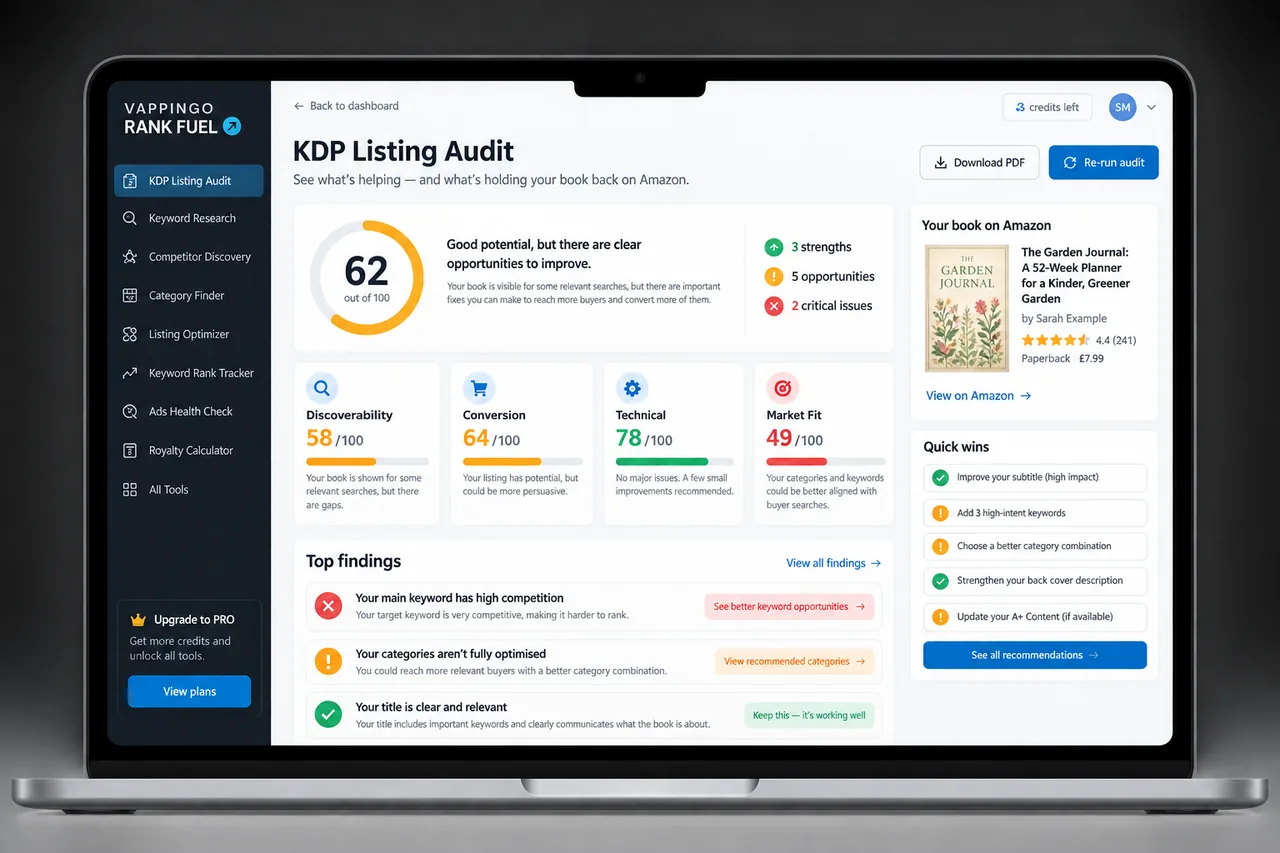
Writing the description is easier when each page has one job. Start with the complete Amazon book description guide for the overall structure, then use the specialist guides for genre, hooks, formatting, series copy, length, or diagnosis. If a live listing is underperforming, compare the description with the broader KDP Listing Audit process so you do not rewrite copy when the real bottleneck is the cover, positioning, keywords, or price.
For authors who want a more structured listing workflow, Rank Fuel’s current Listing Generator helps create a complete Amazon listing, while Listing Audit identifies the areas most likely to need attention. Treat those tools as drafting and diagnosis aids, then apply human judgment to the final promise, tone, and accuracy.