Amazon Ads Keyword Match Types for Books: Broad, Phrase, Exact, and Negative
Use broad, phrase, exact, negative phrase, and negative exact match types in Amazon book ads without confusing discovery with control.
Keyword match types are one of the most misunderstood elements of Amazon Ads for authors, and one of the most consequential. Choose too narrow a match type and you miss readers who would have clicked. Choose too broad and you pay for clicks from readers who will never buy your book. The right approach is not to pick one match type and apply it universally, but to use each type strategically for distinct purposes in a well-structured campaign.
Why Match Types Matter
When you add a keyword to a manual Amazon Ads campaign, you are not just telling Amazon what topic to match your ad to, you are telling it how precisely the reader’s search must match that topic before your ad can appear. This precision setting has a direct effect on three things: the volume of impressions your ad receives, the relevance of the searches that trigger it, and therefore the conversion rate and ACoS you achieve. A keyword like “mystery” set to broad match can trigger your ad for hundreds of loosely related searches, some of which are exactly the right audience, many of which are not. The same keyword set to exact match triggers your ad only for “mystery” and close variations like “mysteries”, high relevance, low volume. Most keywords belong somewhere between these extremes, at the phrase match level that combines meaningful volume with reasonable relevance. Understanding match types also changes how you interpret your Search Term Report. When you see a search term in that report, the match type column tells you which keyword triggered it, which reveals whether your match type choices are exposing you to useful adjacent searches (phrase match working as intended) or completely irrelevant noise (broad match generating off-target spend).
Exact Match: Precision Targeting
Exact match is the most restrictive positive match type. Amazon says the search is matched word for word in the same order, while close variations such as plurals can still match; current match-type documentation also notes that matching can account for misspellings and translations. Use exact when you want the greatest control over a query that has earned focused investment.
Amazon says Sponsored Products delivery depends on the bid and the relevance of the ad to the shopper’s query or context. It does not publish an author-facing “quality score” formula that lets you calculate a hidden multiplier. Treat listing quality as a conversion and relevance issue: a professional, clearly positioned detail page can make paid traffic more valuable, but do not claim that a review count or conversion rate feeds a documented numeric quality score.
Phrase Match: The Practical Workhorse
Phrase match shows your ad when a reader’s search contains your keyword in the same word order, with additional words allowed before or after. It captures the natural language variations in how readers phrase their searches without opening up to the full range of related searches that broad match allows. Keyword:
(phrase match) Matches: “best cozy mystery british 2026,” “new cozy mystery british author,” “cozy mystery british village series,” “top cozy mystery british books to read,” “short cozy mystery british” Does NOT match: “british cozy mystery” (word order changed), “mystery british cozy books” (order broken), “british mystery cozy village” (order wrong) Phrase match is the most versatile match type for book advertising. It respects the core phrase structure your readers use, “cozy mystery British” in that order, capturing the intent of someone specifically looking for that type of book, while allowing enough variation to capture the full range of how readers actually phrase that search. It generates meaningful impressions volume without the noise floor of broad match. Use phrase match for: your primary genre and subgenre terms, core trope vocabulary your book’s audience uses, series-type phrases (“cozy mystery series to binge”), and setting-specific terms (“mystery set in Cornwall,” “Victorian detective fiction”). In most campaigns, phrase match keywords should form the backbone of your manual targeting, more volume than exact, far more controlled than broad. Word order matters more than many authors realise. “British cozy mystery” and “cozy mystery British” are different phrase match keywords with potentially different search volumes and audiences. Test both if your genre uses the terms in either order. Readers searching “British cozy mystery” may be a slightly different audience (potentially more British-based, more geographically specific in intent) than those searching “cozy mystery British.”
Broad Match: Discovery With Risk
Broad match gives Amazon the most freedom. The shopper query can contain the keyword terms in any order and may include variations, synonyms, and related concepts based on meaning and product context. That makes broad useful for discovery, but it also means the Search term report matters because the keyword itself may not appear in every matched query.
(broad match) Matches may include: “cozy mystery books,” “cozy mystery series,” “light mystery fiction,” “amateur sleuth books,” “mystery without violence,” “feel-good mystery,” “mystery books no swearing,” “detective fiction cozy,” and many other related searches, some excellent, some irrelevant. May also match: searches Amazon considers semantically related that have nothing to do with your book’s actual content. Broad match’s value is discovery, it surfaces audience segments and vocabulary that your more controlled keyword lists might miss entirely. A broad match keyword might match “mystery books for book clubs” in a way that reveals a high-converting audience segment you then promote to phrase and exact match. Without any broad match keywords, your targeting can develop blind spots around peripheral but real reader segments. Broad match’s cost is noise. Every match that is not a real reader for your book is a click you pay for with zero chance of conversion. Broad match without active, weekly negative keyword management from the Search Term Report is one of the most reliable ways to drain an advertising budget with nothing to show for it. If you use broad match, you must run the Search Term Report every two weeks without exception and add non-converting terms to negatives. Use broad match for: a small proportion of your keyword list when you want to explore whether adjacent audience segments respond, as a discovery supplement to your automatic campaign rather than a replacement, and only with full commitment to fortnightly Search Term Report negative keyword work.
Negative Match Types
Negative keywords use the same exact and phrase match logic, but in reverse, they block your ad from appearing for those searches rather than triggering it.
blocks only searches that precisely match the negative term. Negative exact “free mystery books” blocks searches for “free mystery books” but not “mystery books free download” or “free cozy mystery ebooks.” More surgical, prevents blocking related searches you might want to keep.
Negative phrase blocks queries containing the complete phrase or close variations; Amazon currently limits a negative phrase to four words and 80 characters. Negative exact blocks the exact query or close variation and currently allows up to 10 words and 80 characters. Use negatives to remove clear mismatch without accidentally shutting down useful discovery. for the complete strategy.
Match Types Side by Side
For the keyword “cozy mystery series” across the three match types, here is how the triggering logic differs in practice:
Triggers for “cozy mystery series,” “cozy mystery series UK,” “cozy mysteries series.” Does not trigger for “new cozy mystery series” or “best cozy mystery series to read.”
Triggers for “best cozy mystery series,” “new cozy mystery series 2026,” “long cozy mystery series to binge,” “cozy mystery series with recipes,” “cozy mystery series completed.” Does not trigger for “series cozy mystery” (order broken) or “cozy series mystery books” (order broken).
Triggers for all of the above plus potentially “mystery series books,” “cozy mystery books,” “amateur detective series,” “feel-good fiction series,” and other variations Amazon considers related, including some that may be substantially off-genre for your specific book.
Which Match Types to Use and When
Use match type according to the job of the keyword, not the age of the campaign. Exact is useful when you want tight control around a known query or close variation. Phrase keeps the ordered phrase together while allowing additional language around it. Broad gives Amazon the most freedom and can include variations, synonyms, and related terms, making it useful for discovery when the budget can tolerate more uncertainty.
A launch can use all three if each has a reason to exist. A highly specific nonfiction query may be sensible in exact from day one. A genre phrase may belong in phrase to discover modifiers. A small number of broad terms can explore related language. You do not need to wait for a “first harvest cycle” before exact match becomes legitimate.
As reports accumulate, keep the match type that produces useful traffic. A broad target that repeatedly discovers valuable queries deserves discovery budget. A phrase target that converts well does not need to be promoted out of phrase. Match types are permissions, not stages in a mandatory funnel.
Structuring Campaigns by Match Type
You can separate match types into different campaigns or ad groups when doing so improves bid control and reporting. Separation is especially useful when the same core keyword behaves very differently in broad, phrase, and exact or when one match type needs a different budget. It is not mandatory simply to keep data “clean.”
Amazon reports target and search-term performance at levels that let you investigate what is happening inside a campaign. A compact structure can therefore be easier to manage than three duplicate campaigns if the budgets and objectives are similar. Use more structure only when it solves a real control problem. Name the campaigns and ad groups so the match type and job are obvious, and keep the Search term report as the place where you inspect the actual shopper language created by broad and phrase freedom.
Bidding Differences by Match Type
Do not set a universal rule that exact must be 20% or 30% higher than phrase, or phrase higher than broad. Match type changes the freedom of the match, not the value of every click. A broad keyword that consistently finds profitable long-tail searches can deserve a higher bid than an exact term that attracts expensive low-converting traffic.
Use a cautious opening bid informed by Amazon’s suggested range and the book’s reader economics, then replace the match-type assumption with target-level evidence. Compare CPC, search terms, conversion, attributed outcomes, and spend. If broad is noisy, lower its bid or narrow it with negatives. If exact is profitable but constrained, test more bid or budget.
Hypothetical ACoS examples are useful for learning, but the action depends on the target ACoS for that book. An exact term at 80% ACoS can be excellent for one high-value series and unacceptable for a low-royalty standalone. Precision does not create a universal profitability threshold.
Match Type Examples for Fiction Authors
For a contemporary romance novel with workplace rivals-to-lovers tropes set in London: “enemies to lovers romance,” “workplace romance london,” “rivals to lovers contemporary romance,” “forced proximity office romance”
“enemies to lovers,” “workplace romance,” “contemporary romance series,” “london romance novel,” “forced proximity romance,” “slow burn romance” “romance novel,” “contemporary romance”, these are high-volume but high-noise; monitor weekly for irrelevant search patterns and add negatives aggressively
Match Type Examples for Nonfiction Authors
For a personal finance guide targeted at millennials paying off student debt: “student debt payoff guide,” “personal finance millennials book,” “how to pay off student loans fast book” “student loan repayment,” “personal finance beginners,” “money management millennials,” “how to pay off debt,” “financial independence guide”
“personal finance,” “debt free”, broad terms that might surface related but non-obvious reader segments; require aggressive negative keyword management to avoid “debt free community,” “debt free apps,” and similar irrelevant searches
The Match Type Mistakes That Cost Money
Using broad without reading the search terms. Broad can be an effective discovery tool, but the freedom it receives means you need to inspect what traffic it actually creates. Add precise negatives for persistent mismatch rather than assuming broad is inherently wasteful.
Forcing every successful phrase into exact. Exact can give tighter control, but phrase may continue to uncover profitable modifiers. You can target the exact query directly while leaving phrase active when both have a useful job.
Duplicating targets without a reason. The same keyword can exist in several match types, but every duplicate should have a purpose, such as different discovery freedom or bidding. If the structure makes decisions harder, simplify it.
Using match type as a substitute for economics. Exact does not guarantee conversion, and broad does not guarantee poor ACoS. Let actual shopper queries and target-level performance determine the bid and budget.
A Match-Type Test You Can Actually Read
Take one highly relevant phrase and run it in broad, phrase, and exact under a structure that lets you see each match type separately. Keep the experiment long enough to produce meaningful search-term evidence. Broad may uncover adjacent language you would never have typed; phrase may preserve the core idea while allowing useful modifiers; exact may concentrate spend on a proven query.
The result is not “exact wins.” The result is a map of what each level of freedom buys. If broad repeatedly finds profitable new language, it deserves discovery budget. If phrase catches strong long-tail queries, keep it. If exact concentrates efficient volume, scale it within the book’s economics. Match type is a traffic-shaping tool, not a ladder that every keyword must climb.
Turn the article into a repeatable Amazon Ads workflow
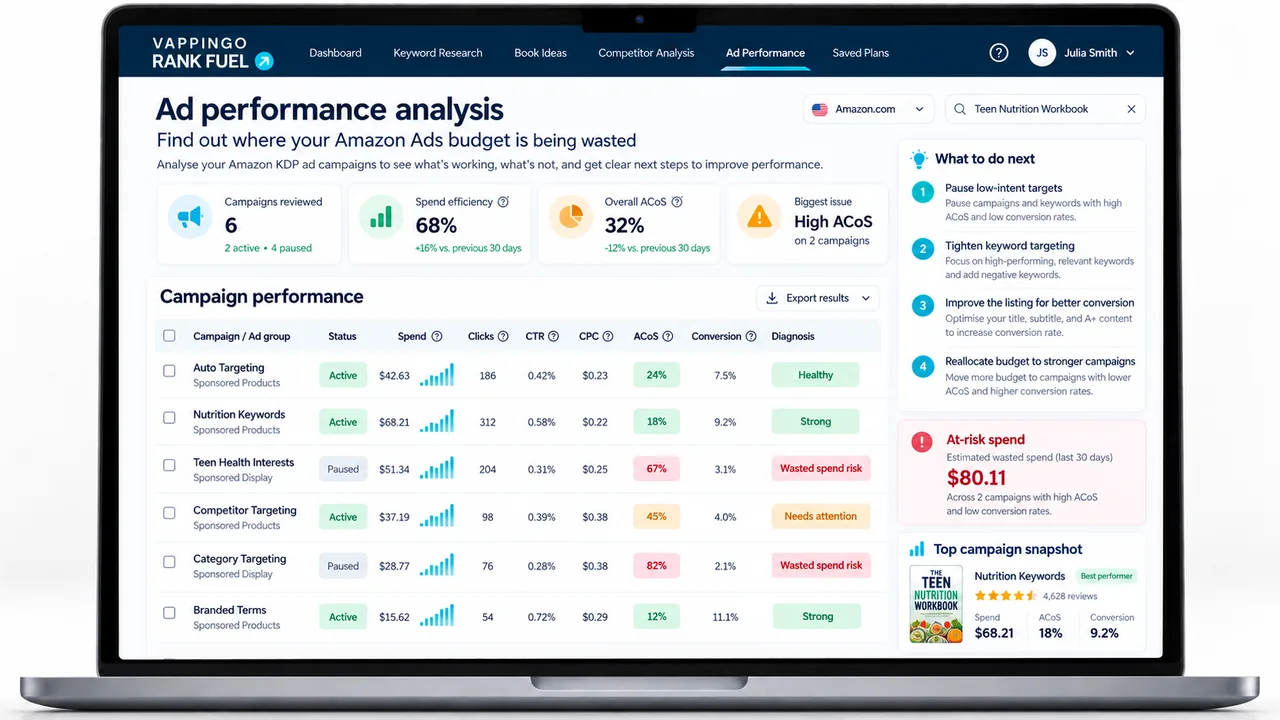
KDP Rank Fuel’s current Amazon Ads Generator builds a guided five-campaign Sponsored Products plan, while Amazon Ads Weekly Coach helps turn exported reports into clearer recurring decisions. Use the tools as decision support and keep the live Amazon Ads console as the authority on eligibility, settings, and final changes.
Frequently Asked Questions
What are the three positive keyword match types?
Broad, phrase, and exact. Broad gives Amazon the most freedom; phrase keeps the ordered phrase together; exact is the most restrictive.
Can broad match use synonyms?
Yes. Amazon says broad match can include variations, synonyms, and related terms based on meaning and product context.
Does exact match include plurals?
Yes. Exact remains restrictive, but close variations such as plurals can match.
What negative match types are available?
Negative phrase and negative exact. They block different degrees of query variation and should be used carefully.
Should I bid the same on all match types?
Not automatically. Bid from the traffic quality and economics each target produces rather than from a universal hierarchy.
Use Match Types to Shape Traffic
Broad, phrase, and exact are different permissions you give Amazon. Combine them intentionally, inspect the shopper queries they produce, and let each match type keep the job it proves it can do well.