Amazon Ads for KDP: A Current Guide to Sponsored Products
Sponsored Products can buy relevant visits to your Amazon book page, but the listing still has to convert. Build targeting, bids, and weekly review around that reality.
Have you ever opened Amazon Ads after a few days, seen the campaign collecting clicks, and still had no clear idea whether you should increase the budget, lower the bids, or leave everything alone? That uncertainty is common because the advertising console gives you plenty of numbers before it gives you much confidence about what those numbers mean for a book.
It is tempting to solve that uncertainty by copying somebody else’s campaign structure: run an automatic campaign, add a few broad keywords, create an exact campaign for the terms that look promising, and keep raising bids until the impressions appear. Sometimes that produces useful data. It can also produce a surprisingly expensive collection of clicks if the searches are poorly matched or the product page is not ready to convert them.
Amazon Ads works better when it is treated as part of the book’s buying path rather than as a separate marketing activity. The targeting decides which shoppers may see the ad, the bid and budget decide how often you can compete for those opportunities, and the listing decides what happens after the click. The royalty economics then determine whether the sale was worth acquiring at that cost.
This guide explains how to use Amazon Ads for KDP authors in that order. We will look at Sponsored Products, automatic and manual targeting, keyword match types, product targeting, bids, budgets, negatives, campaign structure, and the reports that tell you what to change next, without turning one popular campaign recipe into a rule every book has to follow.
Are Amazon Ads Worth Using for KDP Books?
They can be, but only when you know what problem the campaign is supposed to solve. Amazon Ads for KDP authors are most useful when the book already has a credible product page and you want to place it in front of more relevant shoppers, learn which searches attract interest, or support a launch or established backlist title.
The important point is that Sponsored Products do not repair a weak listing. The ad can win the click; the cover, title, subtitle, reviews, price, sample, and description still have to persuade the shopper that this is the book they should buy.
How Do Sponsored Products Work for Books?
Sponsored Products are cost-per-click ads. Amazon can show them in relevant shopping results and on book detail pages, and the shopper is sent to the advertised book’s detail page when they click.
You choose the book or books to advertise, set a budget, and decide how Amazon should match the ads to potential readers. Amazon’s current author guide describes Sponsored Products as the recommended starting point for authors who are new to sponsored advertising.
A click means the ad created enough interest for a shopper to visit the product page. It does not tell you that the search was profitable, that the shopper was the right reader, or that the listing converted well once they arrived.
What Do You Need Before You Can Advertise a Book on Amazon?
Amazon’s current author guidance says the book must be available in the country where you are advertising and listed in Author Central. You then register for Amazon Ads in the marketplace you want to use and create the campaign from the advertising console.
That marketplace detail matters. A campaign built for Amazon.com is competing in a different store from a campaign built for Amazon.co.uk, so keep book availability, pricing, targeting, and reporting tied to the store you are actually advertising in.
Can Authors Advertise Audiobooks With Amazon Ads?
Yes, in the United States for eligible titles. Amazon announced on August 28, 2026 that authors, including ACX creators, can advertise eligible audiobook ASINs through Sponsored Products and Sponsored Brands in the US.
Amazon says the pen name must first be claimed in Author Central. It also says authors can include audiobook, digital, and print formats in campaigns and can see cross-format sales in reporting when a shopper clicks one format and buys another.
Should a KDP Author Start With Automatic Targeting?
Automatic targeting can be useful when the main goal is discovery. Amazon uses information about the book to decide which shopping queries and products may be relevant, which gives the campaign a chance to surface searches you did not think to target manually.
That makes automatic targeting a research tool as well as an advertising tool. The important part comes later: review the search-term and targeting evidence rather than leaving the campaign to run indefinitely simply because Amazon is doing the matching.
When Should You Use Manual Targeting for KDP Ads?
Manual targeting gives you more control because you choose the keywords, books, or product categories the campaign should compete around.
It becomes particularly useful once you have evidence from keyword research, competitor research, or an automatic campaign. Instead of asking Amazon to explore broadly, you can deliberately test the searches and books that appear most relevant to the reader you want.
What Do Broad, Phrase, and Exact Match Mean in Amazon Ads?
For manual keyword targeting, Amazon currently offers three match types: broad, phrase, and exact.
| Match type | What it does | Best use |
|---|---|---|
| Broad | Allows the widest set of related shopping queries and close variations | Discovery and finding useful search language |
| Phrase | Keeps the keyword words together in order while allowing extra words around them | More control without closing the search down completely |
| Exact | Targets the keyword closely, including very close variations | Searches where you already have stronger evidence of value |
The mistake is to turn those purposes into a rigid formula. Broad is not automatically wasteful and exact is not automatically profitable. The search still has to fit the book and the economics still have to work.
What Is Product Targeting in Amazon Book Ads?
Product targeting lets you compete around specific books, categories, brands, or related product features rather than relying on shopper keywords alone.
For a KDP author, the obvious use is comparable-book targeting. If a shopper is viewing a book that serves a very similar reader, your title may be a reasonable alternative or next choice. The comparison needs to be genuine; targeting a popular bestseller simply because it has traffic is not the same as targeting a book whose buyers are plausible buyers for yours.
How Should KDP Authors Use Negative Targeting?
Negative targeting prevents the ad from continuing to compete around search terms, keywords, or products that do not fit the campaign.
It is most useful when the campaign data shows a repeated mismatch. For example, a broad keyword may generate a shopping query for a different age group, format, or subgenre. Excluding that query can stop the campaign from repeatedly paying for the same irrelevant traffic.
Do not use negatives too aggressively at the start. A search term with one click and no sale is not automatically waste. The evidence needs to be strong enough to justify closing that route.
How Do Amazon Ads Bids Work for KDP Books?
Amazon Ads is auction-based. Your bid is the amount you are willing to pay for a click, while relevance also affects whether the ad is eligible to win the placement.
Amazon currently offers fixed bids, dynamic bids down only, and dynamic bids up and down. Those strategies affect how Amazon adjusts the bid in different auctions, so the starting bid is not always the final amount used to compete.
A higher bid can increase the chance of delivery. It cannot make an irrelevant target valuable or persuade a shopper to buy once they reach a weak listing.
How Much Should a KDP Author Budget for Amazon Ads?
There is no universal starting budget that fits every book. The sensible budget depends on the royalty available from a sale, the cost of clicks in the market, how much data you can afford to gather, and what the campaign is trying to achieve.
Amazon’s daily budget is averaged across the month rather than behaving as an identical hard daily spend every single day. That is another reason to judge the campaign over a useful reporting period rather than reacting to one busy or quiet day.
Why Should You Calculate Break-Even ACoS Before Launching KDP Ads?
Because Amazon Ads reports sales revenue, while the author keeps only the royalty. A campaign can therefore have an ACoS that looks attractive in the Ads console while still costing more than the immediate royalty generated by the sales.
Your break-even point depends on the price and royalty economics of the advertised formats. For a series or Kindle Unlimited title, you may deliberately tolerate a higher immediate acquisition cost because later-book or KU value matters, but that should be modeled separately rather than assumed.
For the full calculation, see Amazon Ads ACoS for KDP Authors.
Should You Run Amazon Ads Before the KDP Listing Is Ready?
Usually not. Paid traffic magnifies whatever is already happening on the product page.
If the cover does not communicate the genre, the title and subtitle leave the buyer uncertain, the description is weak, the price is difficult to justify, or the sample undermines the promise, more clicks simply expose more shoppers to the same conversion problem.
- confirm the cover works at Amazon thumbnail size
- make sure the title and subtitle communicate the offer quickly
- check that the description confirms the promise rather than merely summarizing contents
- compare price and format with close alternatives
- inspect Read Sample or Look Inside where available
- check the live listing for obvious technical and keyword problems
What Is a Sensible Starting Campaign Structure for KDP Authors?
A useful starting structure separates discovery from targets you already have evidence for.
That may mean an automatic campaign to discover searches and product relationships, a manual keyword campaign for deliberate search terms, and product targeting for close competing books. As the campaign produces data, useful search terms can move into tighter targeting while repeated waste can be excluded.
The exact number of campaigns matters less than whether you can explain what each one is testing. Complexity should follow evidence rather than arrive on day one.
How Often Should You Review Amazon Ads for a KDP Book?
Give a new campaign enough time to produce evidence before you start changing it repeatedly. Amazon’s current author guide suggests waiting about two weeks after launch before making more advanced bid adjustments, then checking performance on a continuing cadence.
Rank Fuel’s Weekly Coach uses a weekly review rhythm because it is designed to turn uploaded reports into a regular action plan. That does not mean every keyword needs a change every seven days. Some targets should be acted on, some should be watched, and some need more data.
Which Amazon Ads Reports Matter Most for KDP Authors?
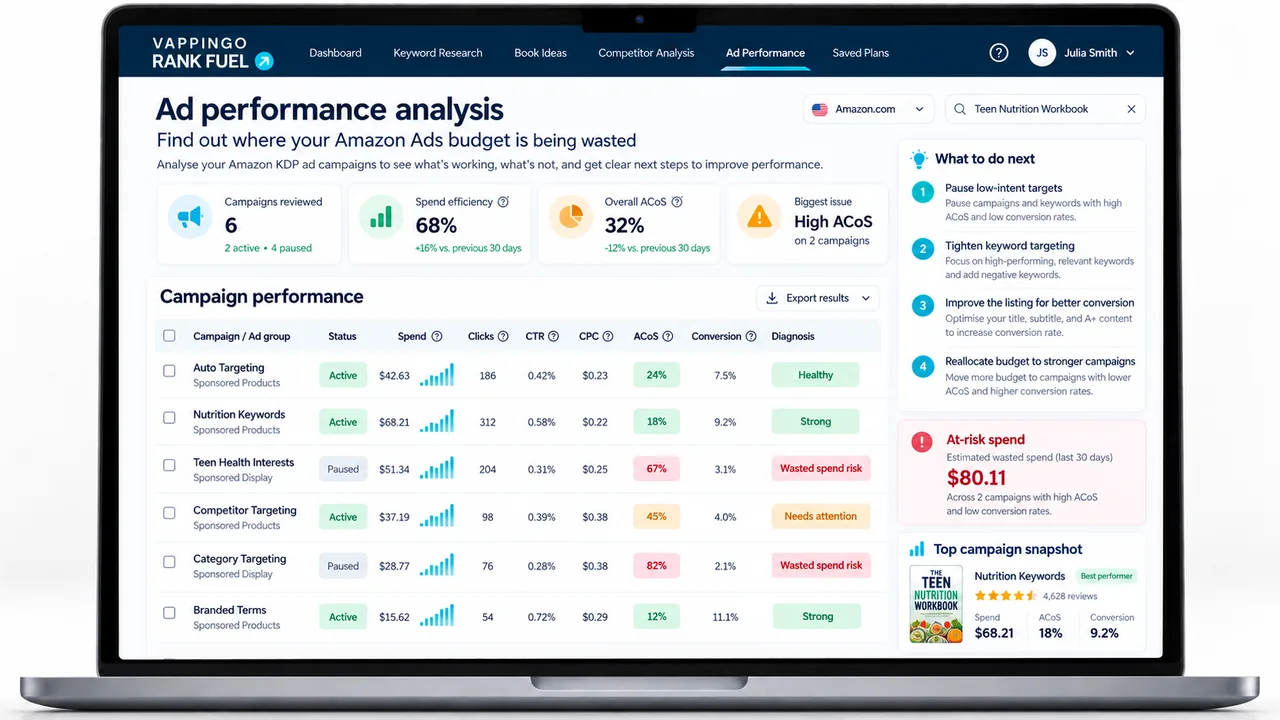
The Search Term report is particularly useful because it shows the shopper searches that actually triggered your ads. Campaign and Targeting reports add the broader budget, bid, and target-level picture.
Together, those reports help answer different questions: where money is being spent, which searches are attracting clicks, which targets convert, which campaigns may be constrained by budget, and where the data is still too thin to justify a decision.
When Should You Pause an Amazon Ads Keyword?
Pause or reduce a target when the evidence shows that continued spend is no longer justified by the likely value of the traffic.
A universal rule such as “10 clicks with no sale means pause” ignores the book’s royalty, click cost, expected conversion rate, series value, and the amount of data needed in that market. A high-priced specialist book can tolerate a different acquisition pattern from a low-priced paperback or book-one series entry.
Use the book’s economics and the actual search-term evidence rather than a borrowed click threshold.
When Should You Increase a KDP Ads Bid or Budget?
Increase spend when you have evidence that the target deserves more opportunities and the campaign is actually constrained.
A converting keyword with a sensible acquisition cost may justify a higher bid if delivery is weak. A profitable campaign may justify more budget if it regularly runs out before the useful demand is exhausted. Neither change makes sense simply because the dashboard contains a green number.
What Should a KDP Amazon Ads Review Look Like?
Start with the question you are trying to answer rather than the metric you happen to notice first.
Delivery
Are the campaigns receiving enough relevant impressions and clicks to generate useful evidence?
Target quality
Which search terms and product targets genuinely fit the book?
Economics
How does spend compare with attributed sales, royalties, and the campaign objective?
Next action
What deserves a bid change, negative, promotion, budget increase, pause, or simply more time?
Then record the changes you make. Without a change history, it becomes surprisingly difficult to remember whether the next result came from a new bid, a new negative, a listing change, a price change, or something outside the campaign entirely.
Should KDP Authors Use Sponsored Products or Sponsored Brands First?
For most authors starting with Amazon Ads, Sponsored Products is the simpler first step. Amazon recommends Sponsored Products for beginners and currently makes Sponsored Brands available to authors with three or more eligible titles under the same author name.
Sponsored Brands can be useful when the objective is broader author or catalog visibility rather than one book alone. But adding another ad product does not fix a Sponsored Products campaign whose targeting, listing, or economics have not yet been understood.
Which Rank Fuel Solutions Help With Amazon Ads for KDP Authors?
Use the tool that matches the stage of the advertising decision.
| Solution | Use it when… |
|---|---|
| Amazon Ads Generator | You have the book details, keywords, and competitor ASINs and want a structured campaign portfolio with break-even economics built in. |
| Amazon Ads Weekly Coach | You have live campaign reports and need ranked weekly actions around bids, negatives, budgets, winners, and watch items. |
| Book Keyword Spy | You want to investigate the Amazon search territory around competing books before paying to target it. |
| Keyword Research | You need buyer-search ideas and market evidence before turning a phrase into a paid target. |
| Listing Audit | The ads are getting visibility or clicks but the live product page may be the reason traffic is not becoming sales. |
Frequently Asked Questions About Amazon Ads for KDP Authors
How much do Amazon book ads cost?
Sponsored Products use a cost-per-click auction model. You choose bids and a daily budget, and the actual cost depends on the auctions your ads enter.
Should a new KDP author use automatic targeting?
Automatic targeting can be useful for discovery because Amazon decides which queries and products may fit the book. Review the resulting data rather than leaving it to run without a clear learning objective.
Which Amazon Ads keyword match type should I use?
Broad is useful for discovery, phrase adds more control, and exact is useful when a specific query has stronger evidence behind it. Many campaigns use different match types for different jobs.
When should I pause an Amazon Ads keyword?
Pause or reduce it when the amount being spent is no longer justified by the value of the traffic and the evidence is strong enough to act. Avoid universal click-count rules.
Can Amazon Ads fix a weak KDP listing?
No. Sponsored Products can deliver relevant shoppers to the book’s detail page, but the listing still has to persuade them to buy.
Can KDP authors advertise audiobooks?
In the US, Amazon announced on August 28, 2026 that eligible authors, including ACX creators, can advertise audiobook ASINs with Sponsored Products and Sponsored Brands.
How often should I change Amazon Ads bids?
Do not change them simply because a few new clicks appeared. Amazon’s current author guide suggests giving new campaigns around two weeks before moving into more advanced bid optimization, then reviewing performance regularly.
What Is the Best Way to Start Amazon Ads for a KDP Book?
Start with the book, not the campaign.
Make sure the listing gives the right reader a clear reason to buy, calculate what a sale is worth to you, and identify searches or competing books that genuinely fit. Then use Sponsored Products to test those assumptions with a budget you can afford to learn from.
The objective is not to create more campaigns. It is to build a repeatable route from relevant shopper to profitable reader.