KDP Keyword Research: Validate Demand and Competition Before You Publish
Use Rank Fuel Keyword Research to explore buyer searches, compare demand and competition, and decide which book or keyword opportunities deserve deeper work.
The single most expensive mistake in KDP publishing is not a bad cover or a weak listing or a failed launch. It is writing a book for a niche that was never going to reward the effort.
It is expensive because it costs months: the time to research, write, edit, format, and publish: before you find out that the niche has no search volume, or has so much competition that a new title cannot gain traction without a marketing budget you do not have, or has demand but for a specific format or reader experience your book does not deliver. By the time the evidence is in, the cost has already been paid.
The Keyword Research is built to surface that evidence before you start writing. Not by replacing the creative judgement required to develop a book worth reading, but by giving you the market intelligence to know whether the niche you are considering is one you can win in: and if not, to find a better one in the same general space before you commit.
Why Search Volume and Competition Are Not Enough
Most KDP research tools evaluate niches on two dimensions: search volume and competition. High volume, low competition: good opportunity. Low volume, high competition: bad opportunity. Simple, clean, and consistently wrong in ways that cost publishers months of wasted effort.
Here is why. Search volume tells you how many people are searching for a term. It does not tell you whether those people are buyers. A search term with ten thousand monthly searches from readers browsing for free content is a worse commercial opportunity than a term with two thousand monthly searches from readers actively looking to purchase. The volume number is the same either way.
Competition metrics tell you how many books are ranking for a term and how established they are. They do not tell you whether the competition is beatable: whether the top books have weaknesses in their listings, gaps in what they deliver, or audience segments they are not serving that a well-positioned new book could claim.
The Keyword Research was built around a more useful question: not how big is this niche and how crowded is it, but can I write a book that wins a meaningful slice of it? That question requires five inputs, not two.
How to Read the Research Signals
Rank Fuel combines multiple research signals into comparative assessments so you can decide which ideas deserve deeper investigation. Those assessments are proprietary decision aids, not published Amazon ranking factors, and the public article should not expose internal scoring mechanics.
Use the visible evidence at a practical level: Is there estimated buyer demand? Are the results genuinely relevant to the book you plan to create? How strong are the books already competing for the search? Is there a credible way to offer a better or more specific reader proposition? The score should start a decision, not end it.
Every keyword the Keyword Research analyses receives a score out of ten across five dimensions. The composite research assessment is a weighted average of all five. Here is what each one measures and why it matters.
The composite research assessment weighs these five dimensions and ranks keyword opportunities from highest to lowest. A keyword that scores highly across all five is a niche where you can write a book, build a listing, and reach page one within a realistic timeframe with a realistic investment. A keyword that scores low on Buyer Intent regardless of its other scores is a niche where rankings will not translate into sales. The scores do not make the decision for you: but they make the decision significantly more informed.
Finding Weakness, Not Emptiness
The most important shift in thinking the Keyword Research encourages is this: you are not looking for niches with no competition. You are looking for niches where the existing competition is weak in ways you can exploit.
An empty niche is usually empty for a reason. No competition can mean no demand, an audience that does not buy on Amazon, or a topic so specific that the total addressable market is too small to generate meaningful royalties. Pursuing an empty niche because it is empty is as risky as avoiding a competitive one because it is competitive.
What you are actually looking for is a niche where the existing top books have high review counts alongside recurring complaints: the same criticisms appearing in review after review about what the book fails to deliver. That pattern is the most reliable commercial signal in KDP publishing. It tells you that the audience exists and is buying, that the current options are imperfect enough that readers notice and say so, and that there is a specific gap you can position your book to fill. The Differentiation Potential dimension of the research assessment is designed to surface exactly this pattern.
Finding the niche is only the beginning
Every niche has quality expectations set by the books already selling in it. Readers who consistently buy in a well-established niche know what good looks like: and a new book that does not meet that standard generates the reviews that end rankings before they have time to build. Vappingo’s professional manuscript proofreading service has worked across every KDP genre and nonfiction category: ensuring the book you publish in your chosen niche is one that earns its place there from the first review.
How to Use the Keyword Research in Practice
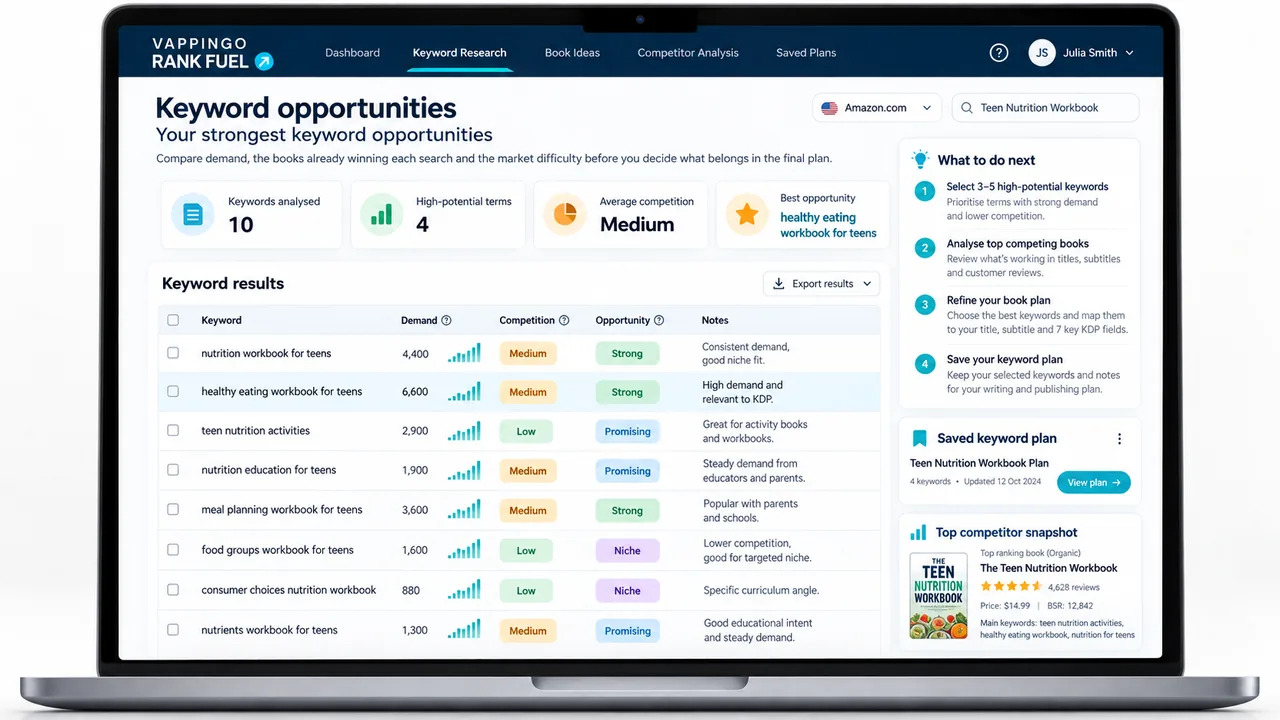
Start with a broad topic rather than a specific keyword. If you are thinking about writing a book on productivity, enter “productivity” as your seed topic. The Navigator analyses hundreds of keyword variations derived from that seed: every related search term, sub-niche, and audience-specific variation it can find in Amazon’s search data: and scores each one across the five dimensions.
The output is a ranked list of opportunities. Sort by research assessment and look at the top ten. Then look at the individual dimension scores for each, not just the composite. A keyword that scores 7 overall but scores 3 on Buyer Intent is a different type of opportunity from one that scores 7 overall with 8 on Buyer Intent: the first will rank more easily, the second will convert more reliably once it ranks.
For each high-scoring keyword, use the Keyword Research to validate what you see. The Navigator tells you the opportunity looks strong from a search intent and competitive structure perspective. The Keyword Research shows you the actual books ranking for that term: their BSR, their review counts, their pricing: so you can confirm that the opportunity is as navigable as the score suggests before committing to it.
When you have identified a keyword you want to build a book around, click the Generate Full Listing button on that keyword’s result. The keyword and the research context are passed directly to the
, pre-filled and ready to use. You do not need to transfer the data manually: the workflow moves from research to listing in a single action.
How the Keyword Research Differs From Publisher Rocket
Publisher Rocket is the most widely used KDP research tool and the most direct comparison for the Keyword Research’s functionality. The difference is worth being explicit about because they are doing related but meaningfully different things.
Publisher Rocket shows you search volume and competition for any keyword you enter. It is excellent at answering the question “how many people search for this term and how hard is it to rank for?” It does not evaluate whether the term will convert to sales, whether the format expectation is a match for your planned book, or whether the existing competition has weaknesses that make the niche more navigable than the raw competition number suggests.
The Keyword Research starts with a broader topic and surfaces keyword opportunities you did not know to look for, then evaluates each one across five dimensions rather than two. The two tools are complementary rather than interchangeable: serious publishers who use Publisher Rocket for volume and competition data alongside the Keyword Research’s comparative research workflow get a more complete picture than either tool provides alone. For a detailed comparison of the available options, the article on
the best KDP keyword research tools in 2026
covers the main alternatives side by side, and
provides useful independent context on KDP keyword methodology more broadly.
What to Do After the Navigator
The Keyword Research produces a keyword opportunity. What you do with it determines whether that opportunity becomes a book that earns consistently.
The next step for most publishers is the Keyword Research: verifying the specific books ranking for your chosen keyword, understanding their weaknesses from their review data, and confirming that the daily sales needed to reach the top ten are achievable given your planned launch approach. From there, Book Keyword Spy maps the full keyword landscape around the top-ranking books so you understand which adjacent terms your listing should also target. The Keyword Research also connects directly to the
for publishers who want to deepen their understanding of how keyword selection affects ranking: and to the
Publisher Rocket alternative guide
for publishers evaluating which research tools best fit their workflow. The Navigator is available on all tiers including the free tier. Three credits on signup is enough to run a full niche analysis on one topic. Sign up at
: no payment details required to get started.
Who the Keyword Research Is Not For
Publishers who have already written the book. The Navigator is a pre-writing research tool. If your manuscript is complete, the relevant question is no longer “which niche should I write for?” but “which keywords does my existing book have the best chance of ranking for?” For that question, Book Keyword Spy and the Keyword Gap Finder are the more appropriate starting points.
Publishers looking for a tool that will tell them what to write. The Navigator will tell you which opportunities are stronger than others given the current state of Amazon’s search landscape. It will not tell you what book to write or whether you are the right person to write it. That judgement remains yours: and according to
Jane Friedman’s analysis of successful self-publishing
, the publishers who sustain long-term income from Amazon are consistently those who combine genuine subject knowledge or storytelling craft with commercial awareness, not those who replace one with the other. The Keyword Research is the commercial awareness half of that equation.
Publishers who want to validate a niche they have already committed to emotionally. The Navigator will show you the data honestly. If the research assessment is low, that is the data’s verdict, not a suggestion. Publishers who run the tool hoping for confirmation of a decision already made tend to interpret low scores as a tool limitation rather than a signal. The tool works best when you arrive open to following the data rather than hoping the data follows your plan. For the full picture of how the Keyword Research fits within the KDP Rank Fuel suite, see the
.
Frequently Asked Questions
Is this still a separate niche-research tool?
The older route has been consolidated into the current Keyword Research workspace. Saved or legacy routes may still redirect, but public guidance should use the current name.
What should I look at besides search volume?
Use search demand alongside relevance, the books already competing for the query, their strength, and whether the intended book genuinely matches what buyers appear to want.
Does Rank Fuel’s Opportunity Score reveal an Amazon ranking factor?
No. Rank Fuel scores and assessments are proprietary research aids. They summarize evidence for decision-making and should not be described as Amazon ranking factors.
Can keyword research tell me whether a book will sell?
It can reduce guesswork by showing market evidence, but it cannot guarantee demand, conversion, reviews, or profitability for a future book.
What should I do after finding a promising search?
Validate the competitive set, inspect relevant books, develop a clear reader promise, and carry the strongest evidence into the listing and category decisions.
What to Do Next
Once a search looks promising, study the books already earning visibility for it rather than making the publication decision from one metric.
Move from a keyword to a competitive picture
Once a search looks promising, study the books already earning visibility for it rather than making the publication decision from one metric.