Amazon Ads for Nonfiction Books: Problem-Driven Keywords and Higher-Stakes Conversion
Build Amazon Ads for nonfiction around problems, audiences, outcomes, comparable books, listing clarity, and book-specific break-even economics.
Nonfiction Amazon Ads work differently from fiction ads in almost every structural way: the keyword vocabulary is more predictable and problem-focused, the reader is searching for a specific outcome rather than an emotional experience, price points are often higher, and the conversion stakes are different because nonfiction readers are making a more considered purchase decision. These differences require a distinct approach to campaign structure, keyword selection, and listing optimization.
Nonfiction Advertising Is Different
Nonfiction shoppers often arrive with a more explicit problem, skill, audience, or outcome in mind than fiction shoppers. That can make search language easier to map, but the purchase may also involve stronger scrutiny of authority, specificity, reviews, sample quality, and whether the book appears capable of solving the stated problem.
Do not assume a higher nonfiction price automatically creates more bidding room. A qualifying ebook can earn 70% only within KDP’s current marketplace price band, and a higher price can lower conversion. Use the actual KDP royalty estimate and observed conversion to decide what a click can be worth.
Problem-Solution Keyword Architecture
The foundation of nonfiction keyword strategy is the problem-solution framework. Nonfiction readers describe their need in one of three ways: the problem they want to solve (“how to stop procrastinating,” “losing weight after 50,” “managing business finances”), the skill they want to acquire (“public speaking skills,” “learning Python programming,” “home renovation basics”), or the transformation they want to achieve (“career change guide,” “productivity system,” “mindfulness for anxiety”). Your primary keyword list should cover all three framings of the same core need.
A book on personal finance might target: “how to get out of debt” (problem), “personal finance for beginners” (skill), and “financial independence guide” (transformation). The searches are different but the reader is the same, someone who needs financial help. Any one of these framings might have significantly different search volume and CPC; building a keyword list that covers all three framings ensures you reach the full audience regardless of how they describe their need.
Audience-Specific Keyword Targeting
Nonfiction readers often self-identify by demographic, role, or situation when searching. “Budgeting for college students,” “fitness for women over 40,” “marketing for small business owners,” “parenting a toddler with anxiety,” “investing for beginners in their 20s”, these audience-qualified phrases produce higher conversion than unqualified equivalents because the reader self-selects. They see a result specifically for their situation and feel it will be more relevant than a generic book on the same topic.
Build a set of audience-qualified variations for your best problem-solution keywords. If your nonfiction book targets a specific demographic, profession, or life stage, those qualifiers are keywords, not just descriptors. A book specifically designed for first-time homebuyers will convert better on “first-time homebuyer guide” than on “real estate buying guide” because the former signals exact relevance. Include the audience qualifier in your subtitle, your description, and your keyword targeting simultaneously for maximum coherence.
Outcome and Transformation Keywords
Beyond problem and audience keywords, nonfiction readers search for outcomes, the specific result they want to achieve. “Make money online,” “lose 20 pounds,” “write a novel in 30 days,” “become debt-free in a year,” “launch a profitable Etsy shop.” These outcome-oriented searches are often highly competitive (the promised transformation is compelling to many people) but also highly converting when your book genuinely delivers the promised result. Outcome keywords work best in conjunction with credibility signals in your listing: a strong review count that validates the promise, a subtitle that quantifies the outcome, and a description that clearly explains how the book delivers the result.
An outcome keyword that sends a reader to a book claiming “become debt-free in a year” with 200+ reviews and a detailed, credible description converts well. The same keyword sending traffic to a book with no reviews and a vague description does not. The keyword quality is not the constraint, the listing credibility is.
Defining and Targeting Your Competitive Set
Nonfiction has a much clearer competitive set than most fiction categories. The bestselling books on your topic are direct competitors for the same readers with the same need, and their ASINs are your best product targeting candidates. Readers visiting the page of a bestselling personal finance book who have not yet made a purchase decision are in your target audience.
Appearing as a Sponsored Products ad on that book’s detail page places you in front of a reader already committed to buying in your category. Identify the top 10-20 bestselling books in your sub-category. Add their ASINs as product targeting in a Sponsored Products manual campaign.
Monitor which specific competitor ASINs produce conversions, some competitive titles will send highly converting traffic (similar audience, similar need level) and others will send poor-converting traffic (adjacent topic but different reader intent). Keep the converters, pause the underperformers.
Nonfiction Cover Requirements for Advertising
Nonfiction cover design priorities differ from fiction. Where fiction covers must signal genre mood and emotional experience, nonfiction covers must communicate authority, clarity of topic, and target audience at a glance. The most effective nonfiction covers for advertising typically: use bold, readable typography for the title; include the exact topic descriptor in the subtitle (visible at thumbnail size); convey authority through design professionalism (clean, well-designed, not stock-photo-heavy); and signal the target audience where relevant through imagery or design language.
The most common nonfiction cover mistake in advertising: a cover where the subtitle (which contains the most specific topic descriptor) is too small to read as a thumbnail. In Amazon search results, book thumbnails are small, if your subtitle says “The Complete Guide to Personal Finance for Millennials” but this text is in an 8-point font on the cover, readers see only the main title. Ensure your cover’s typography hierarchy is readable at small sizes, the topic must be identifiable at thumbnail scale.
Description and Conversion for Nonfiction
Nonfiction descriptions convert best when they address the reader’s specific problem within the first sentence, enumerate the specific outcomes or content the reader will receive, and include credibility signals (author expertise, reviews, endorsements). Unlike fiction descriptions, which hook with narrative tension, nonfiction descriptions convince with specificity and proof. A description that says “This book covers everything you need to know about budgeting” converts poorly. A description that says “In twelve weeks, you’ll build a budget that pays off £15,000 in debt, using a system the author used to become debt-free by age 30” converts much better because it is specific, outcome-oriented, and credible.
Nonfiction Price and ACoS Implications
Price changes the economics of every click, but a higher list price does not automatically make advertising easier. On Amazon.com, the Kindle 70% royalty option currently covers qualifying prices from $2.99 to $12.99; other marketplaces have their own equivalent bands and conditions. For print, royalty is calculated from the applicable 50% or 60% rate minus printing cost.
Use the royalty estimate shown in KDP for the actual format and marketplace you are advertising. A $9.99 specialist guide may have more room to acquire a customer than a $2.99 ebook, but only if the product page converts at that higher price. Price, perceived authority, reviews, sample quality, and the specificity of the problem all move together.
Set Nonfiction ACoS From Your Own Break-Even Point
Generic nonfiction ACoS benchmarks are less useful than the economics of your own title. Calculate the direct royalty you retain, compare it with ad spend, and decide whether the campaign’s job is immediate profit, audience acquisition, launch learning, or support for a wider product funnel.
If the book leads into consulting, a course, a newsletter, or another product, keep that downstream value separate from Amazon Ads reporting. Measure what Amazon attributes, then add external lifetime value only when you can support it with your own data.
Advertising in Narrow-Niche Nonfiction
Niche nonfiction, a highly specific professional topic, a regional subject, or a deeply specialised how-to, has limited total search volume on Amazon. This means impression volume will be inherently low even with good bids and broad targeting. Niche authors should adjust expectations accordingly: monthly ad spend may be £30-£80 rather than hundreds, impression counts in the hundreds or low thousands per week rather than tens of thousands, and clicks measured in single digits per day.
In very narrow niches, CPCs are often lower (less competition) and conversion rates are often higher (searchers are more self-selected). Even small ad budgets can generate meaningful sales volume when the keyword targeting is precisely matched to the niche vocabulary. The key risk in niche nonfiction advertising is over-expanding the keyword set to generate more impressions, adding broad terms that generate clicks from a non-niche audience leads to wasted spend and poor conversion. Stay tight to the specific vocabulary of the niche.
Practical and How-To Nonfiction
Practical how-to books, DIY guides, cookbooks, craft instruction, skill-building manuals, have some of the clearest keyword sets in nonfiction because the skill or activity is the keyword. “How to knit for beginners,” “sourdough bread recipe book,” “woodworking projects for beginners,” “guitar lessons book for adults” are all highly specific, high-intent searches with moderate competition and good conversion when the book delivers exactly what the title promises. Product targeting on bestselling comparable titles in the specific category works particularly well for practical nonfiction because readers in this category browse category bestsellers extensively before purchasing.
Narrative and Creative Nonfiction
Narrative nonfiction, memoir, true crime, essay collections, narrative history, has advertising dynamics that are closer to literary fiction than to practical nonfiction. Keywords are less problem-oriented and more subject- and atmosphere-oriented: “true crime books 2026,” “World War II history memoir,” “nature writing books,” “celebrity memoir.” Conversion is more sensitive to cover, description quality, and review count than keyword specificity. Comparable author targeting is particularly effective: readers who have enjoyed one narrative nonfiction writer are actively looking for similar voices.
Professional and Business Nonfiction
Professional and business nonfiction often commands the highest price points and has the clearest benefit-driven keyword vocabulary: “leadership book,” “productivity for executives,” “startup funding guide,” “sales techniques book,” “negotiation skills.” These readers have measurable professional outcomes in mind and are willing to pay for specific expertise. CPCs in business categories are competitive, many business books are published by traditional publishers with meaningful ad budgets, but the higher royalties per sale support more aggressive bidding. Credibility signals are paramount: reviews from credentialed professionals, a strong author bio, and specific case studies in the description all meaningfully affect conversion.
Optimization Priorities for Nonfiction
Start with relevance. Promote search terms that describe the exact problem, audience, or outcome your book serves, and exclude terms that attract a different need. When clicks arrive but purchases do not, inspect the promise on the detail page before assuming the bid is wrong.
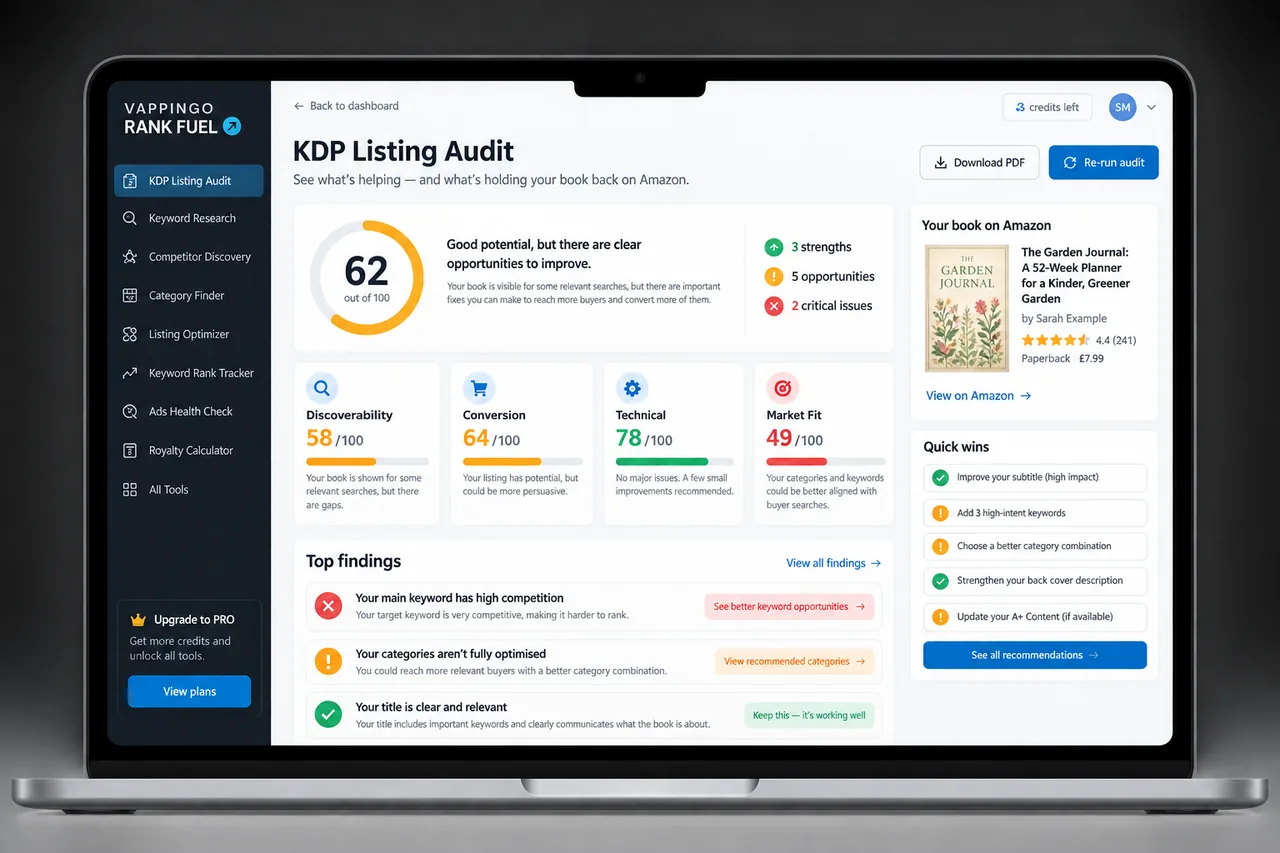
Rank Fuel’s Keyword Research can help develop buyer-search ideas, and its Amazon Ads Weekly Coach can turn report exports into a structured weekly review. The tools are decision aids; your own conversion and royalty data remain the final test.
Turn the research into a repeatable ad workflow
KDP Rank Fuel’s Amazon Ads Generator builds a guided five-campaign Sponsored Products plan, while Amazon Ads Weekly Coach helps turn exported reports into clear weekly decisions. Use the tools as decision support and keep your own royalty, conversion, and marketplace evidence in control.
Frequently Asked Questions
What keywords work for nonfiction books?
Start with the reader problem, audience, outcome, subject, use case, and genuinely comparable books. Search-term evidence should refine the list over time.
Is a higher nonfiction price better for ads?
Not automatically. Higher price can increase royalty but may reduce conversion. Judge the combination of price, royalty, CPC, and conversion.
Should nonfiction authors use product targeting?
Yes when there are books serving the same problem or audience. Product targeting is especially useful when the competing set is clear.
What ACoS should I target?
Use your own break-even economics rather than an industry benchmark. ACoS is revenue-based, while profit depends on royalty and other costs.
Can ads work for a very narrow niche?
They can, but delivery may be limited. Narrow niches need precise targeting, realistic volume expectations, and a detail page that clearly serves the search intent.
Make the Problem Match Obvious
The best nonfiction ad is a clean handoff from a precise reader problem to a detail page that looks capable of solving it. Build around that match, then let your own economics decide how aggressively to scale.