Amazon Ads for Fiction Books: Genre, Tropes, Covers, and Reader Search Language
Build Amazon Ads for fiction around genre fit, tropes, comparable books, cover signals, search-term evidence, and your own break-even economics.
Fiction advertising on Amazon is about matching your book to the reader vocabulary of your genre. Unlike nonfiction, where readers search for specific problems, topics, and expertise, fiction readers search by genre, mood, trope, setting, and comparable author. They are looking for the emotional and narrative experience your book delivers, not information. This changes what keywords work, how your cover matters, what your description needs to do, and what realistic ACoS looks like across different fiction genres.
Why Fiction Advertising Is Different From Nonfiction
A nonfiction book about email marketing has a relatively predictable keyword set: “email marketing book,” “email marketing for beginners,” “email list building,” and so on. The reader’s need is specific and the vocabulary that describes it is fairly consistent. A fantasy novel does not have equivalent directness.
The reader who wants your epic fantasy series might search for “epic fantasy books,” “dragons and magic novels,” “books like Brandon Sanderson,” “found family fantasy,” “military fantasy series,” or a dozen other variations, and all of them are looking for the same type of emotional reading experience from different angles. This breadth of search vocabulary means fiction advertising requires a wider keyword net, a more active discovery process through automatic campaign data, and a much heavier reliance on competitive author targeting and trope-based phrases. It also means that fiction advertising performance is much more sensitive to cover quality than nonfiction, in genre fiction, the cover communicates the genre, tone, and audience in a fraction of a second, making it the primary driver of whether a reader clicks your ad at all.
How Fiction Readers Actually Search on Amazon
Research and real Search Term Report data consistently show that fiction readers use several distinct search patterns. They search by genre and sub-genre: “cozy mystery books,” “dark fantasy novels,” “contemporary romance,” “gothic horror fiction.” They search by setting or trope: “books set in Scotland,” “time travel romance,” “slow burn enemies to lovers,” “academy fantasy.” They search by comparable author: “books like Nora Roberts,” “authors similar to Patrick Rothfuss,” “Stephen King horror books.” They search by series type: “complete fantasy series,” “standalone thriller,” “dragon rider series books.” And increasingly, they search by emotional experience: “books that will make me cry,” “funny romance reads,” “dark and twisty thriller.” Your keyword strategy should map to all of these patterns, not just the most obvious genre terms.
The obvious genre terms (“mystery novels,” “romance books”) are the most competitive and expensive in the auction. The specific trope, comparable author, and emotional-experience terms are often dramatically lower competition and, because they are so specific, often higher conversion when they match your book precisely. A reader who finds your book by searching “forced proximity small-town romance with Christmas setting” is extremely likely to be exactly your reader.
Trope Keywords: The Most Underused Fiction Ad Strategy
Genre fiction readers have a sophisticated vocabulary for the story elements they seek, and they use it on Amazon. Trope terms are specific combinations of narrative and emotional elements that readers know they love and actively search for: “enemies to lovers,” “found family,” “chosen one,” “second chance romance,” “dark academia,” “slow burn romance,” “magical academy,” “reluctant hero,” “fish out of water,” “forbidden love.” These trope-based phrases are among the highest-converting keywords in fiction advertising for one critical reason: readers who search “forced proximity romance” already know what they want.
When your book appears and clearly delivers that trope (through cover, title, subtitle, and description), conversion is high. When your book does not deliver that trope, if you rank for “enemies to lovers” but your book is actually a friends-to-lovers story, conversion is catastrophically low, and readers who do buy are disappointed. Trope keyword targeting is only effective when the book actually delivers what the trope promises. Build your trope keyword list by: reviewing your own book’s core tropes honestly; reading reviews of comparable books to see what trope language readers use organically; browsing Amazon search auto-complete for your genre terms (type “romance with” into Amazon’s search bar and note the completions); and mining your Search Term Report after several weeks of automatic campaign data for trope phrases that have already converted.
Comparable Author Keywords
Comparative author keywords, “books like [Author Name]” or simply “[Author Name] books”, are among the most powerful targeting options in fiction advertising. A reader who searches for “books like Colleen Hoover” is in an extremely specific mindset: they know the emotional experience they want, they know the quality level they expect, and they are in active purchase mode. If your book genuinely delivers a comparable experience, appearing in that search result at a competitive bid is highly efficient targeting.
The risk with comp author targeting is precision. If you target “books like [Literary Fiction Author]” for a genre romance novel because the author is broadly popular, you will get clicks and very poor conversion, the reader’s expectation was not met. Target comp authors whose work is genuinely similar in tone, genre, and audience to yours.
The similarity needs to be real and specific, not aspirational. Use exact match for the most specific comp author phrases (“books like Sarah J Maas”) and phrase match for variations (“SJK Maas fantasy,” “[Author Name] series”). Test 10-15 comp author terms as an initial batch and use your Search Term Report to identify which are generating actual conversions versus expensive clicks with no sales.
Series and World Keywords
Once your series has an established name and readership, series-branded keywords become highly efficient. “[Series Name] books,” “[Main Character Name] series,” and “[World Name] fantasy” reach readers who already know and want your specific series, often at very low CPCs because competition for your specific branded terms is minimal. Add these to your exact match manual campaigns as soon as your series has enough name recognition to generate search volume.
World and setting keywords are particularly effective in fantasy and science fiction, where readers often become deeply attached to specific worlds and actively search for more books set in them. If your secondary world has a distinctive and searchable name, it functions as a branded keyword for your catalog.
Why the Cover Deserves an Early Audit
For fiction, the cover is one of the strongest signals a shopper sees before clicking. Amazon does not publish a percentage of ad performance attributable to cover design, so avoid assigning a fixed percentage to cover performance. The practical point is still important: an ad can be well targeted and still fail if the thumbnail signals the wrong genre, tone, or level of professionalism.
Audit the cover at thumbnail size beside current books serving the same reader. Look for instant genre recognition, readable typography, and visual promises that match the description. If clicks are weak across highly relevant targets, the creative and positioning deserve investigation before you simply raise bids.
Build Campaigns Around Distinct Learning Jobs
A useful fiction account separates discovery from control. An automatic Sponsored Products campaign can surface search terms and product matches; manual broad and phrase campaigns can test language; exact targeting can isolate proven searches; and product targeting can test genuinely comparable books. Keeping those jobs separate makes the reports easier to interpret and lets you move budget toward evidence rather than intuition.
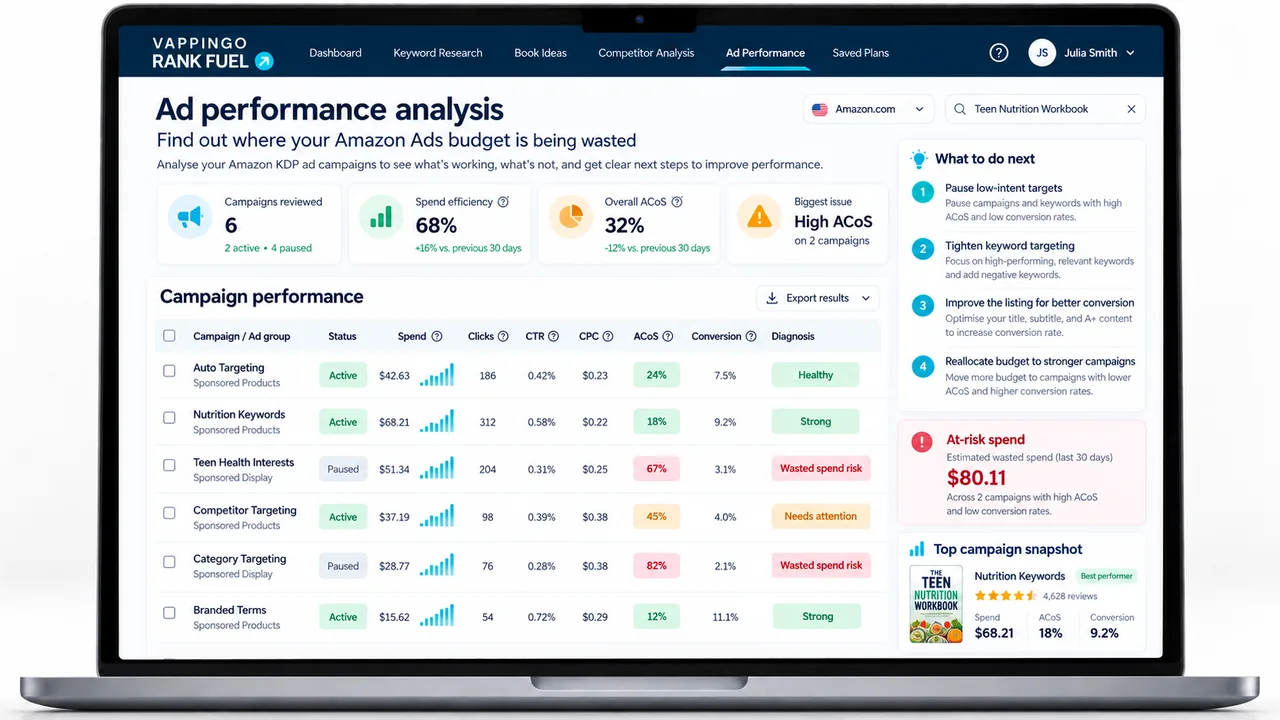
Rank Fuel’s current Amazon Ads Generator uses this same five-campaign logic in a guided setup: Auto Discovery, Broad Research, Phrase Precision, Exact Scale, and Competitor Targeting. For KDP Author advertising profiles, it provides guided campaign setup and keyword workbooks rather than promising a full campaign bulk-upload file.
Romance Advertising Specifics
Romance is the highest-volume fiction genre on Amazon and one of the most active advertising categories. CPCs are moderate to high in mainstream sub-genres (contemporary romance, romantic suspense) and lower in more niche sub-genres (western romance, historical romance, paranormal romance). Romance readers are extremely trope-literate and will respond to very specific trope keyword targeting if the cover and description signal the trope accurately.
Key romance targeting priorities: sub-genre keywords (“cozy contemporary romance,” “dark billionaire romance,” “small-town romance”), heat level signals (“steamy romance,” “clean romance,” “sweet romance without explicit content”), trope phrases (“enemies to lovers,” “fake dating,” “second chance romance”), and setting terms (“Regency romance,” “Scottish Highland romance,” “small town holiday romance”). Comparable author targeting performs exceptionally well in romance because the genre has high brand loyalty, readers who love one author actively seek others writing in the same vein.
Fantasy and Science Fiction Specifics
Fantasy and science fiction have highly varied CPCs by sub-genre. Epic fantasy and space opera have moderate to high competition; LitRPG, GameLit, and progression fantasy have relatively lower CPCs but very specific reader vocabulary that must be used accurately. Science fiction has a wide vocabulary gap between casual (“sci-fi novels,” “space adventure books”) and hardcore readers (“hard science fiction,” “generation ship novel,” “solarpunk fiction”), targeting both audiences in the same campaign typically produces poor conversion from one segment or the other.
Fantasy readers respond well to setting and tone keywords: “dark fantasy,” “cozy fantasy,” “grimdark novels,” “epic world-building fantasy,” “magical academy.” Comparable author targeting works well in fantasy for established author names, but be precise, “books like Brandon Sanderson” attracts a different reader than “books like Joe Abercrombie” even though both are fantasy. Series-selling in fantasy is particularly important because fantasy readers often prefer long series, advertising book one with a clear “N-book series” signal in your title or subtitle improves conversion.
Thriller and Mystery Specifics
Thrillers and mysteries have some of the most consistent and searchable vocabulary in fiction. Sub-genres are well-defined (“psychological thriller,” “cozy mystery,” “police procedural,” “legal thriller,” “domestic noir”) and readers use them consistently. CPCs are moderate to high in mainstream thriller categories but lower in niche cozy mystery sub-categories. Mystery readers in particular respond well to setting-specific targeting: “English village mystery,” “historical mystery 1920s,” “Scottish crime fiction,” “Southern US mystery.” Protagonist type is also highly searchable in mysteries: “female detective novel,” “amateur sleuth mystery,” “retired detective books.” For thrillers, the central hook often drives search behavior: “unreliable narrator thriller,” “missing persons thriller,” “psychological thriller twist ending.”
Literary Fiction Specifics
Literary fiction can be harder to reduce to a neat trope list because readers may discover books through themes, authors, awards, reviews, and cultural conversation. That does not make Amazon Ads useless; it means broad genre terms often need tighter testing. Comparable authors, precise themes, settings, and product targets can provide a more credible starting point than generic “literary fiction” traffic.
Sponsored Products can appear on Amazon, Kindle, and Goodreads. Authors with three or more eligible titles under the same pen name can also use Sponsored Brands in supported author marketplaces. Do not assume a special remarketing feature or Goodreads audience signal exists unless it appears in your current advertising account and reports.
Set Fiction ACoS From Your Own Economics
There is no reliable universal ACoS benchmark for fiction. A profitable target depends on the royalty earned by the advertised format, click cost, conversion, Kindle Unlimited economics where relevant, and downstream value from a series. A campaign at 60% ACoS can be excellent for one book and unacceptable for another.
Start with direct break-even: advertising cost divided by attributed sales is the reported ACoS, while royalty per sale determines how much of that revenue you actually keep. For series fiction, model downstream value separately and label it as an estimate. Do not let hoped-for read-through turn an obviously wasteful campaign into “profitable” on paper.
Optimization Priorities for Fiction
Work from the bottleneck. Weak impressions can point to bids, budget, target relevance, or limited search volume. Impressions without clicks should push you toward cover, price, and promise. Clicks without purchases should push you toward detail-page fit, description, reviews, sample quality, and whether the target genuinely matches the book.
Use the Search Term report to turn real shopper language into better exact targets and negatives. Rank Fuel’s Keyword Research and Book Keyword Spy can help generate and prioritize buyer-search ideas, while the Amazon Ads Weekly Coach can turn exported ad reports into a repeatable optimization routine.
Turn the research into a repeatable ad workflow
KDP Rank Fuel’s Amazon Ads Generator builds a guided five-campaign Sponsored Products plan, while Amazon Ads Weekly Coach helps turn exported reports into clear weekly decisions. Use the tools as decision support and keep your own royalty, conversion, and marketplace evidence in control.
Frequently Asked Questions
Should fiction authors start with automatic or manual targeting?
Either can work. Automatic targeting is useful for discovery, while manual keyword and product targeting gives more control. Many authors use both for different learning jobs.
Are trope keywords allowed in Amazon Ads?
Yes when they accurately describe the book and comply with Amazon Ads policies. Relevance matters because a trope that the book does not deliver can create expensive, disappointed clicks.
Can I target other authors or books?
Amazon Ads supports keyword and product targeting. Use comparable authors and books because the readership genuinely overlaps, not simply because the target is popular.
What is a good ACoS for fiction?
There is no universal number. Calculate your royalty, conversion, KU or series value, and campaign objective before setting a target.
Do ads improve organic rank?
Ads can generate paid traffic and attributed purchases, while sales activity may move alongside organic visibility. Amazon does not publish a guaranteed organic-ranking multiplier for ad sales.
Turn Reader Language Into Testable Campaigns
Fiction ads improve when every target has a reader reason behind it. Start with the language your ideal reader uses, protect genre fit on the detail page, and let reports decide which terms deserve more budget.