
So, you have made it to the final boss of your undergraduate degree: the dissertation. You have got a mountain of journal articles, a rough outline, and a whole lot of caffeine. But as you start writing, you might notice a recurring nightmare in your supervisor’s feedback: “Too descriptive,” or “Needs more critical analysis!”
If you are staring at those comments wondering what exactly “critical analysis” even means, take a deep breath. You are not alone. In high school and your early university years, you were mostly rewarded for showing that you understood what you read—essentially, describing facts. But a dissertation is a totally different beast. Universities want you to focus on what is not known or universally agreed upon. They want you to weigh the evidence, challenge the experts, and form your own rock-solid conclusions.
But how do you actually do that? Enter your new best friend: Socratic Questioning.
In this guide, we are going to dive into what Socratic questioning is, why it is the ultimate tool for crushing your dissertation, and how you can use it to transform your writing from a basic summary into top-tier, critical brilliance.
Who is Socrates, and Why Should I Care?
Socratic questioning is a rigorous evaluation technique used to test claims and assumptions. It is named after the Ancient Greek philosopher Socrates, a guy who was famous for annoying the intellectual elite of Athens by constantly asking them “Why?” instead of just nodding along. Socrates encouraged his students to reach their own conclusions by aggressively examining ideas, rather than just accepting information at face value.
When you apply this to your dissertation, it means you stop treating published authors like untouchable gods. Just because a theory is published in a textbook does not mean it is flawless. By applying Socratic questioning, you become a critical thinker who evaluates the worth, truth, and validity of the research you are reading.
Moving Beyond PEEL: The Semantic Wave
We have talked before about the TEEL or PEEL paragraph structures (Point, Evidence, Explanation, Link). These are fantastic for organizing your thoughts. But here is a secret: at the dissertation level, simply using PEEL is not always enough. If you only make a point, drop in a quote as evidence, and link it back, your writing might still be considered purely descriptive.
To get those top grades, like a 2.1 or a First, you need to ride what academic experts call the Semantic Wave.
- Unpacking: This is the descriptive part where you make your point and introduce the evidence. You are explaining the basics.
- Repacking: This is where the magic happens. This is the critical analysis phase where you take that evidence, criticize it, combine it with other theories, and “repack” it using your own analytical words.
Socratic questioning is the exact tool you use to power your way up that “repacking” slope.
The 6 Socratic Questions to Ask Your Research
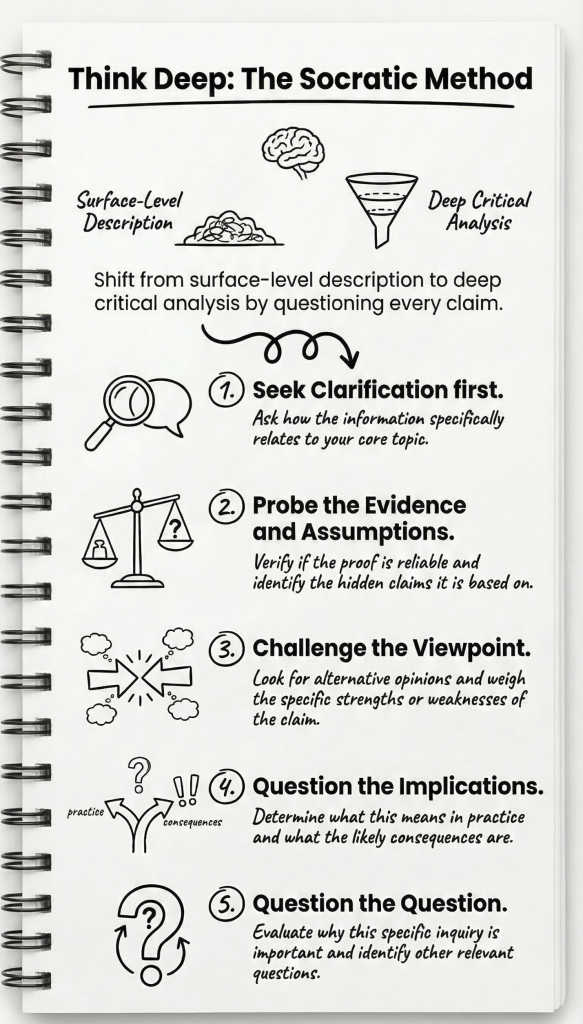
Whenever you are reading an article or writing a paragraph for your literature review, you should aggressively probe the research by asking yourself these six categories of Socratic questions. Keep this list pinned to your monitor.
1. Probing the Evidence
Never let a claim sit there unchallenged. When an author says something is a fact, ask yourself:
- What is the actual evidence or proof for this?
- What examples are provided?
- Are the evidence and examples actually valid, reliable, and sufficient?
2. Probing Assumptions
Every researcher makes assumptions. Your job is to catch them.
- What is this claim based on?
- Can this claim be checked or verified elsewhere, or are we just taking their word for it?
3. Questioning a Viewpoint
A strong dissertation always acknowledges that there is more than one way to look at a problem.
- What are the alternative views or opinions on this topic?
- What are the specific strengths and weaknesses of this claim?
4. Questioning Implications
This is where you show your supervisor you understand the real-world impact of the theory.
- What might this mean in practice?
- What are the likely consequences of this idea being applied?
5. Seeking Clarification
Sometimes, you need to zoom out and make sure the evidence actually belongs in your paper.
- How does this relate to my specific dissertation topic?
- What else do I need to find out to fully understand this?
6. Questioning the Question
Take a step back and look at the foundation of the debate.
- Why is this question important in the first place?
- What other questions might also be relevant to the topic?
Socratic Questioning in Action: A Real Example
Theory is great, but let’s look at how this transforms your actual writing. Let’s say you are writing a dissertation on business management, and you come across a statement you want to include:
The Boring, Descriptive Approach
“Inceoglu et al. (2018) claim Leader Member Exchange (LMX) theory of leadership is the most effective theory for understanding how leadership shapes employee performance.”
This is purely descriptive. You just reported a fact. If you leave it like this, your supervisor will write “So what?” in the margins. Let’s apply Socratic questioning to “repack” this and make it critically analytical.
Step 1: Probe the Evidence (What is the proof?)
“Research found LMX produces better relationships with employees, which in turn improves performance and gives employees more autonomy and responsibility, improving their well-being (Martin et al., 2005).”
Step 2: Probe the Reliability (Is this evidence actually valid?)
“However, it’s argued the studies lack validity due to limited research, with questions asked only leading to positive outcomes to support the claim, and therefore reliability suffers.”
Step 3: Question the Viewpoint (Are there alternative views?)
“On the other hand, LMX can be seen to have a negative effect on employee performance, if some individuals see or perceive unequal resource distribution and injustice created (Hooper & Martin, 2008).”
Step 4: Question the Implications (What does this mean in practice?)
“This implies that it’s therefore difficult to assume a set style of leadership to achieve effectiveness, and according to this view, different styles affect individuals differently.”
The Final Result: By combining those Socratic answers, you have taken one flat, descriptive sentence and turned it into a robust, highly critical paragraph. You introduced the theory, explained its supposed benefits, tore apart its methodology, offered a contrasting viewpoint, and told the reader what it all actually means for the real world. That is how you write a first-class dissertation.
Pro-Tips for Using Socratic Questioning
As you dive into drafting your dissertation chapters, keep these pro-tips in mind to maximize your critical analysis.
1. Avoid the “I Think” Trap
When evaluating evidence and deciding that a theory is weak, avoid writing “I think” or “in my opinion.” Let your Socratic questions do the talking. Keep the focus entirely on the subject of your analysis. Instead of saying “I think this study is bad,” say “The reliability of this study suffers due to limited sample sizes.” It sounds infinitely more academic.
2. Follow the “Journals Within Journals” Trick
Struggling to find alternative viewpoints to question a claim? When you find a good journal article that introduces a theory, immediately scroll down to its reference list. Look at the authors they are citing, or the authors they are criticizing. Searching for those specific articles will instantly give you a broader understanding of the debate, allowing you to easily write your alternative views section.
3. Remember the Demographics and Context
If you are struggling to probe the evidence, look at how the research was conducted. Ask yourself:
- Was this study done in the US or the UK?
- Was it done on university students or actual business professionals?
- Was the sample size large enough?
Pointing out that a study conducted entirely on 18-year-old American students might not apply to 50-year-old British professionals is a brilliant, easy way to inject critical analysis into your writing.
4. Build Argument Maps
If you have a massive, confusing literature review chapter, use Socratic questions to build an argument map. Write down the main conclusion you want to make, and then list your reasons. Next to each reason, apply Socratic questions to evaluate its strength, point out hidden assumptions, and note where you need more evidence. This ensures your entire chapter flows logically and every single claim is tested.
Final Thoughts: Become the Critic
Writing your undergraduate dissertation is definitely a challenge, but it does not have to be a mystery. Whenever you feel yourself just summarizing what you have read, stop, channel your inner Socrates, and start aggressively questioning the text.
Ask for the proof. Demand to know the alternative views. Unpack the real-world implications. By shifting your mindset from a passive reader to an active, questioning critic, you will elevate your writing, impress your supervisor, and craft a dissertation that truly stands out.
You have totally got this. Now, go grab a coffee, open that Word document, and start questioning everything.
