
STEM students face a unique academic challenge. Unlike essay-based disciplines, Science, Technology, Engineering, and Mathematics demand precision, logical reasoning, complex equations, coding fluency, and the ability to interpret dense scientific literature. A misplaced symbol, a flawed assumption in a proof, or a debugging oversight can derail hours of work.
Artificial intelligence is rapidly transforming how STEM students approach these challenges. Today’s AI tools do far more than summarize notes or draft paragraphs, they compute advanced mathematical equations step-by-step, explain complex algorithms, debug code, visualize multidimensional data, and break down highly technical research papers into understandable insights.
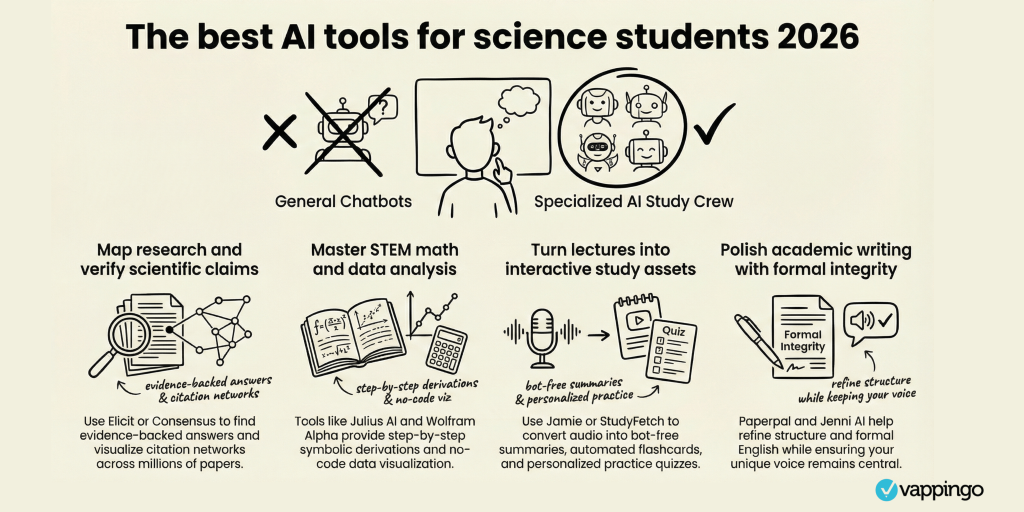
However, not all AI tools are built for STEM. Many general-purpose chatbots struggle with symbolic reasoning, higher-level mathematics, or domain-specific coding tasks. The tools featured in this guide are specifically designed to handle the rigor and structure required in STEM disciplines. Whether you’re solving differential equations, writing Python scripts, analyzing datasets, or navigating research papers, these platforms are built to support, not shortcut, your learning.
Below, we break down the top AI tools for STEM students, followed by specialized platforms for data analysis, from lightweight spreadsheet assistants to enterprise-grade analytics systems.
The Best AI Tools for Science Students 2026
1. Conquering Math, Coding, and Complex Equations
Standard AI models often struggle with the precision required for high-level mathematics, but these specialized tools are built for the job:
Wolfram Alpha
An absolute must-have for any STEM major. Instead of just giving you the final answer, Wolfram Alpha acts as a computational knowledge engine that breaks down complex algebra, calculus, physics, and chemistry problems into step-by-step solutions so you can actually understand the methodology.
CompSciLib
If you are studying computer science, engineering, or higher-level math, this all-in-one platform is a lifesaver. It features equation solvers, code explainers, LaTeX converters, and curated study roadmaps for notoriously difficult subjects like Discrete Math and Algorithms.
Photomath & QANDA
For quick, on-the-go help, these apps utilize optical character recognition (OCR). You can simply point your smartphone camera at a printed or handwritten equation, and the AI will instantly generate a detailed, step-by-step breakdown of how to solve it.
2. Decoding Dense Scientific Literature
Reading academic literature is a vital part of any science degree, but the jargon and dense formatting can slow you down. These tools help you extract insights in a fraction of the time:
SciSpace
Imagine being able to have a conversation with a dense research paper. SciSpace lets you upload a PDF and ask questions about the methodology, results, or confusing statistical terms, breaking them down into plain English.
Elicit
This AI research assistant searches millions of scholarly papers and pulls the exact data you need—such as sample sizes, methodologies, and outcomes—into a clean, structured table so you can compare multiple studies side-by-side.
Consensus
When you need a fact-checked answer, Consensus searches exclusively through peer-reviewed studies to tell you whether the scientific community generally supports, opposes, or complicates a specific claim.
Research Rabbit
If you find one great paper for your literature review, Research Rabbit creates visual network maps of related studies, helping you trace citations and discover earlier foundational research or newer breakthroughs.
SciSummary
Built specifically for academics, this tool extracts abstracts, figures, and references, summarizing papers into clearly labeled sections (methods, results, conclusion) so you can quickly decide if a paper is worth a deep read.
3. Data Analysis and Visualization for Lab Reports
You no longer need to be a coding expert to clean data and generate professional charts for your lab reports or presentations:
Julius AI
This is a conversational data analyst. You can upload your raw CSV or Excel data and use plain English to ask questions like “What are the trends in this dataset?” Julius will run the statistical analysis and generate clear, accurate charts and graphs for your reports.
Vizly
If you struggle with deciding how to present your findings, Vizly analyzes your data structure and automatically suggests the most effective, publication-ready charts and graphs.
4. Smart Lecture Capture & Study Aids
Taking notes during a fast-paced science lecture can feel impossible. These tools ensure you never miss a critical detail:
Jamworks
Unlike standard note-takers, Jamworks is ideal for STEM because it is capable of understanding and capturing complex equations and formulas from your lectures, turning them into text summaries, video clips, and flashcards.
RemNote
A powerhouse for memorizing heavy science material (like anatomy or organic chemistry), RemNote combines your lecture notes, PDF annotations, and an AI that automatically generates flashcards. It then uses spaced repetition to help you retain the information for exam day.
StudyFetch & Mindgrasp
These platforms allow you to upload your lecture recordings, PDFs, or YouTube videos, and the AI will instantly generate comprehensive study guides, notes, and practice quizzes to test your understanding.
5. Drafting Flawless Research Papers
When it is time to write your final paper, AI can help you structure your arguments and polish your prose:
Vappingo
While AI tools can help generate drafts, solve equations, or summarize research papers, STEM students still need human precision when it comes to final submission. Vappingo provides professional human-in-the-loop editing and proofreading services tailored for academic writing. This is especially valuable for lab reports, dissertations, research papers, grant proposals, and journal submissions where clarity, formatting accuracy, and citation integrity are critical. Unlike automated grammar tools, Vappingo’s editors review tone, logical flow, technical consistency, and discipline-specific terminology to ensure your work is polished, accurate, and submission-ready. For STEM students aiming for publication or high-stakes assessment, human oversight remains essential.
Jenni AI
A specialized academic writing assistant that helps you outline and draft your paper. Crucially, it automatically inserts traceable in-text citations that link directly back to the exact page of the source PDFs you uploaded, ensuring your claims are backed by real evidence.
thesify
Instead of just fixing typos, thesify acts like a critical peer-reviewer. It evaluates the structure of your paper, checking if your thesis statement is clear, if your arguments flow logically, and if your claims are properly supported by evidence.
Writefull
Trained on millions of published scholarly articles, Writefull helps you elevate your writing by suggesting academic phrasing, fixing grammar, and ensuring you are using correct discipline-specific terminology.
Responsible AI Use
While these tools are incredible productivity boosters, they come with responsibilities. Always use AI as a learning aid, not a shortcut to do the work for you. AI models can occasionally “hallucinate” or generate inaccurate citations, so it is imperative that you independently verify facts and check original sources. Furthermore, always review your university’s academic integrity policies regarding AI use before submitting any assignments. See our guide to student AI disclosure for more information.
By strategically integrating these tools into your workflow, you can spend less time fighting with formatting and raw data, and more time focusing on genuine scientific discovery and critical thinking.
