
You spend weeks researching, drafting, and polishing your dissertation, only to submit it and get an email from your professor accusing you of using ChatGPT. Welcome to the era of AI content detectors—a time when your hardest work can be instantly invalidated by a flawed algorithm.
AI detectors are essentially statistical probability engines, not mind-readers. They regularly flag 100% human-written work as AI-generated, a phenomenon known as a “false positive”. If you write clearly, follow formal academic structures, and use excellent grammar, your writing might accidentally look mathematically identical to an AI’s output. This “robotic” labeling disproportionately affects non-native English speakers, neurodivergent students, and highly formal writers.
To protect your academic record and your sanity, you need to understand how these tools work and what you can do to keep your writing authentically yours. Here is exactly what you need to do to avoid false AI detection in your assignments.
How to Avoid False AI Detection in Your College Essays
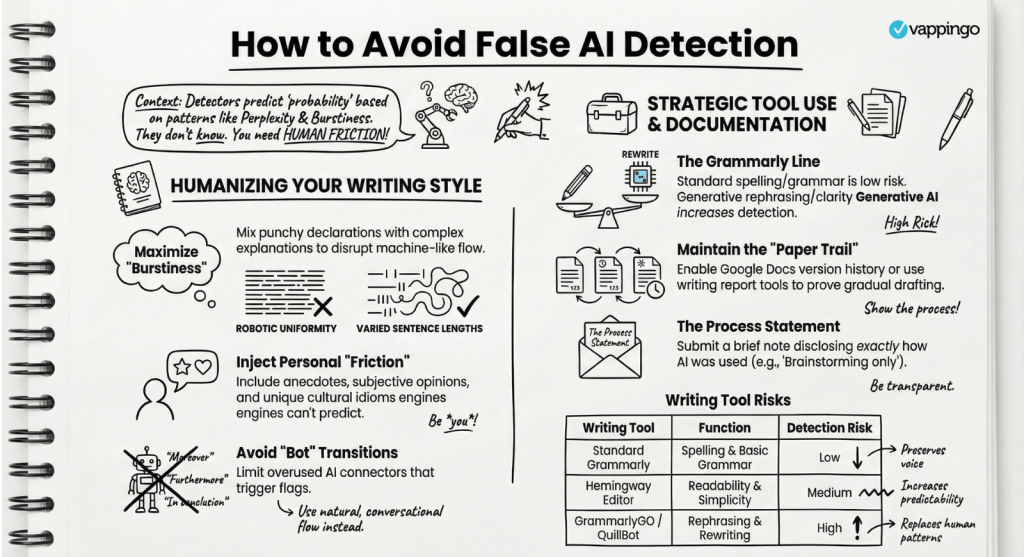
1. Keep Your Receipts (Document Everything)
The absolute strongest defense against an AI accusation is a documented writing process. AI detectors analyze the final product, but they cannot fake the human journey of creating it.
- Use Version History: Write your essays in cloud-based platforms like Google Docs or Microsoft Word Online, which automatically track every keystroke, deletion, and revision.
- Save Your Scraps: Keep all your research notes, brainstorming outlines, early drafts, and search histories. If a professor flags your paper, presenting a detailed version history and your messy early drafts will effectively prove your authorship.
2. Beware of Writing Assistants and Grammar Checkers
You might think you are just fixing a few comma splices, but heavy reliance on tools like Grammarly can trigger AI detectors.
- Stick to Basic Spell-Check: Using basic grammar and spelling corrections carries a very low risk of triggering AI detection.
- Avoid Generative Rewriting: Do not use features like GrammarlyGO, “Rewrite for Clarity,” or paraphrasing tools like QuillBot. When you allow a tool to rewrite your sentences, it replaces your natural human phrasing with statistically optimal patterns—which is exactly what AI detectors are scanning for.
3. Boost Your “Burstiness”
AI detectors look for a metric called “burstiness,” which refers to the variation in sentence structure, length, and rhythm throughout your document. AI models tend to produce uniform, monotonous sentences that are all roughly the same length.
- Vary Sentence Length: Humans naturally write in bursts. Follow up a long, complex, and highly detailed sentence with a short, punchy one.
- Vary Paragraph Length: Avoid making every paragraph a standard 3–5 lines. Throw in a brief, one-line paragraph for rhetorical emphasis, which is a very human structural choice.
4. Ditch the Robotic Transitions
If your essay relies heavily on words like Moreover, Furthermore, In conclusion, and Additionally, you are waving a red flag at AI detectors. Generative AI relies heavily on these rigid, formulaic transitions to stitch paragraphs together. Instead, try using more conversational or contextual bridges between your ideas.
5. Inject “Idiomatic Friction” and Lived Experience
AI text is designed to be safe, predictable, and devoid of true personality. To make your writing algorithm-proof, you need to add elements that a machine’s training data wouldn’t naturally prioritize.
- Use Personal Anecdotes: Whenever the assignment allows, include subjective insights, lived experiences, or personal observations. AI struggles to replicate authentic emotional grounding.
- Be Specific: AI often relies on vague buzzwords and imprecise abstractions (e.g., “data-driven solutions”). Swap these out for highly specific, concrete examples and unique critical perspectives.
6. Include a “Process Statement”
If your professor’s syllabus allows for limited AI use (like brainstorming or outlining), be fully transparent about it. Attach a brief “process statement” to the end of your essay detailing exactly how you completed the assignment.
For example: “I used ChatGPT to generate a list of potential essay topics, but I selected the topic, conducted the research, and wrote the entirety of this draft myself, using Grammarly solely for basic comma corrections.”
This builds trust and preempts misunderstandings.
Read more: How to Acknowledge AI Use
7. Pre-Check Your Own Work
Before you submit a major dissertation, consider running your final draft through an AI detector yourself to see how a machine interprets your writing.
You can use free tools like GPTZero or Copyleaks to scan your text. If specific paragraphs are flagged, read them aloud.
Often, you will find that those sections are too uniform or overly formal, allowing you to manually edit them to restore your natural human voice.
What Should I Do if I am Falsely Accused of Using AI to Write Essays?
The strongest defense against a false AI accusation is a documented writing process. If you are falsely accused, you should gather and present the following specific types of evidence to prove your authorship:
1. Version History and Drafts
Digital breadcrumbs that show the gradual evolution of your document are the most compelling proof you can offer. You should provide:
- Version histories from cloud-based platforms like Google Docs or Microsoft 365, which track your keystrokes, revisions, and timestamps.
- Dated, intermediate drafts or saved versions of your work, including drafts saved across multiple devices.
- Screenshots showing your progress on the assignment over time.
2. Research and Preparatory Materials
AI generators produce final texts instantly, but human writers leave a trail of preparation. Compile the materials you used to build the assignment, such as:
- Handwritten notes, brainstorming outlines, and research logs.
- Annotated bibliographies and browser search histories demonstrating your active investigation into the topic.
3. Comparative Writing Samples
Because AI detectors analyze stylistic patterns, you can use your past work to prove that the flagged text matches your natural voice. Present:
- Copies of previous assignments, essays, or in-class writing from the current course or previous terms.
- A writing style analysis to demonstrate consistency in your personal voice and structure.
4. External Verification and Communications
Evidence that other humans interacted with your work during its creation can strongly support your case. This includes:
- Tutor or Writing Center proof: Appointment summaries, session notes, or verification letters from faculty or writing tutors you met with during the drafting process.
- Peer and Instructor feedback: Comments from peers or instructors on early versions of your work.
- Chat logs: Time-stamped text messages, emails, or school forum discussions where you talked about the assignment’s topic with classmates or tutors.
5. Process Statements and AI Logs (If Permitted)
If your professor’s policy allowed limited use of AI, such as for brainstorming or basic grammar checking, you must be fully transparent about it:
- AI Chat Logs: Provide saved links, PDFs, or screenshots of the exact prompts and chats you had with AI tools to prove you only used them within the permitted boundaries.
- A Process Statement: Write a detailed, factual statement explaining exactly how you approached the assignment, your research process, and how digital tools were used. If you used tools like Grammarly, explicitly explain how they differ from the prohibited software alleged by the school.
6. Documentation of Neurodivergence (If Applicable)
If you have a documented disability, such as Autism, ADHD, or Dyslexia, you may want to disclose this or present it as evidence. Neurodivergent writers often use highly direct, literal, or structured writing patterns that AI detectors may wrongly classify as robotic or AI-generated. Highlighting this can help you challenge the detector’s algorithmic bias.
