
Yale University Admissions Guide 2024
Yale's admitted students boast impressive standardized test scores, typically within the range of 1460-1570 for the SAT and 33-35 for the ACT, showcasing the high caliber of its stude…
Yale’s admitted students boast impressive standardized test scores, typically within the range of 1460-1570 for the SAT and 33-35 for the ACT, showcasing the high caliber of its student body.
Yale’s comprehensive curriculum offers over 2,000 courses across more than 80 majors, catering to a wide array of interests and academic pursuits. While pre-professional programs like pre-law or pre-med are not offered in the traditional sense, Yale’s liberal arts education is designed to cultivate a well-rounded and adaptable intellect, preparing students for a multitude of career paths.
The requirement to complete 36 courses to graduate exceeds the norm for many institutions, emphasizing a broad and immersive educational experience. First-year courses tend to be larger, but as students progress through their major, they benefit from an increasingly personalized and intimate learning environment, with a student-to-faculty ratio of 6:1, fostering close mentorship and academic engagement.
Regarding campus life, a significant majority of Yale students live on campus, integrating fully into the university’s vibrant community. While New Haven presents its own set of challenges and characteristics distinct from the Yale campus, it also offers a range of cultural, culinary, and civic opportunities. The university and the city alike are actively engaged in initiatives to enhance safety, community relations, and student involvement both on campus and in the wider New Haven area, providing a rich backdrop to the collegiate experience.
Yale Admissions Statistics at a Glance
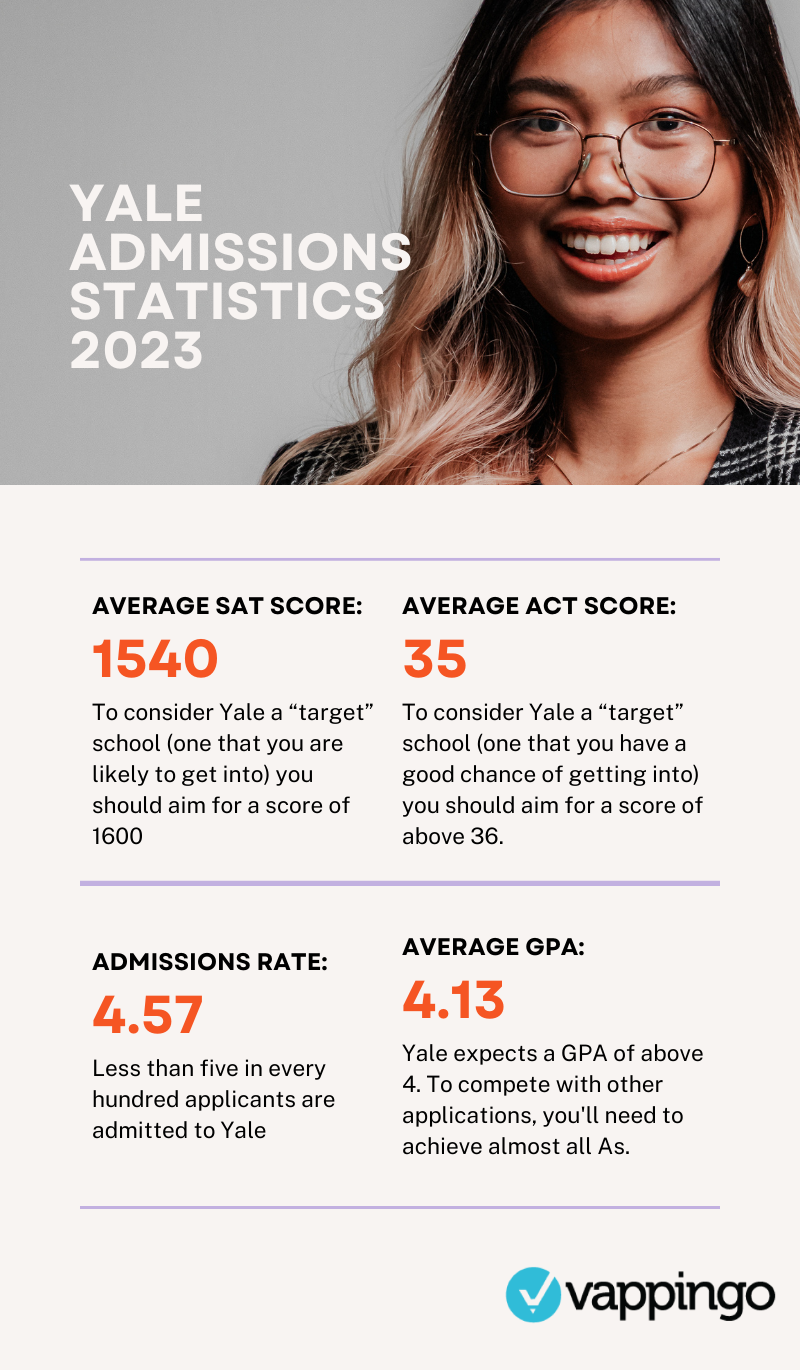
The Facts About Yale Admissions
Yale’s commitment to diversity and inclusion is evident in its admitted class, drawing students from all 50 states, the District of Columbia, four U.S. territories, and 78 countries, emphasizing the university’s global appeal and its role as a melting pot of cultures and ideas.
Unlike Harvard, which is known for its decentralized structure with various colleges offering a multitude of majors and concentrations, Yale boasts a cohesive and interconnected academic environment. It offers a broad spectrum of undergraduate academic programs, with students admitted to the Class of 2027 intending to major in 82 different areas of study. This reflects Yale’s dedication to providing a diverse and comprehensive educational experience that caters to a wide range of interests and academic pursuits
Yale’s approach to admissions is inclusive, with policies designed to appeal to talented students from varied backgrounds. The university’s decision to adopt a test-optional policy in response to the COVID-19 pandemic, subsequently renewed through the Class of 2028’s application cycle, is indicative of its holistic admissions process. This policy shift has contributed to a nearly 50% increase in the volume of applications since the Class of 2024, further intensifying the competitive landscape.
Nestled in the historic city of New Haven, Connecticut, Yale benefits from a unique blend of cultural richness and academic vitality, offering students an immersive educational experience. The campus is a stone’s throw away from a plethora of cultural, social, and intellectual opportunities, enriching students’ academic journey with real-world experiences and community engagement.
In summary, Yale University mirrors the prestige and rigor often associated with Harvard but distinguishes itself through its unique academic offerings, inclusive admissions policies, and the dynamic community of New Haven. The university continues to attract a diverse and talented student body, eager to explore a multitude of disciplines and contribute to the global community.
Doesn’t sound like your cup of tea? Take a look at our guide to the top US colleges for some more inspiration.

Student Life at Yale
What’s Good About Studying at Yale
“The school really has an intellectual and social mystique, that makes every day interesting, even when the pressure is on.”
“There is no early decision program, only early action, so it takes the pressure off potential students and levels the financial playing field.”
“Yale tries to work on the whole person rather than just focusing on the end result and ultimate career. It makes you less stressed when the going gets rough.”
What’s Bad About Studying at Yale
“New Haven is the kind of town you never walk alone in. And why would you want to?”
“There isn’t a lot of socializing. It tends to be very cliquey and people are always just studying on weekends.”
“There is a lot of political bias that exists. Students are sort of divided into liberals and conservatives, and both sides tend to be way too politically correct for my tastes.”
Yale Admissions Requirements
Yale Acceptance Rate
Grade Point Average
SAT and ACT Requirements
SAT and ACT Requirements and Rules at Harvard
Yale has adopted a flexible standardized testing policy, allowing applicants for fall 2025 admission and beyond to submit scores from the ACT, SAT, Advanced Placement (AP), or International Baccalaureate (IB) exams. This flexibility means you can choose which scores best represent your academic abilities, without a preference for one test type over another by the admissions office.
For those opting for SAT or ACT scores, aiming for the upper percentiles can strengthen your application. The middle 80% of enrolled first-year students for fall 2020 scored between 31-36 on the ACT and 680-790 on SAT-Evidence-Based Reading and Writing, with SAT-Math scores ranging from 690 to 800.
Although Yale doesn’t explicitly state a preferred SAT or ACT score, competitive applicants often have SAT scores around 1510 or ACT composite scores nearing 35.
Yale’s comprehensive review process means every part of your application is considered to understand your academic strength, extracurricular involvement, and personal qualities. While excellent scores and a high GPA are crucial, showcasing your unique experiences, interests, and the impact you’ve made in your community can also significantly influence your admissions outcome.