
If you are staring at a blank document, wondering how to transform a jumbled mess of research notes into a persuasive, top-tier academic essay, you need to meet your new best friend: the TEEL paragraph structure.
The TEEL structure is a highly specific, strategic approach to organizing the body paragraphs of your essays. By providing a clear framework for your writing, it ensures that every single paragraph you write introduces a solid claim, explains it thoroughly, backs it up with credible research, and connects it seamlessly back to your overarching topic. Instead of writing loosely connected sentences and hoping your professor understands your point, TEEL forces your ideas to flow logically.
Whether you are drafting a quick response paper or a massive final year research project, mastering the TEEL structure for essays will elevate your writing from mediocre to spectacular. In this upbeat, comprehensive guide, we are going to dive deep into exactly what the TEEL acronym stands for, why it works so well, and how you can use it to construct bulletproof academic arguments. Let’s get writing!
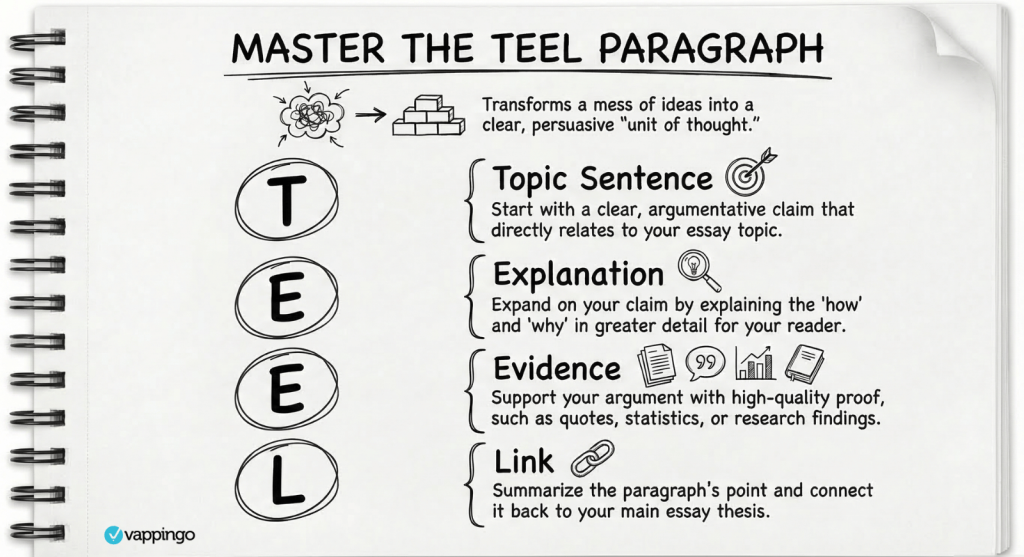
What Exactly is the TEEL Paragraph Structure?
TEEL is an acronym that represents the four essential elements of a strong, fully developed body paragraph. While some universities might occasionally swap out a word, such as using “Example” instead of “Evidence,” or “Elaborate” instead of “Explanation,” the core formula remains the exact same.
TEEL stands for:
- T – Topic Sentence
- E – Explanation
- E – Evidence
- L – Link
When you combine these four elements in this specific order, you create a well-formed, easy-to-read paragraph that leaves no room for confusion. Let’s break down each pillar of the TEEL structure so you know exactly how to craft them.
1. T – Topic Sentence
The topic sentence sits at the very beginning of your paragraph and acts as the boss of the entire section. Its primary job is to tell your reader exactly what argument or main idea you are about to discuss. By the time your audience finishes this single sentence, they should have a crystal-clear idea of the paragraph’s central focus.
The Golden Rule: Your topic sentence should never be a simple factual statement. A factual statement is a closed door—it does not require any further evidence, which limits your ability to expand and critically analyze the topic. Instead, your topic sentence must be an argumentative claim.
Weak (Factual): No single country wants to shoulder the burden of climate change.
Strong (Argumentative): One of the main obstacles to reaching international consensus on climate change action is the ongoing debate over which countries should shoulder the burden.
The strong example opens the door for a robust debate and tells the reader exactly what the paragraph will try to prove.
2. E – Explanation
You have hooked your reader with a brilliant topic sentence, but you cannot just leave them hanging. The second element is the Explanation (sometimes called “Elaborate”). This is a sentence or two where you expand upon your topic sentence in greater detail, clarifying your argument and giving it sharp focus.
A fantastic trick for writing the explanation phase is to assume your audience is completely clueless about the topic. You need to take the time to clearly spell out what you mean, why your claim is important, and how it sets the stage for the research you are about to introduce. If your topic sentence introduced the main idea, your explanation sentence tells the reader why that idea matters before you hit them with the heavy academic data.
3. E – Evidence
An academic argument is completely meaningless unless you have the receipts to back it up. The Evidence section (or “Example”) is where you introduce valid, credible proof to support the claims you just finished explaining. In university essays, this usually takes the form of factual data, a direct quotation, paraphrased research, or references to peer-reviewed journals.
However, presenting the evidence is only half the battle. To score top marks, you must also evaluate your evidence. Do not just drop a quote and run away. You need to explain how this evidence proves your point, or even address its strengths, weaknesses, and limitations. The evidence determines whether the paragraph actually impacts the reader, so make sure it is logical and directly relevant to your topic sentence.
4. L – Link
You have made your claim, explained it beautifully, and backed it up with bulletproof evidence. Now it is time to bring it all home with the Link (sometimes called “Connection”).
The linking sentence is the final piece of the TEEL puzzle. Its job is to summarize the core idea of the paragraph and elegantly tie it back to the main topic or overarching thesis of your essay. It acts as a mini-conclusion for the evidence you just presented, ensuring your reader understands exactly how this specific paragraph helps prove your whole essay’s argument.
A strong link also sets up a smooth transition into your next paragraph, keeping the flow of your essay seamless and logical.
Why Should You Use the TEEL Structure?
You might be wondering why professors and academic advisors are so obsessed with acronyms like TEEL, or its close cousin, PEEL. We all adopt different writing techniques, but the TEEL structure is universally recommended for several massive advantages:
- It Offers Absolute Clarity: Properly utilizing this framework helps your readers easily digest your content, making your arguments infinitely more impactful.
- It Maintains Your Focus: When you have a massive word count to hit, it is easy to start rambling. The TEEL structure prevents you from losing track and going off-topic, ensuring every single sentence serves a specific purpose.
- It Validates Your Claims: By forcing you to include a dedicated evidence section, TEEL ensures you never make empty claims. It builds a habit of validating your arguments with solid academic proof.
- It Enhances Creativity: Believe it or not, having a strict structure actually boosts your creativity. By giving you a clear sandbox to play in, you spend less time worrying about how to format your essay and more time coming up with brilliant, creative arguments.
Leveling Up: Making Your TEEL Paragraphs More “Critical”
If you want to move from standard undergraduate grades to top-tier academic excellence, you need to understand that simply following the TEEL structure is not always enough if your writing remains purely descriptive. At the university level, your professors want to see critical analysis.
To elevate your TEEL paragraphs, try incorporating these two advanced academic strategies:
The Semantic Wave
Think of your paragraph as a wave of understanding. You start at the top with academic language in your topic sentence. Then, you ride the wave down to unpack that idea into basic, understandable language through your explanation and evidence.
But here is where many students lose marks: they forget to ride the wave back up. To finish the Semantic Wave, you must repack your ideas using critical analysis before your final link. Repacking means you do not just accept the evidence at face value; you criticize it, compare it to other theories, and use your own words to summarize its true academic value.
Socratic Questioning
When writing your evidence section, use Socratic Questioning to aggressively probe your research. Instead of just inserting a quote, ask yourself:
- What is this claim based on? Can it be verified elsewhere?
- Are there alternative views or opinions on this data?
- What are the likely consequences or implications of this proof in practice?
By actively questioning your evidence right there in the paragraph, you prove to your professor that you are a critical thinker who does not just copy and paste from textbooks.
The TEEL Structure in Action: A Real-World Example
Theory is great, but let’s see what the TEEL structure actually looks like in the wild. Below is a strong example of a fully developed TEEL paragraph exploring global climate change policy. Notice how the writer moves through the four stages.
Topic Sentence: One of the main obstacles to reaching international consensus on climate change action is the ongoing debate over which countries should shoulder the burden.
Explanation: Because the developed world has historically been responsible for the majority of greenhouse gas emissions, it has been argued that they should reduce emissions and allow developing nations to prioritise development over environmental concerns.
Evidence & Consideration: The notion of “common but differentiated responsibility” (CBDR) was formalised in the UN Framework Convention on Climate Change in Rio de Janeiro in 1992 (UNFCCC, 1992). Article 3.1 explicitly states, “Accordingly, the developed country Parties should take the lead in combating climate change and the adverse effects thereof” (p. 4). However, because CBDR outlines a principle and not an actionable plan, it has remained problematic. For example, it does not stipulate the extent to which, under the principle of CBDR, developing nations should be exempt from specific emissions targets.
Link: Fairness and equity need to be pursued in reaching a global agreement on climate change, but transforming this into an actionable strategy is problematic.
This paragraph is a miniature model of effective academic writing. It introduces a bold claim, explains the historical context, brings in a direct quote from a UN convention as evidence, critically evaluates the limitations of that evidence, and then ties it back to the main theme of the essay.
Pro Tips for Flawless TEEL Paragraphs
Want to make sure your TEEL paragraphs shine? Keep these tips in your back pocket while you draft.
1. Outline Before You Write
Do not just stare at a blank page hoping a brilliant paragraph will appear. Start by jotting down a quick outline. Write down a bullet point for your T, E, E, and L. Outlining saves you time, prevents writer’s block, and ensures your logic is sound before you commit to writing full, complex sentences.
2. Ditch the Personal Pronouns
Unless you are specifically writing a reflective journal, keep your academic writing formal and in the third person. Avoid emotional language, and absolutely banish phrases like “I think” or “in my opinion” from your essays. Keeping the focus purely on the subject of your analysis makes your arguments sound far more confident and credible.
3. Master Your Transitions
A cohesive essay is not just a stack of isolated paragraphs; it is a unified narrative. Use linking words and transition phrases such as consequently, similarly, or in contrast to connect your ideas both within your TEEL paragraph and between different paragraphs. This ensures your essay flows smoothly from one point to the next.
4. Proofread, Proofread, Proofread
Even the most perfectly structured TEEL paragraph can be ruined by messy grammar, comma splices, or typos. Always give yourself enough time to review and edit your work before hitting submit. Read your essay out loud to catch awkward phrasing, or use digital tools to check your grammar and formatting.
Final Thoughts: Embrace the TEEL Structure
Writing university essays does not have to be an intimidating, tear-your-hair-out experience. By mastering the TEEL paragraph structure, you are equipping yourself with a highly effective, professor-approved blueprint for success.
Just remember the golden formula: every great paragraph needs a strong, argumentative topic sentence to set the stage, a clear explanation to provide context, solid evidence paired with critical evaluation, and a sharp link to tie it all back to your main argument.
So, grab that assignment brief, fire up a fresh document, and start outlining your TEEL paragraphs. You have totally got this.
