
AI tools can assist you at every stage of writing an undergraduate research paper, from finding relevant sources to polishing your final draft. Rather than simply writing the paper for you, the most effective tools act as specialized research assistants that streamline your workflow and enhance your critical thinking.
Here is how AI tools can help you throughout the research paper process.
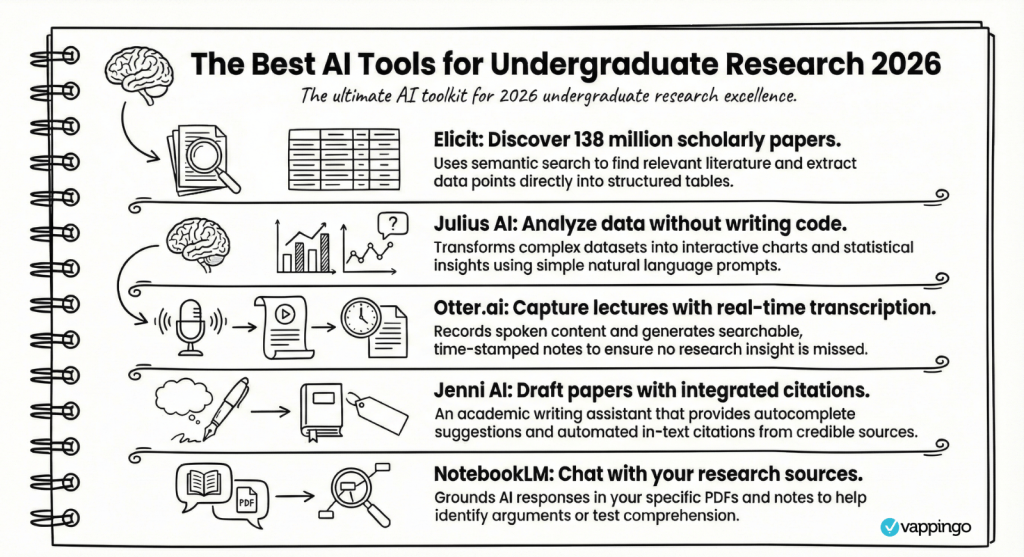
The Best AI Tools for Undergraduate Research
1. Literature Discovery and Mapping
Instead of relying solely on traditional keyword searches, you can use AI to navigate vast academic databases more intelligently for RRL and RRS literature review.
Elicit
This tool acts as a semantic search engine. You can ask a research question in plain English, and it will search millions of scholarly papers, extracting specific data points—like methodologies, sample sizes, and outcomes—into a structured, easy-to-compare table.
Consensus
This search engine specializes in providing evidence-backed answers. It scans peer-reviewed studies and highlights whether the academic community generally supports, opposes, or complicates a specific claim.
Research Rabbit & Connected Papers
If you find one highly relevant paper, these tools create visual citation networks and co-authorship maps, helping you discover earlier foundational studies and newer related works that you might have missed.
For a step-by-step walkthrough of the exactly how to leverage AI tools to create student-led research, see our guide to How to Use AI for Research.
2. Reading and Comprehending Dense Papers
Reading complex academic texts can be time-consuming, but AI can help you quickly extract the information you need.
SciSpace & ChatPDF
These tools allow you to upload a PDF and “chat” directly with the document. You can ask the AI to explain complex jargon, break down the methodology, or summarize the results in plain language.
Scholarcy
This tool breaks down long research papers into structured “flashcards,” extracting key findings, arguments, and data so you can quickly decide if a paper is worth a deep read.
3. Drafting and Citation Management
When it is time to start outlining and drafting, AI can help you overcome writer’s block and organize your references:
Jenni AI
This specialized academic writing assistant can help generate outlines and suggest text tailored for an academic tone. Crucially, it automatically inserts traceable in-text citations that link directly to the source PDFs you have uploaded, ensuring your claims are grounded in actual literature.
Scite
To ensure you are using credible evidence, Scite analyzes your citations and tells you whether subsequent research has supported, disputed, or simply mentioned the claims made in your referenced papers.
Zotero, Mendeley, & Paperpile
These tools capture citations directly from your browser, store your PDFs, and automatically format your bibliography in APA, MLA, Chicago, or other styles.
4. Feedback, Editing, and Refining
Before submitting your paper, AI can act as a critical peer reviewer and copyeditor:
Vappingo
As undergraduate STEM students begin conducting independent research, writing becomes just as important as calculations and code. Lab reports, research proposals, capstone projects, and undergraduate theses require clear explanations, precise terminology, and accurate referencing. Vappingo provides human-in-the-loop editing and proofreading designed to help students refine their academic writing before submission. Rather than relying solely on automated grammar tools, undergraduate researchers can benefit from professional editors who review clarity, logical flow, formatting consistency, and citation accuracy. For students preparing high-stakes assignments or research intended for publication or presentation, human review adds an important layer of confidence and quality control.
thesify
Rather than just fixing typos, this tool gives you structural feedback. It evaluates your thesis statement, points out logical gaps, highlights where claims lack evidence, and ensures your sections flow coherently.
Writefull & Paperpal
These language tools are trained specifically on scholarly articles. They help you rewrite informal phrasing into professional academic prose, fix complex grammar issues, and ensure consistent terminology throughout your paper.
Student AI Use: Important Ethical Best Practices
While these tools are powerful, they should be used responsibly to maintain academic integrity:
- Verify Everything: AI can sometimes “hallucinate” facts or generate fake citations. Always verify AI-generated insights by reading the original source texts yourself.
- Preserve Your Own Thinking: Use AI to brainstorm, critique, or summarize, but ensure the core reasoning and final conclusions are your own. Over-relying on AI to do the writing for you can hinder the development of your own critical thinking and analytical skills.
- Follow University Policies: Check your professor’s syllabus and your university’s guidelines. Many institutions require you to explicitly disclose if and how you used AI tools to assist in your writing. See how to disclose AI usage for more assistance.
