
We’ve all been there: staring at a blinking cursor on a blank screen as the deadline gets closer. In that moment, the idea of pressing a “magic button,” asking AI to handle the research, structure, and drafting feels almost impossible to resist.
But treating AI like a “black box,” where you type a prompt and receive a finished essay, creates a serious problem. You can’t see how the argument was built. You lose track of the reasoning behind the work. This is what experts call the “black-box effect.”
The result? You submit something that may look polished, but it doesn’t clearly reflect your own thinking.
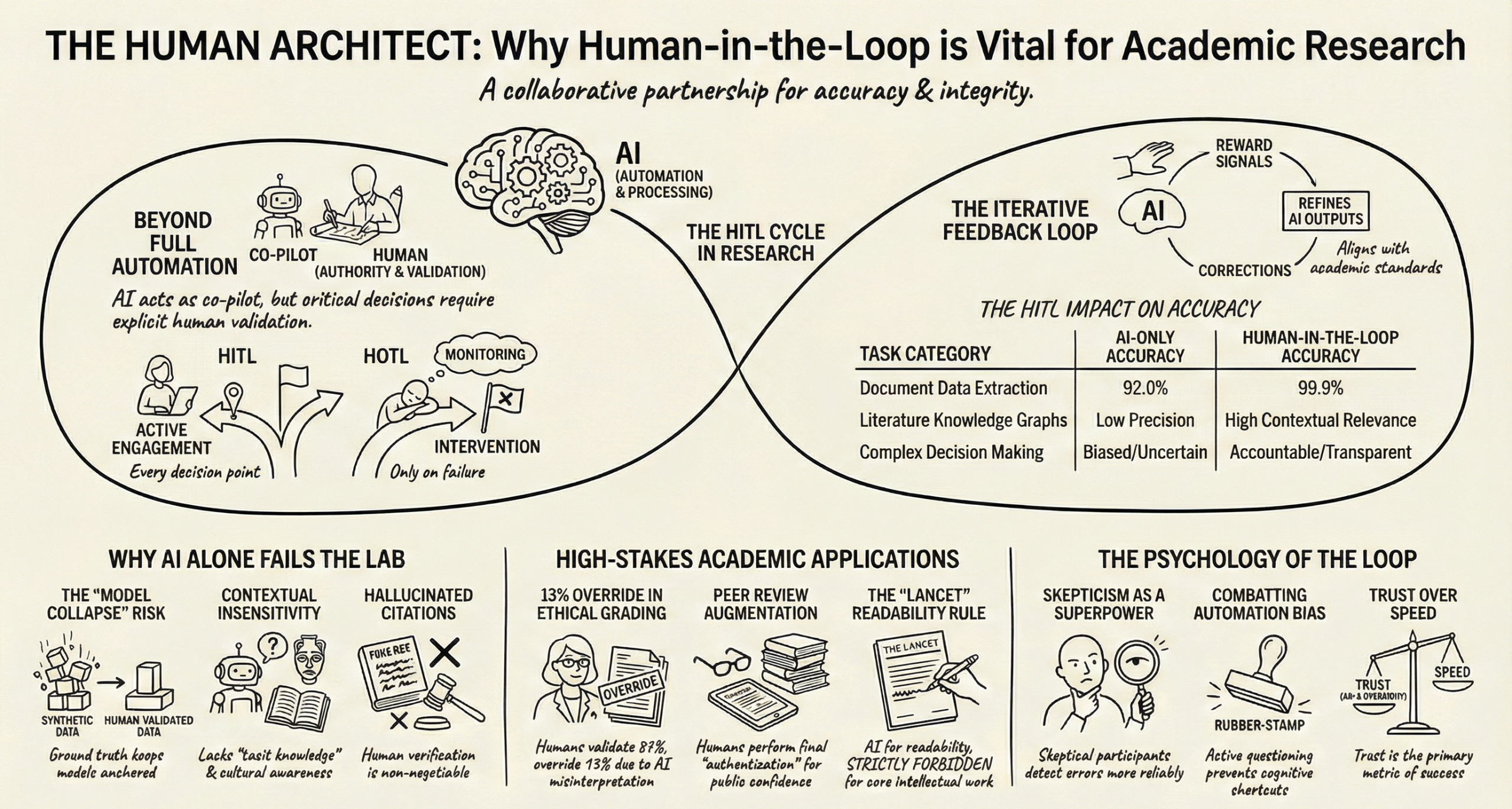
The solution is Human-in-the-Loop (HITL) writing.
For students, HITL simply means staying involved at key decision points while using AI. It is the difference between asking AI to “write my introduction” and reviewing an AI-generated outline to make sure it includes the specific theory or debate discussed in your Tuesday seminar.
AI can help. But you must remain the author.
Why AI Essays Need Human Editors
Human Input is Your Advantage
AI systems are very good at processing large amounts of information. They generate text by predicting the next most likely word based on patterns in data.
But academic writing is not just pattern prediction. It depends on context.
Your essay exists within:
- A specific course
- A specific professor
- A specific reading list
- A specific academic debate
AI does not understand the “unwritten rules” of your department. It does not know the subtle expectations behind your assignment. When AI works without supervision, it can miss these small but important details.
As researcher Juliet John explains, even advanced AI systems struggle with nuance and edge cases. When AI operates without full context, small misunderstandings can quickly become larger problems.
In essays, these gaps show up as arguments that seem well structured but feel shallow. The writing may sound confident, but it may fail to engage with the deeper scholarly debate your professor expects.
By staying in the loop, you provide:
- Course-specific knowledge
- Context
- Judgment
- Common sense
AI predicts patterns. You understand meaning and expectations.
Bridging the Empathy Gap
Education is not just about transferring information. It is a social process. Writing an essay means participating in a conversation with scholars, professors, and classmates.
AI can imitate tone and style, but it does not truly understand empathy, responsibility, or social impact. It can simulate seriousness, but it does not grasp what certain topics mean in real academic or social contexts.
This creates what some researchers call an “empathy gap.”
Because AI cannot genuinely understand people or communities, its writing can sometimes feel slightly artificial. It may lack sensitivity or depth when discussing topics that carry social or developmental weight.
Human involvement is essential. Learning is social. Your essay should reflect a real person thinking carefully about real issues — not just a sequence of statistically generated sentences.
Defending Against Algorithmic Bias
Using AI without oversight also exposes you to algorithmic bias.
Research shows that both generative AI tools and AI detection systems can unfairly penalize non-native English writers. Structured or simplified language may be wrongly interpreted as “robotic,” even when it is completely authentic.
AI systems can also:
- Reflect cultural bias
- Reinforce stereotypes
- Ignore minority perspectives
- Generate fake academic references
This is why human editorial oversight is so important.
To protect your work, watch for these three red flags:
Linguistic Bias
Does the tool unfairly change your phrasing or push your writing toward a narrow, Western-centered tone?
Hallucinated Citations
Always verify sources. AI often produces academic references that look convincing but do not exist.
Perspective Monoculture
Does the argument ignore alternative viewpoints or marginalized voices? AI tends to default to the most common or “probable” perspectives.
Staying in the loop allows you to correct these problems before they weaken your essay.
Accountability in the “Wild West”
The current EdTech environment has been described as a “Wild West.” Many AI tools lack clear standards, transparency, or oversight.
In this environment, students must think about data sovereignty—staying aware of how their work and personal information are being used.
Many students have become used to sharing information without questioning it. As one LSE student representative noted, we have been “propagandised into believing that it’s okay to have our information completely in the open.”
You should resist that mindset.
One way to protect yourself is through traceability.
In professional settings, “audit logging” tracks how AI systems make decisions. For students, this means keeping a clear record of your work’s development.
You can:
- Save early drafts
- Use version history in Google Docs
- Keep notes on prompts you used
- Record how you refined AI suggestions
This creates an audit trail. It shows that you guided the process. It proves the AI supported your thinking rather than replacing it.
The Feedback Loop: Making the Tool Work for You
In professional Human-in-the-Loop systems, every correction helps improve the system’s performance. The same idea applies to students.
If you simply copy and paste AI output, you lose the opportunity to refine it and align it with your own voice.
Long-term learning happens when you treat AI as an assistant that requires supervision.
Instead of accepting a full draft, act as a curator.
Step 1: Use a “Collect Data” prompt to ask AI to find five relevant sources.
Step 2: Review the sources yourself and reject the ones that do not fit your thesis.
Step 3: Ask AI to draft a short section using only the approved sources.
This “reviewer” mindset keeps you in control. The system remains a tool for your expertise, not a replacement for it.
AI gathers.
You decide.
Beyond the Prompt
Institutions like SUNY, through initiatives such as the INSPIRE Center, are exploring how AI can be used for social good. The goal is not to automate thinking, but to enhance it in a responsible and secure way.
Human-in-the-Loop writing moves you away from blind automation and toward intentional oversight.
In a world where anyone can generate a thousand words in seconds, the real value of your essay is not speed.
It is:
- Your judgment
- Your interpretation
- Your critical thinking
- Your voice
AI can generate text.
Only you can generate understanding.
When you stay in the loop, AI becomes a support tool. Without you, it becomes a shortcut that weakens ownership.
In the end, your human voice is not optional.
It is the point.
