
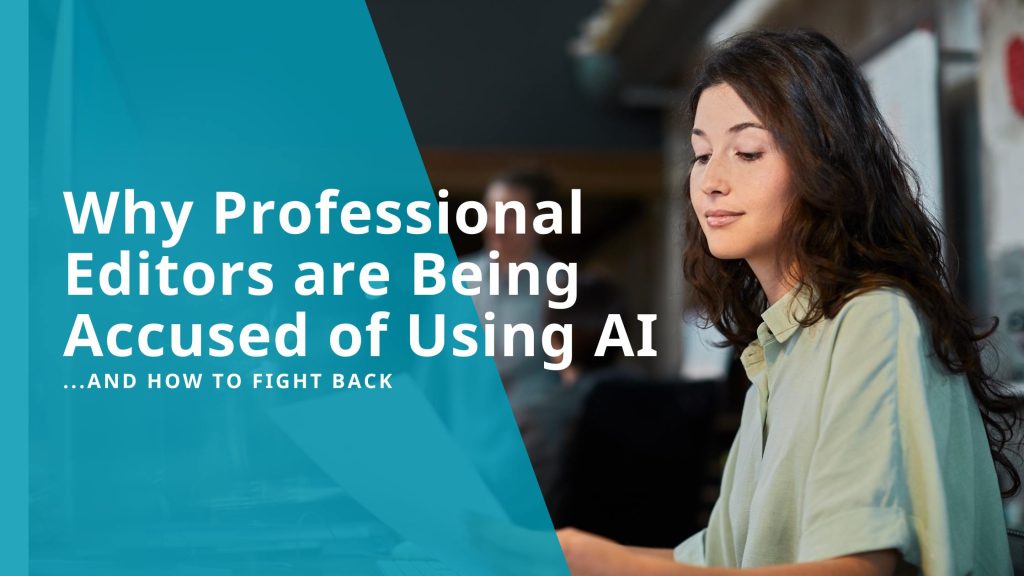
It is a modern professional horror story: an editor or student spends hours meticulously refining a draft, choosing every word with surgical precision to ensure a seamless, authoritative flow. They submit the work, only to have a notification flash across the screen: AI detected. In an instant, decades of hard-won expertise are dismissed by a mathematical probability score.
We are witnessing the algorithmic erasure of the expert human voice. As generative AI tools proliferate, organizations have turned to “black-box” detectors to safeguard integrity. However, these tools are increasingly red-flagging the hallmarks of professional excellence, viewing structured, polished human writing as inherently suspicious. This isn’t just a technical glitch; it is a relatable crisis for the modern wordsmith. My goal here is to analyze the forensic reasons behind these false accusations and provide a survival guide for students facing false AI detection.
The High-Fluency Penalty: When Good Writing Looks Like Code
The central irony of the current publishing landscape is that the more “perfect” a piece of writing is, the more likely it is to trigger a detector. To a machine, high-quality human writing often displays “unusually low surprisal” and “low token entropy”—technical terms for text that is too predictable for an algorithm’s logic. Because professional editing removes the “messiness” of average human text, it creates a probabilistic profile that mimics the statistical uniformity of a Large Language Model (LLM).
The VERMILLION framework, a heuristic used to identify machine authorship, highlights cues that are actually the “linguistic fingerprints” of professional editing. Specifically, “Echoed sentence structures” (the rhythmic repetition of syntax) and “Mechanical transitions” (canned connectives like Moreover or Furthermore) are standard tools in formal discourse. When an editor ensures a text follows a consistent, predictable flow, they are inadvertently lowering the “variance” that detectors use to identify humanity.
The manuscript exhibits unusually high fluency, uniformity, and consistency… tonal shifts and syntactic irregularities are absent… [with] near-perfect contextual continuity with minimal natural drift, high N-gram repetition, and low token entropy.” — Excerpt from the rejection letter received by David Mingay.
David Mingay’s experience serves as a forensic case study. Trained in a Scottish grammar school in the 1970s, where students were disciplined to write with rigid structure and fluency, Mingay was told his writing was essentially “too good” to be human. This creates a perverse incentive: professionals are now pressured to “de-polish” their work, purposefully introducing clunky phrasing or errors to prove they aren’t bots. And the same issue is now impacting professional editors and proofreaders.
Read more: What you should say if you are falsely accused of using AI.
The Bias Gap: Neurodiversity and Non-Native Speakers Under Fire
The rise of AI detection creates a discriminatory “tax” on specific groups. Research into “The AI That Isn’t” reveals that neurodivergent writers, particularly those on the autistic spectrum, and non-native English (ESL) speakers are disproportionately red-flagged.
These groups are vulnerable due to a direct synthesis between their natural logic and the detector’s math:
- Structured Documentation: As writer Elise Gomes notes, many neurodivergent individuals have a lifelong affinity for “manuals and documentation.” This preference for highly precise, “robotic” structures aligns perfectly with the “Echoed sentence structures” that algorithms flag.
- Formal Tone as a Safety Net: ESL writers often rely on formal tone and standard transitions as an accommodation for language barriers. Lacking casual, expressive flourishes, their prose is often mathematically misclassified as an algorithmic template.
- The Predatory Tax: There is a deeply cynical side to this bias. Many detectors flag human text and then immediately offer a paid “humanizer” service to “fix” the problem they manufactured.
“It would be funny if it weren’t so dehumanizing… I have always had a ‘robotic’ way of writing, and it’s not because I lack creativity or emotion—it’s simply how my brain organizes thoughts.” — Elise Gomes, on being treated like an AI.
This is an ethical bankruptcy. No one should be forced to pay a “humanity tax” simply because their natural voice lacks the “surprisal” of neurotypical or native-speaker norms.
The Myth of the Fallible Detector
Despite their marketing, every professional editor worth their salt will know by now that AI detectors are fundamentally limited. As of the 2024–2026 window, there is a persistent, industry-wide failure: no validated method can reliably distinguish polished, well-edited human academic writing from AI-assisted writing.
These tools are “black-box” systems; they provide a verdict without an audit trail. Even the pioneers are retreating. OpenAI, the creator of ChatGPT, famously shut down its own detection software due to poor accuracy and high error rates. When the world’s leading AI laboratory cannot identify its own product, the reliance on third-party detectors for high-stakes professional decisions is pseudoscientific.
How Professional Editors Can Protect Themselves Against Being Falsely Accused of Using AI
To protect your integrity, you must move from a defensive posture to a proactive, evidence-based workflow. Use these “content credentials” to document your human-in-the-loop process:
1. The Process Statement: Include a brief narrative of the writing/editing journey. Describe how you verified information, why you made specific stylistic shifts, and which sources informed your synthesis.
2. Digital Provenance (C2PA): Adopt the use of “Content Credentials.” By utilizing a C2PA-enabled tool, you can provide a “Manifest Store” that contains tamper-evident “Assertions.” This manifest logs specific c2pa.actions—showing the exact edits, crops, and transformations performed by a human.
3. The “Early Draft” Archive: Maintain a timestamped trail of early, “messy” versions. Showing the evolution from rough notes to polished prose is the strongest forensic proof of human cognitive effort.
4. Transparency Agreements: Adhere to Committee on Publication Ethics guidelines. Disclosure is the new ethical mandate. In your “Materials and Methods” section, explicitly state how any AI was used (e.g., for grammar checking) rather than offering a blanket, easily doubted denial.
Reframing the Workflow Toward “Augmented Intelligence”
The future of editing is not a war against the machine, but a shift toward a collaborative, hybrid model. We are moving from “detectives” searching for bot-markers to “curators” of intent.
While AI can mirror the grammar, structure, and “low-surprisal” patterns of professional text, it lacks “human-intentional originality.” As research by Khedr & Abbas suggests, AI does not possess the capacity for “deep emotional resonance and cultural context.” Human scientific judgment remains the only “moral and interpretive” anchor. The editor’s role is now to ensure that the text carries the cultural nuance and authentic brand voice that an algorithm (which is trained on past data and trained to mimic humans, and not vice versa) can mimic but never originate.
The Future of the Human Voice
AI detection is a flawed science, but transparency is a durable professional standard. The heart of editing remains human empathy and deep thought—qualities that an algorithm can simulate but never possess. We must resist the pressure to write or edit poorly just to satisfy a poorly designed algorithm. The challenge for the modern editor is to remain authentic in a world that increasingly values a standard of “perfection” it simultaneously finds suspicious.
If we lose the illusion that we can reliably spot a bot, will we finally start trusting the person behind the page again?
