
Master Epistemic Positioning in Academic Writing to Elevate Your Grades
Epistemic positioning in academic writing is the strategic use of language to show your level of certainty and your commitment to a claim. It acts as a linguistic dial that allows you to confidently assert facts, cautiously suggest interpretations, and seamlessly join the scholarly conversation. By mastering this concept, you protect your arguments from direct criticism while building a strong, authoritative academic voice.
Have you ever received feedback from a professor stating that your essay sounds “too colloquial”, “overly confident”, or “unsupported”? You are not alone. Many university students struggle to find the perfect academic tone. The secret to fixing this does not lie in using a thesaurus to find bigger words. Instead, the secret lies in a concept called epistemic positioning.
In this guide, you will learn exactly what this framework is, how to use it to instantly improve your grades, and how different academic disciplines require different approaches.
What is epistemic positioning in academic writing?
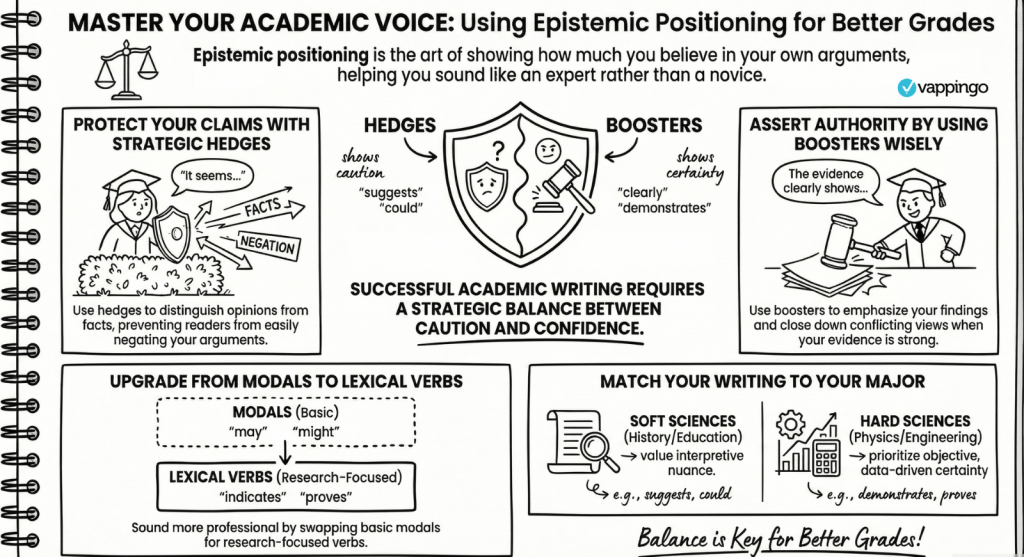
Epistemic positioning is the linguistic framework writers use to negotiate knowledge, express doubt, or project certainty. When you write an academic paper, you are not just presenting a list of facts. You are entering a dialogue with your readers and the broader academic community.
Epistemic positioning refers to your commitment to the reliability of the propositions you provide, as well as your assessment of their potential impact on your readers.
This framework relies on two primary linguistic tools:
- Hedges: Words that reduce the force of a statement and introduce caution.
- Boosters: Words that amplify your certainty and express firm conviction.
Every time you write a sentence, you make a choice about how strongly you want to stand behind your claim. This choice dictates how your professor, peer reviewers, or examiners will receive your work.
Why do students struggle with academic stance?
The most common reason students struggle with academic stance is that they treat all information as absolute truth, rather than negotiated knowledge. Think of your academic voice as having a volume dial.
If you turn the dial all the way up and make absolute, sweeping statements, you sound arrogant. More importantly, absolute statements are incredibly easy for a professor to disprove. If you say, “This evidence proves that the policy failed”, a single exception destroys your entire argument.
If you turn the volume dial all the way down, your writing sounds timid and unconvincing.
Epistemic positioning is how you adjust this volume dial. It allows you to present new, unproven ideas without sounding arrogant, and it helps you acknowledge limitations without sounding ignorant.
Academic writing requires you to balance conviction with caution to gain the acceptance of your colleagues and readers.
How do you use hedges and boosters effectively?
To use hedges and boosters effectively, you must match the strength of your language to the strength of your evidence.
Expert writers use a mix of these devices to guide the reader’s interpretation and build a credible persona. Let us break down the specific tools you can use, based on established linguistic taxonomies.
What are hedges?
Hedges are linguistic features that make things fuzzy, signalling your unwillingness to make an explicit and full commitment to the truth of a proposition.
Using hedges opens a discursive space. It shows respect for your colleagues’ views and invites the reader to participate in a dialogue.
There are three main types of hedges you should integrate into your essays:
- Downtoners: These are adverbs or adjectives that reduce the intensity of a claim. Examples include quite, probably, fairly, and on the whole.
- Rounders: These express numerical approximation or imprecision. Examples include about, around, and approximately.
- Plausibility hedges: These are modal verbs and lexical verbs suggesting that a statement is based on plausible reasoning rather than absolute evidence. Examples include could, might, seem, and indicate.
Example in action:
- Weak (Too certain): The data proves that a lack of sleep causes lower exam scores.
- Strong (Hedged): The data suggests that a lack of sleep may contribute to lower exam scores.
What are boosters?
Boosters are words that allow you to express an idea with conviction, signalling a strong statement about a state of affairs. While hedges leave room for debate, boosters suppress alternative voices and emphasise the significance or originality of your claim.
You should use boosters when your evidence is undeniable. There are three categories of boosters:
- Intensity boosters: extremely, highly, particularly.
- Extremity boosters: most, best, and largest.
- Certainty boosters: show, find, prove, and definitely.
Example in action:
- Weak (Too timid): The results might possibly mean that the formula works.
- Strong (Boosted): The results clearly demonstrate that the formula is effective.
For further tips on structuring your arguments logically, check out our guide on how to master academic essay structure.
How does epistemic positioning change across disciplines?
Your academic discipline dictates your epistemic positioning, with humanities favouring cautious hedging and hard sciences favouring objective boosters.
You cannot write a physics paper the same way you write a sociology paper. Academic disciplines have different epistemological beliefs, meaning they view “truth” and “knowledge” differently.
The Soft Sciences (Humanities, Sociology, Applied Linguistics): The soft sciences are highly interpretative. Because researchers deal with human subjects and abstract concepts, absolute proof is rare. Therefore, writers in the humanities and social sciences rely heavily on hedges to negotiate meaning. They also use a more personal projection, working hard to establish solidarity with their readers.
The Hard Sciences (Physics, Mechanical Engineering, Chemistry): The hard sciences are fact-oriented, empirical, and impersonal. Researchers in these fields typically want the facts to “speak for themselves”. As a result, hard science papers feature fewer hedges and rely more heavily on certainty boosters. The focus is on objective methodology and verifiable outcomes.
Comparison Table: Hard vs. Soft Sciences
| Feature | Soft Sciences (e.g., History, Sociology) | Hard Sciences (e.g., Physics, Engineering) |
|---|---|---|
| Primary Goal | Negotiate interpretations and invite dialogue. | Report empirical data and objective facts. |
| Hedge Usage | High. Writers frequently use modal verbs (might, could). | Low. Facts are expected to stand independently. |
| Booster Usage | Moderate. Used to emphasize the novelty of a theory. | High. Used to express confidence in experimental data. |
| Authorial Voice | Subjective. Higher use of personal pronouns (I, we). | Objective. Focus is on the research, not the researcher. |
If you are transitioning between subjects, learning how to adapt your voice is crucial. You can read more about adapting your writing style in our article on maintaining an academic tone.
How has academic writing changed over time?
Over the last 60 years, the use of epistemic positioning markers has significantly decreased as academic writing has shifted toward a more objective, data-based style.
Language is not static. If you read an academic paper from 1960, it will sound very different from a paper published today. Diachronic studies (studies of change over time) reveal a fascinating trend. Researchers have found that the overall use of hedges and boosters has dropped by over 30% in recent decades.
Today, writers increasingly prefer less use of epistemic markers in pursuit of a scientific and data-driven style. Instead of using modal verbs (like may or must), modern academics prefer lexical verbs (like suggest, show, or demonstrate). This reflects a broader move toward explicit, evidence-based persuasion in modern academic publishing.
You can explore more about these changing trends in the comprehensive study published by Frontiers in Psychology, which analyses how knowledge discourses evolve alongside changing societies. Additionally, extensive databases like PubMed provide excellent examples of modern, data-driven medical and scientific prose.
What are the most common mistakes in epistemic positioning?
When you are writing a complex assignment, such as structuring a literature review or figuring out how to write an abstract, it is easy to lose track of your authorial voice. Here are the pitfalls to avoid:
- The Over-Hedge: Using too many downtoners in a single sentence (e.g., “It might possibly seem that the results perhaps suggest…”). This makes you sound unsure of your own research.
- The Unearned Booster: Using extreme certainty without the data to back it up (e.g., “This proves undeniably that all previous theories are wrong”).
- Ignoring the Discipline: Using a highly subjective, hedged tone in a chemistry report, or an aggressive, boosted tone in a philosophy essay.
Even top-tier university students often struggle to apply these techniques consistently. Balancing your academic voice while managing complex research, formatting rules, and stringent deadlines is incredibly difficult. Because you are so close to your own work, it is hard to objectively judge if your writing sounds too arrogant or too timid.
This is exactly where expert editing helps. Professional academic editors understand the subtle linguistic requirements of different university disciplines. They can fine-tune your epistemic positioning so that your arguments sound natural, highly authoritative, and perfectly aligned with your grading rubric. If you want to ensure your essays project the ideal academic stance, explore how our academic proofreading and editing services can polish your work to perfection.
Conclusion
Understanding epistemic positioning in academic writing is like being handed the cheat code to university grading. By consciously choosing when to use hedges to soften your claims and when to use boosters to project certainty, you instantly elevate the maturity and persuasiveness of your writing. Remember to always consider your specific academic discipline, rely on modern, evidence-based language, and ensure your level of certainty matches the strength of your data. Incorporate these strategies, along with proper academic transition words, and you will transform from a passive student reporting facts into an authoritative scholar contributing to a global conversation.
Frequently Asked Questions (FAQ)
What is epistemic positioning in academic writing?
Epistemic positioning is the linguistic strategy writers use to indicate their level of certainty, doubt, and commitment to a specific claim. It dictates how confidently or cautiously a writer presents their research to an audience.
What is an example of a hedge in academic writing?
A hedge is a word that softens a claim to leave room for alternative interpretations. Common examples include might, perhaps, suggest, indicate, and approximately.
What is an example of a booster in academic writing?
A booster is a word that amplifies a claim and projects strong confidence. Common examples include clearly, obviously, prove, demonstrate, and undoubtedly.
Why is epistemic stance important for university students?
Epistemic stance is important because it prevents students from making easily disprovable absolute statements. It helps students sound professional, objective, and credible, which directly aligns with the grading criteria used by university professors.
Does epistemic positioning change depending on the subject?
Yes. Soft sciences (like literature and sociology) require more hedges because they deal with interpretation and human behaviour. Hard sciences (like chemistry and physics) rely more on boosters and objective language because they deal with empirical, measurable data.
